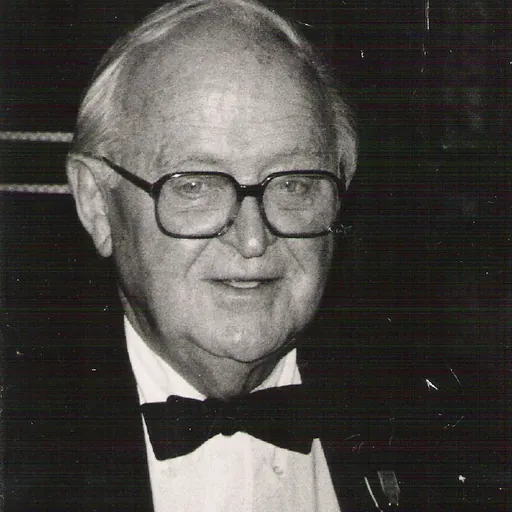
About John I. Yellott
Lived 1908 – 1986 (aged 78). John I. Yellott was an American engineer and physicist.
John Ingle Yellott (October 25, 1908 – December 30, 1986) was an American engineer recognized as a pioneer in passive solar energy, and an inventor with many patents to his credit. In his honor the American Society of Mechanical Engineers (ASME) Solar Division confers a biannual "John I. Yellott Award" which "recognizes ASME members who have demonstrated sustained leadership within the Solar Energy Division, have a reputation for performing high-quality solar energy research and have made significant contributions to solar engineering through education, state or federal government service or in the private sector."
Early life, education, academia, and war service John Ingle Yellott was born in Bel Air, Maryland, the son of the Reverend Dr. John I. (1873-1935) and Mildred Walker Nelson Yellott (1876-1954). His grandfather was John I. Yellott. He was educated at Bel Air High School and at Episcopal High School in Alexandria, Virginia, and then studied Mechanical Engineering at Johns Hopkins University, receiving his M.E. in 1931 and his M.M.E. with distinction in 1933.
Yellott embarked on a career in academia at the Stevens Institute of Technology, Hoboken, and at Illinois Institute of Technology, where he was chairman of the Department of Mechanical Engineering from 1940 to 1943 and director of the Institute of Gas Technology from 1943 to 1945. During World War II he was assigned to the Manhattan Project to work on the development of atomic weapons as a consultant to the Metallurgical Laboratory of the University of Chicago.
Changing fields After the War Yellott served as director of Research, Locomotive Development Committee, Bituminous Coal Research, from 1945 until 1955. He organized the 1957 Living with the Sun competition, a seminal event in the history of the solar house.
Industrial consulting and return to academia In June 1958 Yellott founded John Yellott Engineering Laboratories, and the Yellott Solar Energy Laboratory, in Phoenix, Arizona. Soon after the oil crisis, Arizona State's College of Architecture instituted a solar program and chose Yellott as its head; he continued to teach there until his retirement at age 70.
Solar engineering Yellott's early interest, the source of much consulting work, was on the transparency and transmissivity of glass. In 1960s he helped to develop the solar heat gain factor (SHGF) method of calculating the passive thermal role of glass, now the standard method accepted by the American Society of Heating, Refrigerating and Air-Conditioning Engineers. He served as a consultant to major industrial concerns such as Corning Glass, PPG Industries, Libbey-Owen-Ford Glass company, Shatterprufe Glass Company of Port Elizabeth, South Africa; and Pilkington Brothers Glass Company of Great Britain. One of Yellott's clients was Northrup, Inc. whose founder Leonard L. Northrup Jr. was introduced to solar technology by Yellott, and whose company went on to develop some of the first solar air conditioning systems and heliostats, under Yellott's on-going advice.
Design sketch from Yellott's patent for a coal-injected turbine locomotiveAccording to his Illinois Institute of Technology Hall of Fame entry, Yellott's work resulted in more than fifty patents, such as an electric locomotive with a coal fired gas turbine using pulverized coal directly injected into a combustion chamber; a film-type solar water heater and a transparent cover to heat swimming pools by trapping solar radiation Yellott's pool cover idea remains in commercial use to this day. He also contributed his solar expertise to civic projects such as the landmark Carefree Sundial in Carefree, Arizona.
Sketch of full scale roofpond apparatus experiment at Trinity University, Texas Yellott pioneered passive solar cooling as a field parallel to solar heating, with particular attention to water spray and controlled evaporation. in Texas. Nonetheless, in the words of solar scientist Kenneth Haggard of the San Luis Obsispo Solar Group, implementation of the idea of maintaining a large puddle of water on one's roof to cool the interior "awaits the next period of blossoming of passive solar architecture."
Yellott's achievements particularly in the area of glazing and solar radiation capture have stood the test of time. According to Dr. Jeffrey Cook, College of Architecture and Design, Arizona State University, writing the introduction to the Passive Solar Journal's John I. Yellott Memorial issue, "he made major contributions in areas of basic research, instrumentation, analytic methods, applications, collaboration, education, and demonstration." Solar Hall of Fame, inaugural inductee in 1976. The Most Venerable Order of the Hospital of St John of Jerusalem, Associate Commander Illinois Institute of Technology Hall of Fame The "Yellott Number" for characterising Thermosiphon solar water heaters is named in his honor.
Don’t just read it —
keep it.
Full-length biographies made to live with: read them, listen on the way to work, watch them tonight.
- E-book
- Audio
- Video
Instant download · yours to keep · every purchase keeps this site free
Important facts
People in John I. Yellott's life
Named in this biography and alive at the same time



Related people
Same field, nearest in time




Contemporaries
People whose lives overlapped John I. Yellott's


Frequently asked questions
Who was John I. Yellott?
American engineer (1908-1986)
When was John I. Yellott born?
John I. Yellott was born on 25 October 1908 in Bel Air.
When did John I. Yellott die?
John I. Yellott died on 30 December 1986 in Phoenix.
What was John I. Yellott's occupation?
John I. Yellott was an engineer and physicist.
What nationality was John I. Yellott?
John I. Yellott was American.
Sources & further reading
Cite this page
APA: Biography.guide. (2026). John I. Yellott. https://biography.guide/john-i-yellott/
MLA: "John I. Yellott." Biography.guide, https://biography.guide/john-i-yellott/.
Chicago: "John I. Yellott." Biography.guide. https://biography.guide/john-i-yellott/.
Data last updated: 2026-09-23 · Spot an error? Report a correction.
Portrait: Wikimedia Commons · author & licence
Page generated 2026-09-27 05:05 UTC