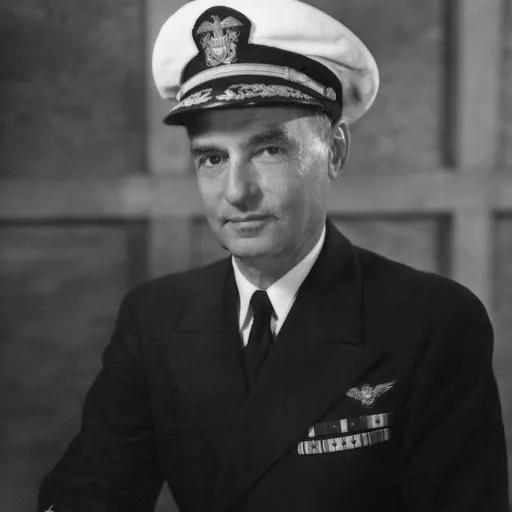
About John H. Hoover
Lived 1887 – 1970 (aged 83). John H. Hoover was an American military officer.
John Howard Hoover (May 15, 1887 – December 2, 1970) was a United States Navy admiral who held several flag commands during World War II most notably those in the Central Pacific under Chester W. Nimitz. Hoover became one of Nimitz's trusted if little known admirals of the Pacific war.
Vice Admiral Hoover served as Commander, Forward Area, Pacific Ocean Areas, during the buildup of Boeing B-29 Superfortress heavy bomber units in 1944–45 in the Mariana Islands.
Early career
John H. Hoover was born on May 15, 1887, in Seville, Ohio as the son of Benjamin Franklin Hoover and Claudia Irene (Crawford) Brown. He grew up in Adel, Montana and following the graduation from the high school in summer 1903, he received an appointment to the United States Naval Academy at Annapolis, Maryland. While at the academy, he was nicknamed "Johnny" and was active in Coxswain team.
Hoover was in the same class as future admirals Augustin T. Beauregard, Patrick N. L. Bellinger, Harold M. Bemis, Richard S. Edwards, Robert C. Giffen, Felix Gygax, Henry K. Hewitt, Jonas H. Ingram, Randall Jacobs, Claud A. Jones, Ernest D. McWhorter, Albert C. Read, and Robert A. Theobald.
Upon graduation with Bachelor of Science degree on June 6, 1907, he was attached as passed midshipman to the protected cruiser USS Chicago and later was transferred to the light cruiser USS Chester, operating along the East Coast of the United States. While aboard that vessel, Hoover was appointed a commission to the rank of ensign on September 13, 1908.
During his tenure, he was fighting German U-boats in the Caribbean and watching the Vichy force at Martinique with a force of just two destroyers, two ancient submarine chasers, three ancient submarines, and a wing of Catalinas. He was experienced with airfield construction and operations, was given command of the land-based naval air force that supported the Central Pacific campaign, and was tasked to develop the new air bases on the captured islands. Hoover remained in that capacity until August 1943 and received Navy Distinguished Service Medal for his service in the Caribbean.
In December 1944, Admiral William F. Halsey Jr., Commander, U.S. Third Fleet underrated the upcoming Typhoon Cobra and lost three destroyers with 790 lives lost. Nine other warships were damaged, and over 100 aircraft were wrecked or washed overboard. Hoover was appointed President of the Court of Inquiry that ultimately recommended Halsey face court-martial for sailing Third Fleet into a typhoon. But the Hoover's recommendation was ignored by the Chief of Naval Operations Ernest J. King and President Franklin D. Roosevelt, who likely felt Halsey was too much of a popular hero to be subjected to public rebuke.
Hoover continued as Commander, Central Pacific Forward Area for the rest of the War and his forces participated in the Battle of Iwo Jima in February 1945. He served briefly as Deputy Commander-in-Chief, Pacific Ocean Area and Pacific Fleet under Fleet Admiral Nimitz in July and August 1945 and returned to the United States shortly thereafter. For his service in last year of the War, Hoover received his third Navy Distinguished Service Medal.
Later career and retirement
Following his return stateside, Hoover was ordered to Naval Air Station San Diego, California and assumed duty as Commander, Fleet Air West Coast. He was later appointed President of the Naval Examining Board and Naval Retiring Board and served in this capacity until May 1947, when he was appointed a senior member, Army-Navy Petroleum Board, which was responsible for the effecting close co-operation between the two departments in procurement, shipment and distribution.
Hoover served in this capacity until July 1948, when he retired from the active duty after 41 years of service and was advanced to the rank of four-star admiral on the retired list for having been specially commended in combat. In December 1950, he was appointed Director of investigation for anti-inflation program within Economic Stabilization Agency. Hoover was responsible for the creating and directing of the enforcement machinery for any price and wage controls imposed by the stabilization agency.
Admiral Hoover died on December 1, 1970, aged 83, in Washington, D.C. and was buried with full military honors at Arlington National Cemetery, Virginia. His wife Helen Braconier Smith Hoover (1896–1981) is buried beside him. They had two daughters, Helen Marie Hoover (1917-1994) and Jeanne Patricia (Hoover) Mears (1927-2019) and a son, William Howard Hoover (1923-2005), who also served in the Navy and retired as captain.
Dates of rank
Don’t just read it —
keep it.
Full-length biographies made to live with: read them, listen on the way to work, watch them tonight.
- E-book
- Audio
- Video
Instant download · yours to keep · every purchase keeps this site free
Important facts
People in John H. Hoover's life
Named in this biography and alive at the same time




Related people
Same field, nearest in time



Contemporaries
People whose lives overlapped John H. Hoover's


Frequently asked questions
Who was John H. Hoover?
United States admiral
When was John H. Hoover born?
John H. Hoover was born on 15 May 1887 in Seville.
When did John H. Hoover die?
John H. Hoover died on 2 December 1970 in Washington, D.C..
What was John H. Hoover's occupation?
John H. Hoover was a military officer.
What nationality was John H. Hoover?
John H. Hoover was American.
Sources & further reading
Cite this page
APA: Biography.guide. (2026). John H. Hoover. https://biography.guide/john-h-hoover/
MLA: "John H. Hoover." Biography.guide, https://biography.guide/john-h-hoover/.
Chicago: "John H. Hoover." Biography.guide. https://biography.guide/john-h-hoover/.
Data last updated: 2026-09-21 · Spot an error? Report a correction.
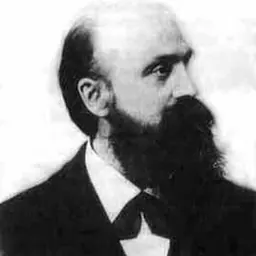
Portrait: Wikimedia Commons · author & licence
Page generated 2026-09-27 04:59 UTC