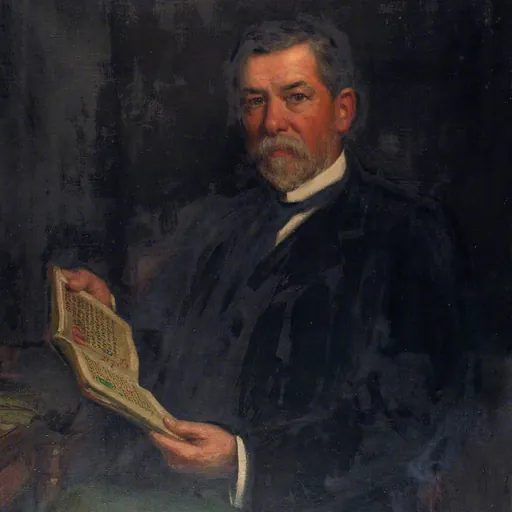
About John Gwenogvryn Evans
Lived 1852 – 1930 (aged 78). John Gwenogvryn Evans was a British writer, christian minister and palaeographer.
John Gwenogvryn Evans (20 March 1852 – 25 March 1930) was a Welsh palaeographic expert and literary translator. His work on medieval Welsh manuscripts constituted a substantial number of translations; he was awarded a Doctor of Letters from both the University of Oxford and the University of Wales for his contributions to the field of Welsh literature.
Born in Wales in 1852, Evans grew up speaking Welsh and only began learning English at the age of 19. He studied to be a Unitarian minister and led multiple congregations until his poor health required him to stop preaching. He then turned to manuscript research and translation, which became the primary focus of most of his professional life.
Early life Evans was born at Llanybydder in Carmarthenshire. When he was one year old, his family moved to Llanwenog, Cardiganshire (now called Ceredigion). Evans contracted typhoid fever as a child and suffered lifelong health issues as a result. His first language was Welsh.
When he was 16, Evans was apprenticed to his uncle David Rees, who worked as a grocer in Lampeter. He returned to school two years later after an accident. While studying in Llandysul, one of his teachers was the minister William Thomas (Gwilym Marles). He also studied under antiquarian and Welsh manuscript collector Alcwyn C. Evans in Carmarthen. In 1872, he enrolled at the Presbyterian College in Carmarthen, travelling to England to work as a school assistant for a year before becoming an ordained Unitarian minister in 1876. After graduating, he worked as a pastor in Carmarthen. Hunter was the secretary of the Carmarthen branch of the RSPCA, and she had spent the past two years organizing petitions to Parliament and bringing prosecutions surrounding animal welfare, particularly the treatment of donkeys used to collect cockles. Her father was the principal of Presbyterian College. They moved to Preston, Lancashire that same year, where Evans continued to preach.
Once home in Oxford, Evans began attending lectures from Welsh scholar John Rhŷs, who was the first professor of Celtic at the University of Oxford. Rhŷs's talks on the Mabinogion reignited Evans's interest in ancient Welsh manuscripts; he had studied them years before under Alcwyn C. Evans in Carmarthen. Evans had also read the "Four Ancient Books of Wales" translated by William Forbes Skene.
He was inspired to create his own translation of the "Red Book of Hergest," one of the four ancient books, as well as a collection of Welsh proverbs. The latter won a prize for poetry and prose at the National Eisteddfod of Wales in 1884.
Manuscript research Evans then began publishing a series of facsimiles of major medieval Welsh manuscripts, setting up his own printing press to create them. After the release of the first volume, "Series of Old Welsh Texts," in 1887, he was awarded an honorary master's degree by the University of Oxford.
Evans spent the rest of his career transcribing and publishing Welsh texts – often including hand drawn reproductions of the manuscripts' intricate lettering and imagery. He frequently partnered with Rhŷs until his death in 1915, and the two published several major works in medieval Welsh literature. Starting in 1893, Evans was granted a £200 (£21,816 in 2025) civil-list pension to fund his manuscript research. The series is a "monumental work," covering over 900 manuscripts from the 12th to 19th centuries.
He was elected the University of Wales's Court of Governors in the fall of 1897 and served as a "mouthpiece" for Williams during negotiations for a national library. Evans helped Williams secure the Peniarth Manuscripts — a collection containing some of the oldest and most important Welsh manuscripts in existence, including the Black Book of Carmarthen, Book of Taliesin and White Book of Rhydderch — in 1898, which became the focal point of the new National Library of Wales and one of the driving reasons for its creation. He introduced Williams to the manuscripts' owner, William Watkin Edward Wynne, and facilitated the collection's sale.
When the library formally began construction in 1911, Evans met King George V and his family — Queen Mary, Princess Mary, and the future King Edward VIII — who travelled to Aberystwyth on July 15 to lay the ceremonial foundation stone.
Work during retirement In 1905, Evans retired to Llanbedrog in Caernarfonshire, where he and his wife Edith lived in Tremfan Hall. Then 53 years old, he did not stop publishing early Welsh texts and creating his own prints. Evans's work during his retirement was "nothing short of astonishing, marked by an extremely high level of accuracy produced by hand-typesetting with the utmost care."
Taliesin and rivalry with John Morris-Jones Starting in 1909, Evans's work began to shift toward text interpretation instead of just translation. His theories on the poetry of Aneirin and Taliesin — the later especially – were controversial and led to his years-long rivalry with fellow Welsh academic John Morris-Jones. His most controversial claim was his belief that the Battle of Catraeth was fought in 1098 A.D. — not the 6th century as is generally accepted. Despite having support from scholars for the factual content of his work, Morris-Jones received little support from the public, who found his response "too acrimonious in spirit" and generally sided with Evans. John Gwenogvryn Evans, Edith Hunter, and their family at Tremfan Hall. c.1920. Many of Evans's translations are still used as the de facto sources today. His hand drawn reproductions of medieval Welsh lettering are credited with helping bring meticulous details of medieval manuscripts to a wider audience. The surrounding land became Tremfan Park and is located within the Llŷn Area of Outstanding Natural Beauty.
All of Evans's papers, manuscripts, and publications were donated to the National Library of Wales.
Don’t just read it —
keep it.
Full-length biographies made to live with: read them, listen on the way to work, watch them tonight.
- E-book
- Audio
- Video
Instant download · yours to keep · every purchase keeps this site free
Important facts
People in John Gwenogvryn Evans's life
Named in this biography and alive at the same time




Related people
Same field, nearest in time

Contemporaries
People whose lives overlapped John Gwenogvryn Evans's

Frequently asked questions
Who was John Gwenogvryn Evans?
British paleographer (1852-1930)
When was John Gwenogvryn Evans born?
John Gwenogvryn Evans was born on 20 March 1852 in Llanybydder.
When did John Gwenogvryn Evans die?
John Gwenogvryn Evans died on 25 March 1930 in Llanbedrog.
What was John Gwenogvryn Evans's occupation?
John Gwenogvryn Evans was a writer, christian minister and palaeographer.
What nationality was John Gwenogvryn Evans?
John Gwenogvryn Evans was British.
Sources & further reading
· Wikipedia: John Gwenogvryn Evans
· DBpedia: John Gwenogvryn Evans
Cite this page
APA: Biography.guide. (2026). John Gwenogvryn Evans. https://biography.guide/john-gwenogvryn-evans/
MLA: "John Gwenogvryn Evans." Biography.guide, https://biography.guide/john-gwenogvryn-evans/.
Chicago: "John Gwenogvryn Evans." Biography.guide. https://biography.guide/john-gwenogvryn-evans/.
Data last updated: 2026-09-23 · Spot an error? Report a correction.
Portrait: Wikimedia Commons · author & licence
Page generated 2026-09-27 05:07 UTC