
About John Ghindia
Lived 1925 – 2012 (aged 86). John Ghindia was an American athletics competitor and american football player.
John Verle Ghindia (October 12, 1925 – March 16, 2012) was an American football player, high school coach, educator, and municipal recreation director.
Ghindia went straight from the Army Air Corp to playing college football at the University of Michigan from 1946 to 1949 under legendary head coaches Fritz Crisler and Bennie Oosterbaan. He was the starting quarterback for the 1949 Michigan Wolverines football team that compiled a 6-2-1 record, tied for the Big Ten Conference championship, and finished the season ranked No. 7 in the final AP Poll. He also appeared in one game at the fullback position in 1948 campaign, before a knee injury ended his season. Ghindia was a member of the undefeated 1947 and 1948 teams, both crowned national champions. The 1947 team is considered one of college football's all-time greats after beating USC 49–0 in the 1948 Rose Bowl. In 1946–1949, Michigan won the Big Ten Football Championship three (3) times.
After earning his bachelors and masters degrees in mathematics, Ghindia served as a high school math teacher and coach at Wyandotte Saint Patrick's, Lincoln Park High School, and Ecorse High School in Michigan. At St Pat's, John coached football, basketball and baseball for 7 years, winning numerous Catholic League titles, and never losing to arch-rival Wyandotte Our Lady of Mt Carmel. At Ecorse High, in 1967, he coached the varsity hockey team (as a last-minute emergency replacement) to a State Runner-up in his only year. Ghindia was the tennis coach from 1964 to 1985, and led his teams to numerous conference and state regional championships, compiling a record of 251-82. He was inducted into the Michigan High School Coaches Hall of Fame, Michigan Catholic Coaches Hall of Fame, and the Michigan Tennis Hall of Fame. He also served as director of the Ecorse Recreation Department.
Early life Ghindia was born in Niles, Ohio, in 1925. His father, John N. Ghindia, was a Romanian immigrant who came to the United States in 1915 and worked in various steel mills as a millwright. As a youth, Ghindia moved with his family to Ecorse, Michigan. Ghindia attended Ecorse High School, and earned 12 Letters competing in football, basketball, baseball and rowing. At age 16, he was the player-coach on the Ecorse basketball team that won the League Title with a 15-3 record. There was no State Basketball Tournaments during World War II. In 1942 Ghindia led Ecorse High School to a League Championship in football, and his team was State Class B Basketball Runner-up. In 1943, the Ecorse High School Rowing Eight Oar Crew won both the National High School Championship and North America Open Championship, upsetting the NCAA Champions.
After graduating from high school in 1943, Ghindia enlisted in the United States Army Air Corps. He was in the military from 1943 to 1945, attained the rank of a second lieutenant, and served as a bombardier on a B-24 heavy bomber.
University of Michigan After being discharged from the military, Ghindia enrolled at the University of Michigan. He played college football at Michigan from 1946 to 1949 under head coaches Fritz Crisler and Bennie Oosterbaan. Ghindia was a member of the Phi Delta Theta fraternity at Michigan. He earned a Bachelor of Science degree from Michigan in 1950 and a Masters of Science degree in 1962.
1946 to 1948 seasons As a freshman in 1946, Ghindia was a reserve on Fritz Crisler's football team and captained Michigan's undefeated freshman team. As a sophomore, he was a reserve player on the undefeated 10-0 1947 Michigan Wolverines football team, which won the Big Ten Championship, and was dubbed the "Mad Magicians" after dismantling USC 48-0 in the 1948 Rose Bowl. Michigan won a share of the National Championship with Notre Dame .
As a junior in 1948, Ghindia started the first game of the season against Michigan State, playing at the fullback position. However, he missed the rest of the season after suffering a knee injury that required surgery in the off-season. The 1948 team compiled Michigan's second straight undefeated season and was recognized as the national champion in the final AP Poll.
1949 season In 1949, Bill Bartlett began the season as Michigan's starting quarterback. For the second game of the season, head coach Bennie Oosterbaan announced that Ghindia would be the starting quarterback. Ghindia led the Wolverines to a 27-8 win over Stanford. According to the Chicago Daily Tribune, Ghindia "called a masterful game" against Stanford.
The following week, Ghindia fumbled on Michigan's 13-yard line leading to an Army touchdown and a 14-0 deficit in the second quarter; Army defeated Michigan 21-7, ending Michigan's 25-game winning streak dating back to the 1946 season. After consecutive losses to Army and Northwestern, Ghindia led the Wolverines to a 14-7 win against No. 1 ranked Minnesota. After the Minnesota game, Arch Ward of the Chicago Daily Tribune wrote, "John Ghindia's performance today should dispel all doubt about the caliber of Michigan's field generalship. He called plays expertly."
Ghindia started seven of nine games for the 1949 Michigan team that finished with a record of 6-2-1, tied for the Big Ten Conference championship and was ranked No. 7 in the final AP poll. Ghindia's value was as a play-caller and blocking back rather than as a passer or rusher. Under Fritz Crisler and Bennie Oosterbaan, the QB called the plays and ran the offense. Run blocking was a key assignment on many plays. In 1949, Ghindia caught eight passes for 77 yards (#3 on team), but completed only one of seven passes for 11 yards and threw two interceptions; halfback Chuck Ortmann was the team's leading passer with 627 passing yards. Ghindia carried the ball only four times in 1949 for negative seven rushing yards. He was the school's first full-time coach, coaching football, basketball and baseball.
Family and later years Ghindia was married in 1956. He and his wife, Katherine Sue, lived for many years in Trenton, Michigan. They had three daughters, Mary Beth, Suzanne, and Janet, and two sons, John and George. In March 2012, he died from congestive heart failure at age 86 in Trenton. His son John said at the time that Ghindia "kept teaching us and providing a great example right up to the end," and added, "Alleluia & Go Blue!" Rick Leach, who followed Ghindia as Michigan's quarterback in the 1970s, noted: "He set a very high standard for the rest of us who consider ourselves to be 'good' M Men. When someone asks you what's the definition of a 'Michigan Man,' think of John V. Ghindia." Buried at Woodmere Cemetery, Detroit, Michigan.
Don’t just read it —
keep it.
Full-length biographies made to live with: read them, listen on the way to work, watch them tonight.
- E-book
- Audio
- Video
Instant download · yours to keep · every purchase keeps this site free
Important facts
People in John Ghindia's life
Named in this biography and alive at the same time


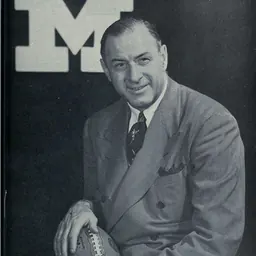

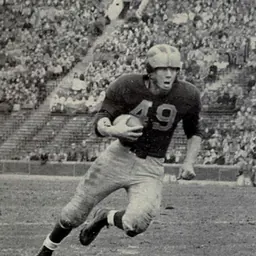

Related people
Same field, nearest in time
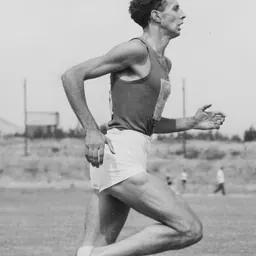
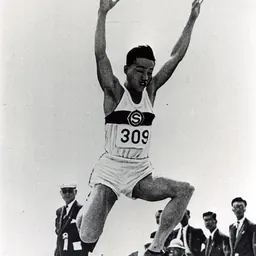


Contemporaries
People whose lives overlapped John Ghindia's



Frequently asked questions
Who was John Ghindia?
American football player (1925-2012)
When was John Ghindia born?
John Ghindia was born on 12 October 1925 in Trumbull County.
When did John Ghindia die?
John Ghindia died on 16 March 2012 in Trenton.
What was John Ghindia's occupation?
John Ghindia was an athletics competitor and american football player.
What nationality was John Ghindia?
John Ghindia was American.
Sources & further reading
Cite this page
APA: Biography.guide. (2026). John Ghindia. https://biography.guide/john-ghindia/
MLA: "John Ghindia." Biography.guide, https://biography.guide/john-ghindia/.
Chicago: "John Ghindia." Biography.guide. https://biography.guide/john-ghindia/.
Data last updated: 2026-09-20 · Spot an error? Report a correction.
Page generated 2026-09-27 05:24 UTC