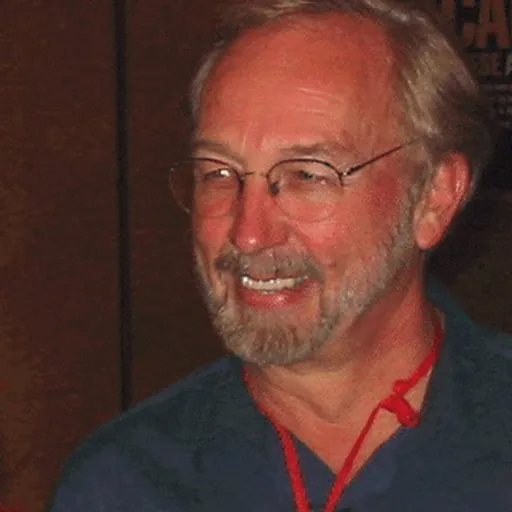
About John Gage
Born 1942. John Gage is an American computer scientist, known for JavaOne and NetDay.
John Burdette Gage (born October 9, 1942) is a retired computer scientist and technology executive. He was the 5th employee of Sun Microsystems, where he is credited with creating the phrase The Network is the Computer. until leaving on June 9, 2008, to join Kleiner Perkins Caufield & Byers as a partner to work on green technologies for global warming; he departed KPCB in 2010 to apply what he had learned "to broader issues in other parts of the world".
In 2006, he joined the board of the Tegla Loroupe Peace Foundation, to build a school and orphanage in Kapenguria, in remote north-west Kenya.
In 2012, he helped build the Kibera Town Centre, a major water and community education center in the middle of Kibera, Kenya, the largest slum in Africa.
He is known as one of the co-founders of NetDay in 1995, a crowd-sourced effort to bring the Internet to every school in the world. NetDay was the first large-scale crowd-sourced mass movement on the Internet. He joined the Human Needs Project in 2012 to build a networked water source and water treatment plant in the Kibera slum in Nairobi, Kenya.
For twelve years he hosted the annual JavaOne conference, bringing 20,000 Java programmers to San Francisco and establishing the Java language in over 95% of mobile devices, and as the basis of the Android operating system.
Background Gage received his bachelor's degree in 1975 from the College of Natural Resources at the University of California, Berkeley. He also attended Harvard Kennedy School and Harvard Business School. Gage worked at Berkeley with Bill Joy, the person largely responsible for the authorship of Berkeley UNIX, also known as BSD, from which spring many modern forms of UNIX, including Solaris, FreeBSD, NetBSD, and OpenBSD. Gage helped found Sun Microsystems in 1982 with Bill Joy and others.
Gage is one of the central figures in Mark Kitchell's film Berkeley in the Sixties, recounting Berkeley's Free Speech Movement. He appears in American Stories: the American Dream: A Future Reborn 1918–1945, a five-part Discovery Channel documentary produced by Atlantic Productions.
In June 2008, Gage retired from Sun Microsystems and joined Kleiner Perkins as a venture capitalist along with Al Gore.
He organized a number of major antiwar demonstrations in Boston, in New York, in Washington, D.C., and in Philadelphia. In 1972, he was named by White House attorney John Dean to Nixon's Enemies List.
He was the first field organizer for students for the McGovern Presidential campaign in California, then joined the national campaign as assistant press secretary and trip director, working for Frank Mankiewicz. In that role, he coordinated the day-to-day movement of the press and staff from event to event nationwide with John Podesta and others. In the 1976 Jimmy Carter campaign, he helped train staff, and organized the final rallies in California. In the 1980 Ted Kennedy campaign, he was assistant national press secretary and trip director, and member of the traveling party.
In 2008, Gage spent several weeks in Ankeny, Iowa, organizing for the 2008 Barack Obama campaign.
Concert activity In 1969, Gage was asked by Bill Hanley, the owner of Hanley Sound, the staging and sound system used at Woodstock, and the system Gage used in Washington, D.C. for the Vietnam Moratorium, to come to Palm Beach, Florida, to take over producing the International Palm Beach Music and Art Festival. B.B. King, Janis Joplin, the Rolling Stones, Sly and the Family Stone, Jefferson Airplane, the Byrds, Sha-Na-Na, Country Joe and the Fish, Steppenwolf, Johnny Winter, Sweetwater and twenty other groups performed; there had been strong opposition from the Governor of Florida, local law enforcement, and some local churches. Heavy rain and unusual cold did not stop some career-best performances, and crowds up to 100,000 people. This Rolling Stones appearance came just six days before the notorious Altamont Free Concert.
Subsequently, Gage was called to rescue the Louisiana Celebration of Life Festival after two people had drowned; produced the New York Shea Stadium Festival for Peace Concert with Peter Yarrow, Janis Joplin, Creedence Clearwater Revival, Herbie Hancock, Miles Davis, Dionne Warwick, Paul Simon, Sha-Na-Na, Johnny Winter, and fifteen more, the Philadelphia Peace Concert, and several other events involving over 100,000 people.
Computer career In 1980, Gage was part of the Homebrew Computer Club, with Steve Jobs, Steve Wozniak, Lee Felsenstein and others.
In 1982, Gage joined Bill Joy, Andy Bechtolsheim, Vinod Khosla, Scott McNealy and others to found Sun Microsystems. He was responsible for all external relations, including marketing, sales, and technical support to customers. As Sun Microsystems grew, Gage became the Vice President and Director of the Science Office, with responsibility for scientific computing, networking, and relationships with universities, scientific laboratories, international scientific bodies, national intelligence agencies, and multilateral agencies including the World Bank and the United Nations. Gage testified often to the US Congress, to United Nations ECOSOC meetings, and was part of numerous United Nations special commissions.
In 1994, with Professor Jianping Wu of Tsinghua University, Gage helped build the Network Research Center in the Tsinghua Main Administration Center, which became CERNET, linking over 1,000 Chinese universities.
In 1995, at the Technology, Entertainment, and Design Conference (TED6) in Monterey, California, Gage and James Gosling announced and Gage demonstrated for the first time the Java programming language, creating the first interactive interface for the World Wide Web. In 2002, Gage joined the United Nations Information and Communication Technologies Task Force, to bring networking to all nations. In 2006, Gage joined the UN Digital Health Taskforce. For the World Economic Forum, he helped organize the Jordan Network Initiative with John Chambers of Cisco and Eric Schmidt of Google.
In 2002, Sun Microsystems reached $25 billion (2015 USD) in revenues.
In 2010, Oracle purchased Sun Microsystems.
Academic career In 2000, Gage spent a year at the Harvard Kennedy School of Public Policy as a Shorenstein Fellow. He taught a class of 90 students entitled "Technology, Journalism and Politics", for which he won the "Most Influential Course" award, awarded by Dean Joseph Nye.
NetDay
Gage founded NetDay in 1995 with Michael Kaufman and several others. NetDay was the first crowd sourcing event organized using the Internet.
Gage created zoomable maps of the 140,000 schools in the United States, placing a meter-accurate dot for each school, color-coded for whether or not the school was connected to the Internet. He created a web-based sign-up page for each school, and "called on high-tech companies to commit resources to schools, libraries, and clinics worldwide so that they could connect to the Internet." At some schools, hundreds of volunteers signed up, promising to come to the school on Saturday, March 9, 1996, to install Ethernet cables to five classrooms and the library. On the first NetDay in California, over 100,000 engineers wired 4,000 schools. President Clinton and Vice-president Gore pulled cables throughout Ygnacio Valley High School. Over the next year, over 70,000 schools across the United States held NetDays to wire their schools, and NetDay spread to Korea, Great Britain, France, and other countries.
In the first state, California, over 100,000 volunteers wired 4,000 schools in one day: March 9, 1996. NetDay was endorsed by President Bill Clinton and Vice President Al Gore, active participants in NetDay '96. Over the next two years, over 70,000 US K-12 schools held NetDays, and Korea, Great Britain, France and other countries held national NetDays.
In 1998, Gage was awarded the ACM Presidential Award by Chuck House, the President of the ACM for his work on NetDay.
Human Needs Project Gage joined Connie Nielsen and David Warner in 2012 to build a large community center in Kibera, Nairobi, Kenya. The Kibera Town Centre is a research platform and learning center, applying new and innovative technologies to provide clean water and waste water treatment in a huge urban slum. The Kibera Town Centre borehole can provide over 400 cubic meters of pure water a day to the 1,000 square-meter facility, which serves over 1,000+ people a day with a combination of educational and career services, showers, toilets, laundry, cafe, and financial services, and provides educational materials to the 4,000 students of neighboring Olympic Primary School, Kenya's largest primary school.
The facility is connected to high-speed fiber optic cable, and has built a half-gigabit wireless network for Kibera.
Family Gage is married to Linda Schacht Gage, a lecturer in journalism at the University of California, Berkeley, and has two children: Peter Gage, formerly with the US Department of Energy, now with Renewable Finance, and Kate Gage, who helped create the USAID Global Development Laboratory, and is now Senior Policy Advisor, International Science and Technology, in the Office of Science and Technology, White House.
Don’t just read it —
keep it.
Full-length biographies made to live with: read them, listen on the way to work, watch them tonight.
- E-book
- Audio
- Video
Instant download · yours to keep · every purchase keeps this site free
Important facts
People in John Gage's life
Named in this biography and alive at the same time




Related people
Same field, nearest in time


Contemporaries
People whose lives overlapped John Gage's


Frequently asked questions
Who is John Gage?
American computer scientist
When was John Gage born?
John Gage was born on 9 October 1942.
What is John Gage's occupation?
John Gage is a computer scientist.
What is John Gage known for?
John Gage is known for JavaOne and NetDay.
What nationality is John Gage?
John Gage is American.
Sources & further reading
Cite this page
APA: Biography.guide. (2026). John Gage. https://biography.guide/john-gage-computer-scientist/
MLA: "John Gage." Biography.guide, https://biography.guide/john-gage-computer-scientist/.
Chicago: "John Gage." Biography.guide. https://biography.guide/john-gage-computer-scientist/.
Data last updated: 2026-09-23 · Spot an error? Report a correction.
Portrait: Wikimedia Commons · author & licence
Page generated 2026-09-27 05:05 UTC