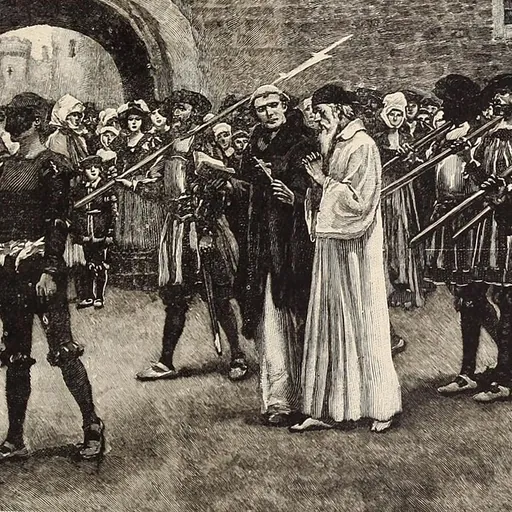
About John Frith
Lived 1503 – 1533 (aged 29–30). John Frith was an English theologian and writer.
John Frith (1503 – 4 July 1533) was an English Protestant priest, writer, and martyr.
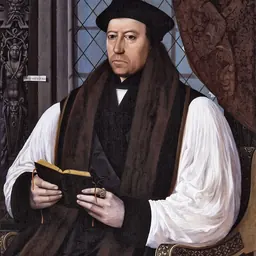
Frith was an important contributor to the Christian debate on persecution and toleration in favour of the principle of religious toleration. He was 'perhaps the first to echo in England' of that 'more liberal tradition' of Zwingli, Melanchthon and Bucer. As his ministry progressed, Frith took greater risks with his stance against the Catholic teachings of Purgatory and Transubstantiation. He was eventually brought before Thomas Cranmer and the Inquisition for his teachings and condemned to be burned at the stake for heresy.
In his revision of Foxe's Book of Martyrs, author Harold Chadwick writes the following about John Frith: "Master Frith was a young man noted for his godliness, intelligence, and knowledge. In the secular world, he could have risen to any height he wished, but he chose, instead, to serve the Church and work for the benefit of others and not himself." During his studies, he became acquainted with William Tyndale who deeply influenced Frith's beliefs. Like Tyndale and Luther, Frith played an influential role in the Protestant Reformation.
Biography
Early life and education John Frith (John Fryth) was born in 1503 in Westerham, Kent, England to Richard Frith the innkeeper of White Horse Inn (now known as Church Gate House.) The house still stands at the gates of the Westerham Parish Church of St Mary the Virgin. His name is recorded in the baptism registry of St Mary's Church in 1503. Though much of the church has been renovated several times over the centuries, the original 14th-century font in which Frith was baptised is still used today. The extended church choir are known as The John Fryth Singers.
He went to Sevenoaks Grammar School. He was further educated at Eton College before being admitted as a scholar to Queens' College, Cambridge, although he received his Bachelor of Arts degree as a member of King's. While Frith was at Cambridge, his tutor was Stephen Gardiner, who would later take part in condemning him to death. He became proficient in Latin, Greek, and Mathematics.
He also met Thomas Bilney a graduate student of Trinity Hall, and began to have meetings concerning the Protestant Reformation. It may have been at one of these meetings that Frith met with William Tyndale. After graduating in 1525, Frith became a junior canon at Thomas Wolsey's Cardinal College, Oxford. While in Oxford, Frith was imprisoned, along with nine others, in a cellar where fish was stored, The second purgatory is Christ's cross. "I mean not his material cross that he himself died on, but a spiritual cross, which is adversity, tribulation, worldly depression, [etc]." While imprisoned for approximately eight months in the Tower of London, Frith penned his views on Communion, fully knowing that it would be used "to purchase me most cruel death." Henry VIII was excommunicated one week later.
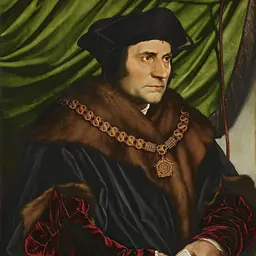
Polemical style John Frith's writings are in answer to, or debate with, the beliefs of men such as Bishop John Fisher, Sir Thomas More, and John Rastell. In 1531 Frith published three attacks on the doctrines of purgatory and transubstantiation, which left him, according to his biographers, a wanted man. The first of these, A Disputacion of Purgatorye, answered the apologies for purgatory contained in Bishop John Fisher's Assertonis Lutheranae Confuatio (1525), in Sir Thomas More's The Supplicacion of Soules (1529), and in A New Boke of Purgatory (1530) by More's brother-in-law, John Rastell. John Frith was unique among the reformers of the early Tudor period in his predilection for polemics and the very weapons of controversy, many of which he fashioned from the figures of rhetoric.
To emphasize his opponents' venality and thus question the motives for their doctrinal position, he used sarcasm, irony, significatio, and praemunitio. To prejudice his readers against opponents' arguments he used praemunitio. A "coulour of Rhetorike"—because Frith uses so many colours to debate against his opponents—which plays an important part in Frith's controversial technique is praemunitio, the orator's preparation of the audience for some succeeding portion of his speech. Frith uses this device to prejudice his readers either against his opponent's entire work prior to dealing with it, or to prejudice them against a particular passage in that work he is about to cite. To impugn his opponents' competence, he answered them with the texts they themselves had cited.
Legacy Thomas Cranmer would himself later subscribe to Frith's views on purgatory, and published the 42 articles which explicitly denied purgatory. Frith's works were posthumously published in 1573 by John Foxe.
Timeline 1503 Born in Westerham, Kent, England 1510 Frith and family moved to Sevenoaks 1520–22 Recorded to have attended Eton College 1522 Enrolled at Queens' College, Cambridge 1523 Transferred over to King's College, Cambridge 1525–28 Transferred to Thomas Wolsey's Cardinal College, Oxford to become a junior canon 1528 Imprisoned at Cardinal College in the institution's fish cellar by Cardinal Wolsey 1528 Roughly 6 months later, Cardinal Wolsey released surviving fish cellar prisoners on the paroling condition of residing within a 10-mile radius around Oxford 1528 Fled England for Antwerp 1528 Travelled to Marburg, Germany 1532 Returned to England and was imprisoned in the Tower of London for approximately 8 months 23 June 1533 Sentenced to death as a heretic and was transferred to Newgate Prison 4 July 1533 Publicly burned at the stake in Smithfield, London
Don’t just read it —
keep it.
Full-length biographies made to live with: read them, listen on the way to work, watch them tonight.
- E-book
- Audio
- Video
Instant download · yours to keep · every purchase keeps this site free
Important facts
People in John Frith's life
Named in this biography and alive at the same time




Related people
Same field, nearest in time


Contemporaries
People whose lives overlapped John Frith's





Frequently asked questions
Who was John Frith?
English Protestant priest, writer, and martyr
When was John Frith born?
John Frith was born in 1503 in Westerham (Feldkirchen-Westerham).
When did John Frith die?
John Frith died on 4 July 1533 in London.
What was John Frith's occupation?
John Frith was a theologian and writer.
What nationality was John Frith?
John Frith was English.
Sources & further reading
· DBpedia: John Frith (martyr)
Cite this page
APA: Biography.guide. (2026). John Frith. https://biography.guide/john-frith-theologian/
MLA: "John Frith." Biography.guide, https://biography.guide/john-frith-theologian/.
Chicago: "John Frith." Biography.guide. https://biography.guide/john-frith-theologian/.
Data last updated: 2026-09-23 · Spot an error? Report a correction.
Portrait: Wikimedia Commons · author & licence
Page generated 2026-09-27 05:08 UTC