
About John E. Fryer
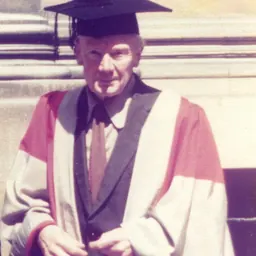
Lived 1938 – 2003 (aged 64). John E. Fryer was an American psychiatrist and psychologist, known for Diagnostic and Statistical Manual of Mental Disorders.
John Ercel Fryer (November 7, 1937 – February 21, 2003) was a prominent American psychiatrist and advocate for gay rights. He is most notably remembered for his impactful speech, delivered anonymously at the 1972 American Psychiatric Association (APA) annual conference. Fryer addressed the conference under the pseudonym Dr. Henry Anonymous, catalyzing the movement to remove homosexuality as a classified mental illness from the APA Diagnostic and Statistical Manual of Mental Disorders. In recognition of his significant contributions, the APA established the "John E. Fryer, M.D., Award" in his honor.
Early life Fryer was born in Winchester, Kentucky, to Katherine Zempter Fryer and Ercel Ray Fryer. Graduating from high school at the age of 15, he swiftly earned a bachelor's degree from Transylvania University in Lexington, Kentucky, where he was an active member of the Phi Kappa Tau fraternity. who was the Executive Secretary of the George W. Henry Foundation. Established in 1948 by Gross and Henry, Engaging in community health initiatives in North Philadelphia, he played a pivotal role in the Health Care and Human Values Task Force. Utilizing a $5,000 grant, he established a group named "Ars Moriendi" to address issues surrounding professional responses to death and dying. This initiative eventually evolved into the International Work Group on Death, Dying, and Bereavement.
This protest led to a meeting the next year, at the association's 1972 annual meeting, on homosexuality and mental illness. Entitled "Psychiatry: Friend or Foe to the Homosexual?; A Dialogue", it included Kameny and Gittings on the panel. Gittings' partner, Kay Lahusen, had noted that the panel included homosexuals who were not psychiatrists, and psychiatrists who were not homosexuals. No homosexual, however, were psychiatrists, so Gittings set out to find one who would be willing to be a panel member. After numerous contacts, she was unable to find a gay psychiatrist who would speak, so she had decided that she would read letters from gay psychiatrists without revealing their names. Not only fear of repercussions led to the theatricality of Fryer's disguised appearance: he later chaired a meeting of the International Work Group on Death, Dying, and Bereavement in 1974 wearing loudly patterned dashikis and used a ceramic cow bell to keep order; he had a propensity for theatricality. and he went on to describe the lives of the many gay psychiatrists in the APA who had to hide their sexuality from their colleagues for fear of discrimination, as well as from fellow homosexuals owing to the disdain in which the psychiatric profession was held among the gay community. Fryer's speech suggested ways in which gay psychiatrists could subtly and "creatively" challenge prejudice in their profession without disclosing their sexuality, and how they could help gay patients adjust to a society that considered their sexual preferences a sign of psychopathology. Reportedly, there were more than 100 gay psychiatrists at the convention. and the text as it has been published in various places. For instance, in the manuscript, Fryer writes that there are more than 200 gay psychiatrists registered for the APA convention, while the published text claims only 100. Similarly, the manuscript says "e should have clearly in our minds our own particular understanding of what it is to be a healthy homosexual in a world which sees that appellation as an impossible anachronism", while the published version corrects "anachronism" to "oxymoron". It is unclear if these changes were made in the process of converting the manuscript to the typescript Fryer read from at the 1972 meeting, or whether they were the result of post-event editing of the text before it was published.
At least one other panelist agreed with Fryer and Kameny that the stance of the psychiatric establishment toward homosexuality was wrong. The vice president of the APA at the time and later president, Dr. Judd Marmor, said: "I must concede that psychiatry is prejudiced as has been charged. Psychiatric mores reflect the predominant social mores of the culture." He later wrote: "In a democratic society we recognize the rights of such individuals to have widely divergent religious preferences, as long as they do not attempt to force their beliefs on others who do not share them. Our attitudes toward divergent sexual preferences, however, are quite different, obviously because moral values – couched in 'medical' and 'scientific' rationalizations – are involved." – leading the now-defunct Philadelphia Bulletin to print the headline "Homosexuals gain instant cure" Gittings later said of it: "His speech shook up psychiatry. He was the right person at the right time."
Awards and honors Fryer received a "Distinguished Alumnus" award (Recognizing alumni who have made significant achievements in their careers and service to the university) from Vanderbilt University in 2002, and in that same year he was awarded a Distinguished Service Award from the Association of Gay and Lesbian Psychiatrists (AGLP), now the Association of LGBTQ Psychiatrists.
After Fryer’s death in 2003,
On October 3, 2017, a historical marker was unveiled in Philadelphia in the Gayborhood, across the street from the Historical Society. It reads:
John E. Fryer, M.D.(1937-2003)Temple professor and psychiatrist Fryer, disguised as "Dr. Anonymous," spoke against the American Psychiatric Association's classification of homosexuality as a mental illness at the APA's 1972 annual meeting. Fryer's testimony convinced the APA to declassify homosexuality as a mental disorder in 1973, ending treatments such as chemical castration, electric shock therapy, and lobotomy and paving the way for advances in LGBT civil rights.Pennsylvania Historical and Museum Commission 2017
In 2022, Fryer’s house at 138 W. Walnut Lane, where he lived from 1972 until he died in 2003, was added to the Philadelphia Register of Historic Places.
Fryer's papers are archived at the Historical Society of Pennsylvania in more than 200 boxes, and are available to the public. Some documents have been digitized and are available online.
In 2025, Dr. Fryer was officially honored in his hometown of Winchester, Kentucky for the first time. On June 29, an official Kentucky historical marker was unveiled near his family home on Bon Haven Ave. in Winchester. On October 18, at the Winchester Pride + Inclusion Festival held on Depot Street, the street was ceremonial renamed "Dr. John Fryer Blvd." for the day. By proclamation of Winchester Mayor Jo Ellen Reed, October 18 was recognized as "Dr. John E. Fryer Day" in Winchester.
In popular culture In May 2016, a play by Ain Gordon, 217 Boxes of Dr. Henry Anonymous – based on Gordon's research as an "embedded artist" at the Historical Society of Pennsylvania (HSP), where Fryer's papers are archived – premiered at the Painted Bride Art Center in Philadelphia. The play explores Fryer and the circumstances around his 1972 appearance at the APA convention through monologues by three people who knew him: Alfred A. Gross, the executive director of the New York City-based George W. Henry Foundation, a social charity that helped homosexual men who had gotten into trouble with the law; Katherine M. Luder, Fryer's long-time secretary; and Fryer's father, Ercel Ray Fryer. Gordon's entire project – including video of all the public events prior to the presentation of the play, the play's script and video of a performance – will be added to the Fryer archive at HSP. In May 2018, the play was revived by the Equality Forum for two weeks of performances at the Baryshnikov Arts Center in New York City, to coincide with the American Psychiatric Association's annual meeting, and again at Transylvania University – Fryer's alma mater – in Lexington, Kentucky, in May 2019, and at the UCLA Center for the Art of Performance in October, 2019.
In June 2020, it was announced that Steven Canals would write and develop for the FX television channel 81 Words, a miniseries that would focus on the campaign to get the APA to remove homosexuality from the Diagnostic and Statistics Manual. The miniseries will be based on "81 Words", the This American Life episode by Alix Spiegel, and Cured- a documentary by Patrick Sammon and Bennett Singer that was scheduled to premiere at the virtual Los Angeles Outfest in August 2020. Cured was the first runner-up for the 2020 Library of Congress Lavine/Ken Burns Prize for Film, having been chosen from more than 150 finalists. The film was scheduled to be shown on PBS.
Don’t just read it —
keep it.
Full-length biographies made to live with: read them, listen on the way to work, watch them tonight.
- E-book
- Audio
- Video
Instant download · yours to keep · every purchase keeps this site free
Important facts
People in John E. Fryer's life
Named in this biography and alive at the same time




Related people
Same field, nearest in time


Contemporaries
People whose lives overlapped John E. Fryer's



Frequently asked questions
Who was John E. Fryer?
American psychiatrist and gay rights activist (1938–2003)
When was John E. Fryer born?
John E. Fryer was born on 7 November 1938 in Winchester.
When did John E. Fryer die?
John E. Fryer died on 21 February 2003 in Philadelphia.
What was John E. Fryer's occupation?
John E. Fryer was a psychiatrist and psychologist.
What was John E. Fryer known for?
John E. Fryer was known for Diagnostic and Statistical Manual of Mental Disorders.
What nationality was John E. Fryer?
John E. Fryer was American.
Sources & further reading
Cite this page
APA: Biography.guide. (2026). John E. Fryer. https://biography.guide/john-e-fryer/
MLA: "John E. Fryer." Biography.guide, https://biography.guide/john-e-fryer/.
Chicago: "John E. Fryer." Biography.guide. https://biography.guide/john-e-fryer/.
Data last updated: 2026-09-25 · Spot an error? Report a correction.
Page generated 2026-09-27 05:10 UTC