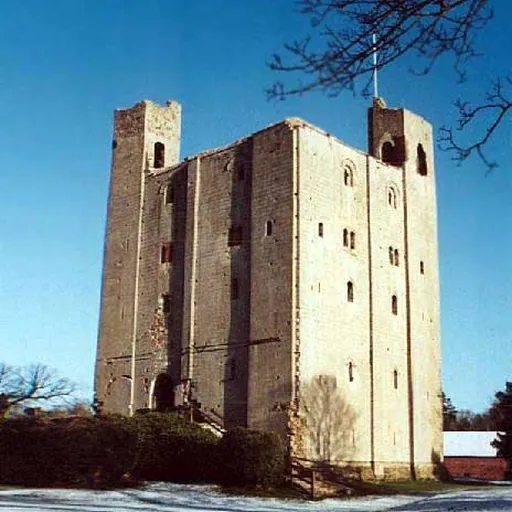
John de Vere, 7th Earl of Oxford
English noble
About John de Vere, 7th Earl of Oxford
Lived 1312 – 1360 (aged 47).
John de Vere, 7th Earl of Oxford (c. 12 March 1312 – 24 January 1360) was the nephew and heir of Robert de Vere, 6th Earl of Oxford who succeeded as Earl of Oxford in 1331, after his uncle died without issue.
John de Vere was a trusted captain of Edward III in the king's wars in Scotland and France, and took part in both the Battle of Crécy and the Battle of Poitiers. He died campaigning in France in 1360. Throughout his career, he was closely associated with William de Bohun, 1st Earl of Northampton, who was his brother-in-law.
Family background and marriage John de Vere was the only son of Alphonse de Vere, and Jane, daughter of Sir Richard Foliot. Alphonse was the third son of Robert de Vere, 5th Earl of Oxford and apparently died shortly before 20 December 1328, when a writ was issued for inquisitions post mortem into the land that he held direct from the King. These hearings established that Alphonse's next heir was his son John, then aged 15 years and more. The manors concerned were Aston Sandford, Buckinghamshire, Westwick by St Albans and Great Hormead, Hertfordshire, as well as property at Beaumont and Althorne in Essex.
Alphonse was a brother of Robert de Vere, 6th Earl of Oxford. When the 6th Earl's son died without issue in 1329, he obtained licence from the king to entail his estates on his nephew, John. It was in this way that John de Vere, when his uncle died 17 April 1331, became Earl of Oxford. He had made homage and received livery by 17 May.
In 1336 John married Maud de Badlesmere, who was the second of the four daughters of Bartholomew de Badlesmere, 1st Baron Badlesmere, of Badlesmere in Kent and Margaret de Clare. Maud was a co-heiress of her brother Giles de Badlesmere, 2nd Baron Badlesmere. When Giles died in 1338, this brought a significant part of the Badlesmere inheritance into de Vere's hands. The marriage also forged a strong bond with William Bohun, Earl of Northampton, who had married Badlesmere's third daughter, Elizabeth de Badlesmere, and thus became Oxford's brother-in-law. The two campaigned together, sat on the same commissions and died the same year.
Fearing a French invasion of England, Oxford was made responsible for the defence of London and the Essex coast. In the spring of 1340, de Vere and Thomas Beauchamp, 11th Earl of Warwick were summoned to reinforce the Earl of Salisbury in Flanders with two hundred men to counter a French invasion of the Low Countries. Despite the urgency of the order, Oxford and Warwick did not arrive until April and then with barely two dozen men.
While serving in the Low Countries, Oxford was therefore out of the country during Edward's disputes with Archbishop John de Stratford. Oxford was not forced to take sides in the conflict, and has been described as a "political neutral". The eldest son, John, married Elizabeth Courtenay, daughter of Hugh Courtenay, 10th Earl of Devon, but died before his father, in 1350. (After the death of her husband, Elizabeth married Sir Andrew Luttrell of Chilton (in Thorverton), Devon.) Another son, Robert, also died in his father's lifetime. The eldest remaining son was then Thomas, born about 1336 or 1337, who succeeded his father in 1360. Thomas's son Robert de Vere, 9th Earl of Oxford succeeded at his father's death, but with Robert's forfeiture in 1392, the earldom was given to Robert's uncle Aubrey – the seventh earl's fourth son. The eldest daughter, Margaret, married three times, while of the second, Matilda, little is known. The third daughter, Elizabeth, married Sir Hugh Courtenay, eldest son and heir of Hugh de Courtenay, 10th Earl of Devon.
John de Vere, in the family tradition of the "fighting de Veres", was active in almost all major military engagements in the years from 1340 to 1360. On the Roxburgh campaign he brought a retinue of twenty-eight men-at-arms and twelve mounted archers. At one point, in the Battle of Poitiers, John Hawkwood, who was later to make his fortune as a condottiero in Italy, also served with de Vere. Yet in spite of this, de Vere never distinguished himself, particularly as a military commander. Neither did he receive a great amount of royal patronage, and was never made a member of the Order of the Garter. This was largely a consequence of the de Vere family's relatively modest resources among the English peerage. As an example can be mentioned that in late 1340, £349 were owed to Oxford in arrears for his services, yet at the same time, the king owed Northampton two debts of £782 and £1237. This obstacle of resources and status John de Vere was unable to overcome either by marriage or warfare.
Footnotes
Don’t just read it —
keep it.
Full-length biographies made to live with: read them, listen on the way to work, watch them tonight.
- E-book
- Audio
- Video
Instant download · yours to keep · every purchase keeps this site free
Important facts
Family & relationships
People in John de Vere, 7th Earl of Oxford's life
Named in this biography and alive at the same time
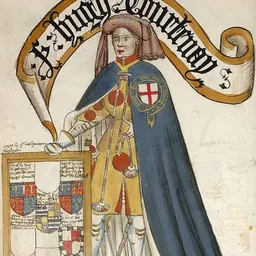


Contemporaries
People whose lives overlapped John de Vere, 7th Earl of Oxford's
Frequently asked questions
Who was John de Vere, 7th Earl of Oxford?
English noble
When was John de Vere, 7th Earl of Oxford born?
John de Vere, 7th Earl of Oxford was born on 12 March 1312.
When did John de Vere, 7th Earl of Oxford die?
John de Vere, 7th Earl of Oxford died on 23 January 1360 in Reims.
Sources & further reading
· Wikipedia: John de Vere, 7th Earl of Oxford
· DBpedia: John de Vere, 7th Earl of Oxford
Cite this page
APA: Biography.guide. (2026). John de Vere, 7th Earl of Oxford. https://biography.guide/john-de-vere-7th-earl-of-oxford/
MLA: "John de Vere, 7th Earl of Oxford." Biography.guide, https://biography.guide/john-de-vere-7th-earl-of-oxford/.
Chicago: "John de Vere, 7th Earl of Oxford." Biography.guide. https://biography.guide/john-de-vere-7th-earl-of-oxford/.
Data last updated: 2026-09-26 · Spot an error? Report a correction.
Portrait: Wikimedia Commons · author & licence
Page generated 2026-10-05 02:12 UTC