
John de St Paul
Lord Chancellor of Ireland and Roman Catholic Archbishop
About John de St Paul
Lived 1290 – 1362 (aged 71–72). John de St Paul was a catholic priest and judge.
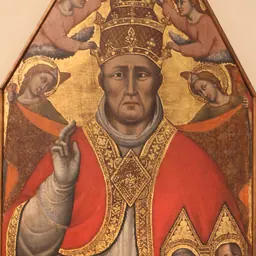
John de St Paul ( 1295 – 1362), also known as John de St. Pol, John de Owston and John de Ouston, was an English-born cleric and judge of the fourteenth century. He was Archbishop of Dublin 1349–62 and Lord Chancellor of Ireland 1350–56. He had previously been Master of the Rolls in England 1337–40. Apart from a brief period of disgrace in 1340, he enjoyed the confidence of King Edward III. He was described as a zealous supporter of English rule in Ireland, but also as a pragmatic statesman who was willing to conciliate the Anglo-Irish ruling class. He did much to enlarge and beautify Christ Church, Dublin, although virtually no trace of his improvements survive, as they were destroyed by the Victorian rebuilding of the cathedral.
Family and early life The St Paul family is thought to have come to Yorkshire from Guienne. They may have had a family connection to the Counts of Saint-Pol, since Marie de St Pol, Countess of Pembroke, often employed John as her attorney. He received a commission from Pope Clement VI to proceed against certain heretics who, having fled from persecution by Richard de Ledrede, the notoriously stern Bishop of Ossory, had been sheltered by St Paul's predecessor in the See of Dublin, Alexander de Bicknor. He held a Synod in Dublin in 1351, which dealt with a wide range of issues, including the proper observance of Good Friday, the banning of secret marriages, and the ritual of genuflection. He maintained the long-running dispute with Richard FitzRalph, Archbishop of Armagh over the latter's claim to be Primate of Ireland. He persuaded the King to revoke his order which gave the See of Armagh precedence, and to remove the cause to Rome for the Pope's adjudication. He obtained numerous benefits for the Archdiocese of Dublin. He sat on a Royal Commission to explore for and oversee gold and silver mines in 1360.
In 1361 he was summoned to a Great Council in Dublin: although he was a strong supporter of English rule in Ireland, he urged a policy of moderation and an end to the bitter divisions of the past decade within the government itself. His proposals included an amnesty for Anglo-Irish leaders who had been in opposition to the Crown, which was duly granted.
Death He died on 9 September 1362 and was buried under the high altar in Christ Church Cathedral – a building which he had done so much to improve at his own expense.
Don’t just read it —
keep it.
Full-length biographies made to live with: read them, listen on the way to work, watch them tonight.
- E-book
- Audio
- Video
Instant download · yours to keep · every purchase keeps this site free
Important facts
People in John de St Paul's life
Named in this biography and alive at the same time

Related people
Same field, nearest in time


Contemporaries
People whose lives overlapped John de St Paul's
Frequently asked questions
Who was John de St Paul?
Lord Chancellor of Ireland and Roman Catholic Archbishop
When was John de St Paul born?
John de St Paul was born in 1290.
When did John de St Paul die?
John de St Paul died on 9 September 1362.
What was John de St Paul's occupation?
John de St Paul was a catholic priest and judge.
Sources & further reading
Cite this page
APA: Biography.guide. (2026). John de St Paul. https://biography.guide/john-de-st-paul/
MLA: "John de St Paul." Biography.guide, https://biography.guide/john-de-st-paul/.
Chicago: "John de St Paul." Biography.guide. https://biography.guide/john-de-st-paul/.
Data last updated: 2026-09-20 · Spot an error? Report a correction.
Page generated 2026-09-27 05:21 UTC