
About John Davis
Lived 1550 – 1605 (aged 55). John Davis was an English explorer, seafarer and discoverer.
John Davis ( – 29 December 1605) was an explorer, navigator and privateer. He led several voyages in search of the Northwest Passage and served as pilot and captain on both Dutch and English voyages to the East Indies. He discovered the Falkland Islands in August 1592.
Early life John Davis was born around 1550 at Sandridge near Dartmouth in Devon, in south-west England. He grew up in the parish of Stoke Gabriel and spent his childhood at nearby Sandridge Barton.
On 29 September 1582, at about the age of 32, Davis married Faith Fulford, daughter of Sir John Fulford, the High Sheriff of Devon, and Lady Dorothy Bourchier, daughter of John Bourchier, 1st Earl of Bath.
Career Map showing Davis's northern voyages. From life of John Davis, the navigator
Northwest Passage expeditions In 1583, Davis proposed an expedition in search of the Northwest Passage to the queen's secretary Francis Walsingham. Two years later, with Walsingham's support, Davis sailed from Dartmouth with two ships, following Martin Frobisher's earlier route along Greenland's east coast, around Cape Farewell, and west toward the eastern coast of present-day Baffin Island. He returned on 30 September 1585. During the voyage, Davis made his first recorded contact with the Inuit and crossed the southern part of the strait that later came to bear his name. The initially amiable approach Davis adopted to the Inuit bringing musicians and having the crew dance and play with them His crew was forced to kill hundreds of penguins for food on the islands, but the stored meat spoiled in the tropics and only fourteen of his 76 men made it home alive.
East Indies voyages From 1596 to 1597 Davis seems to have sailed with Sir Walter Raleigh to Cádiz and the Azores as master of Raleigh's ship; from 1598 to 1600 he accompanied a Dutch expedition to the East Indies as pilot, sailing from Vlissingen and returning to Middelburg, while carefully charting and recording geographical details. He narrowly escaped destruction from treachery at Achin on Sumatra. ) if the voyage doubled its original investment, £1,000 if three times, £1,500 if four times and £2,000 if five times.
Before departure, Davis had told London merchants that pepper could be obtained in Aceh at a price of four reals of eight per hundredweight - whereas it actually cost 20. When the voyage returned, Lancaster complained that Davis had been wrong about both the price and availability of pepper. Unhappy at being made a scapegoat for the situation, on 5 December 1604 Davis sailed again for the East Indies as pilot to Sir Edward Michelborne, an "interloper" who had been granted a charter by James I despite the supposed East India Company monopoly on trade with the East.
Death and legacy Davis died on 27 December 1605, at about the age of 55, off Bintan Island near present-day Singapore.
John Davis is recognised also for his valuable contribution to proto-ethnography of Inuit.
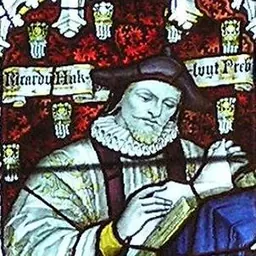
Publications Davis's explorations in the Arctic were published by Richard Hakluyt and appeared on his world map. Davis himself published a valuable treatise on practical navigation called The Seaman's Secrets in 1594 and a more theoretical work called The World's Hydrographical Description in 1595. The account of Davis's last voyage was written by Michelborne on his return to England in 1606.
Inventions
His invention of the backstaff and double quadrant (called the Davis quadrant after him) remained popular among English seamen until long after Hadley's reflecting quadrant had been introduced. conspiring with this man, a counterfeiter, Faith "brought false and unavailing charges" against Davis.
Davis was also involved a plot to entrap Thomas Aufield, a Catholic priest. Likely acting as an agent provocateur at the direction of his patron, Francis Walsingham, Davis claimed to be a Catholic convert and offered to hand over a number of English ships to the Pope or to Spain to aid the Catholic cause. He met Aufield in Rouen to discuss the proposal. Negotiations failed and he returned to England where Aufield was arrested for circulating Catholic texts. Aufield was tortured and found guilty distributing a book in which found fault with the queen's religion. He was hanged on 6 July 1585 at Tyburn.
Don’t just read it —
keep it.
Full-length biographies made to live with: read them, listen on the way to work, watch them tonight.
- E-book
- Audio
- Video
Instant download · yours to keep · every purchase keeps this site free
Important facts
People in John Davis's life
Named in this biography and alive at the same time






Related people
Same field, nearest in time

Contemporaries
People whose lives overlapped John Davis's


Frequently asked questions
Who was John Davis?
English explorer and navigator (1550–1605)
When was John Davis born?
John Davis was born on 1 October 1550 in Sandridge.
When did John Davis die?
John Davis died on 27 December 1605 in Bintan Island.
What was John Davis's occupation?
John Davis was an explorer, seafarer and discoverer.
What nationality was John Davis?
John Davis was English.
Sources & further reading
· DBpedia: John Davis (explorer)
Cite this page
APA: Biography.guide. (2026). John Davis. https://biography.guide/john-davis/
MLA: "John Davis." Biography.guide, https://biography.guide/john-davis/.
Chicago: "John Davis." Biography.guide. https://biography.guide/john-davis/.
Data last updated: 2026-09-26 · Spot an error? Report a correction.
Page generated 2026-09-27 05:15 UTC