
About John Davidson
Lived 1857 – 1909 (aged 51). John Davidson was a British linguist, translator, poet and writer.
John Davidson (11 April 1857 – 23 March 1909) was a Scottish poet, playwright and novelist, best known for his ballads. He also did translations from French. In 1909, financial difficulties, as well as physical and mental health problems, led to his suicide.
Life and works Scotland
He was born at Barrhead, East Renfrewshire as the son of Alexander Davidson, an Evangelical Union minister and Helen née Crocket of Elgin. His strict Protestant upbringing deeply influenced the type of man and writer he would become. Harold Herbert Williams writes: "Like Carlyle he was a protagonist of the actual, for in boyhood he had been trained in the strictest sect of the Calvinists, and like Carlyle he spent half his life buffeting the universe as a Calvinist without dogma."
His family removed to Greenock in 1862 where he was educated at Highlanders' Academy there and entered the chemical laboratory of Walker's Sugarhouse refinery in his 13th year, returning after one year to school as a pupil teacher. Davidson also briefly worked in the Public Analysts' Office, from 1870 to 1871. In these employments he developed an interest in science which became an important characteristic of his poetry. Davidson's first published work was Bruce, a chronicle play in the Elizabethan manner, which appeared with a Glasgow imprint in 1886. Four other plays, Smith, a Tragic Farce (1888), An Unhistorical Pastoral (1889), Aromantic Farce (1889), and the brilliant pantomimic Scaramouch in Naxos (1889) were also published while he was in Scotland.
Besides writing for the Speaker, the Glasgow Herald, and other papers, he produced several novels and tales, of which the best was Perfervid (1890). But these prose works were written for a livelihood.
Verse
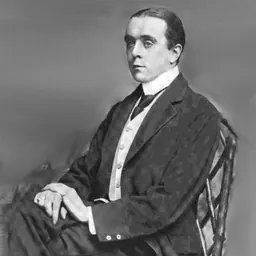
Davidson's true medium was verse. In a Music Hall and other Poems (1891) suggested what Fleet Street Eclogues (1893) proved, that Davidson possessed a genuine and distinctive poetic gift. The late nineteenth century English novelist George Gissing read both these volumes in one day in 1893 at the British Museum Library. Yeats had words of praise for In a Music Hall. He called it, "An example of a new writer seeking out 'new subject matter, new emotions'". Yeats wrote of his emotional dispute with Davidson in Autobiographies (1955). was followed in turn by a second series of Fleet Street Eclogues (1896) and by New Ballads (1897) and The Last Ballad (1899). She survived him with two sons, Alexander (born 1887) and Menzies (born 1889). A caricature by Max Beerbohm appeared in The Chapbook, (1907),
Frank Harris, a member of the Rhymers' Club, described him in 1889:"... a little below middle height, but strongly built with square shoulders and remarkably fine face and head; the features were almost classically regular, the eyes dark brown and large, the forehead high, the hair and moustache black. His manners were perfectly frank and natural; he met everyone in the same unaffected kindly human way; I never saw a trace in him of snobbishness or incivility. Possibly a great man, I said to myself, certainly a man of genius, for simplicity of manner alone is in England almost a proof of extraordinary endowment."
Drowning
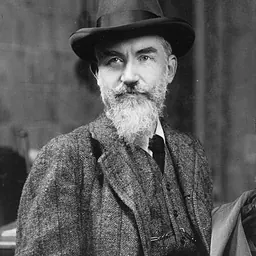
In 1906 he was awarded a civil list pension of £100 per annum and George Bernard Shaw did what he could to help him financially, but poverty, ill-health, and his declining powers, exacerbated by the onset of cancer, caused profound hopelessness and clinical depression.
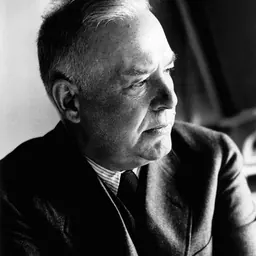
Legacy Davidson's poetry was a key early influence on important Modernist poets, in particular, his compatriot Hugh MacDiarmid and Wallace Stevens. T.S. Eliot was especially fond of the poem 'Thirty Bob a Week' (In Ballads and Songs (1894)). Davidson's poem "In the Isle of Dogs", for example, is a clear intertext of later poems such as Eliot's "The Waste Land" and Stevens' "The Idea of Order at Key West".
Quotes "This is an age of Bovril"
Works
The North Wall (1885) Diabolus Amans (1885), verse drama Bruce (1886 ) a drama in five acts Smith (1888) a tragedy Plays (1889) An Unhistorical Pastoral, a Romantic Farce Scaramouch in Naxos Perfervid: The Career of Ninian Jamieson, (1890) with 23 Original Illustrations by Harry Furniss, Ward & Downey, Ltd., London. The Great Men, And a Practical Novelist (1891) Illustrated by E. J. Ellis. Ward & Downey, Ltd., London. In a Music Hall, and other Poems (1891) Ward & Downey, Ltd., London. Laura Ruthven's Widowhood (with C. J. Wills), (1892) Fleet Street Eclogues (1893)] The Knight of the Maypole, (1903) Sentences and Paragraphs (1893) Ballads and Songs (1894) John Lane Publishers, London Baptist Lake (1894) Ward & Downey, Ltd., London. A Random Itinerary (1894) A Full and True Account of the Wonderful Mission of Earl Lavender (1895) St. George's Day (1895) Fleet Street Eclogues (Second Series) (1896) Miss Armstrong's and Other Circumstances (1896) The Pilgrimage of Strongsoul and Other Stories (1896) New Ballads (1897) Godfrida, a play (1898) The Last Ballad (1899) Self's the Man, a tragi-comedy, (1901) The Testament of a Man Forbid (1901) The Testament of a Vivisector (1901) The Testament of an Empire Builder (1902) A Rosary, (1903) Grant Richards, London The Knight of the Maypole: A Comedy in Four Acts (1903) The Testament of a Prime Minister (1904) The Ballad of a Nun (1905) The Theatrocrat: a Tragic Play of Church and State, (1905) Holiday and other poems, with a note on poetry (1906) The Triumph of Mammon (1907) E.G. Richards, London Mammon and His Message (1908) The Testament of John Davidson (1908) Fleet Street and other Poems, (1909) Contributor to The Yellow Book
He translated: Montesquieu's Lettres Persanes, (Persian Letters) (1892) François Coppée's Pour la couronne, (For the Crown) (1896) Victor Hugo's Ruy Blas, (A Queen's Romance) (1904)
Don’t just read it —
keep it.
Full-length biographies made to live with: read them, listen on the way to work, watch them tonight.
- E-book
- Audio
- Video
Instant download · yours to keep · every purchase keeps this site free
Important facts
Family & relationships
People in John Davidson's life
Named in this biography and alive at the same time



Related people
Same field, nearest in time

Contemporaries
People whose lives overlapped John Davidson's



Frequently asked questions
Who was John Davidson?
Scottish poet (1857-1909)
When was John Davidson born?
John Davidson was born on 11 April 1857 in Barrhead.
When did John Davidson die?
John Davidson died on 23 March 1909 in Penzance.
What was John Davidson's occupation?
John Davidson was a linguist, translator, poet and writer.
What nationality was John Davidson?
John Davidson was British.
Sources & further reading
· DBpedia: John Davidson (poet)
Cite this page
APA: Biography.guide. (2026). John Davidson. https://biography.guide/john-davidson-linguist/
MLA: "John Davidson." Biography.guide, https://biography.guide/john-davidson-linguist/.
Chicago: "John Davidson." Biography.guide. https://biography.guide/john-davidson-linguist/.
Data last updated: 2026-09-20 · Spot an error? Report a correction.
Page generated 2026-09-27 05:26 UTC