
John Busst
Australian artist and conservationist
About John Busst
Lived 1909 – 1971 (aged 61–62). John Busst was a conservationist.
John Horatio Busst (1909–5 April 1971) was an artist and conservationist in Queensland, Australia. He is best known for leading a successful campaign to protect Queensland's Great Barrier Reef and its tropical rainforests from development, mining pressures and exploitation.
His interest in art, architecture and advocacy began in his youth, which he spent in Victoria. After attending Wesley College, he studied at Melbourne University. He then shared a house with Arthur Munday and future Prime Minister Harold Holt, before Busst and Munday studied art with draughtsman-turned-painter Justus Jorgensen, who was influential in Melbourne art circles. In 1934, Busst followed Jorgensen to Eltham, an outer suburb of Melbourne, which had attracted artists since the early twentieth century, to help build the community of painters, sculptors, musicians and crafts-people, later known as Montsalvat. Their architectural vision included the use of natural and local materials, such as pise de terre and mud bricks. As one of Monsalvat's builders, Busst acquired skills in creative and organic building. Phyllis returned to Melbourne and John married Alison Shaw Fitchett, who joined him on Bedarra in the early 1950s. In 1957, John and Alison sold their home on Bedarra Island and moved to Bingil Bay, on a property of just less than , but which extended to the beach and had views over the Coral Sea and Great Barrier Reef. They also acquired portion 19V to the north, a block that included extensive areas of tropical lowland rainforest and the rocky headland known as Ninney Point. In the late 1950s or early 1960s, the Bussts erected a new residence on the site, which they called Ninney Rise.
Ninney Rise Busst designed their new home to be strong enough to withstand cyclones, and utilised locally sourced materials. He employed a local builder to erect the shell of the building, using bricks from the Silkwood Brickworks, and then used bamboo, an exotic species that had been planted in the district in the nineteenth century, to create decorative ceiling features, architraves and fittings throughout the residence, and to make furniture. Patricia Clare, who visited the Busst's new home at Bingil Bay in the 1960s, later wrote: Webb and Tracey, who stayed with Busst at his Bingil Bay house to do all their work on medicinal drugs from rainforest plants associated with the Australian Phytochemical Survey, were pioneers in Australian rainforest ecology and conservation. They promoted the conservation of lowland rainforest through the establishment of national parks and were joined by the Bussts in their campaign.
Busst's Great Barrier Reef campaign received a good deal of publicity and has been well documented in Australian ecology and conservation literature. In 1967, following public notice of a cane grower's intention to harvest coral from of supposedly dead reef as a cheap source of agricultural lime) , Busst lodged an objection and gathered evidence to prove that Ellison Reef was alive. The ensuing battle involved a number of influential environmentalist groups including the: Australian Conservation Foundation, the Queensland Wildlife Preservation Society, the Queensland Littoral Society (renamed the Australian Marine Conservation Society), and the Wildlife Conservation Society (US).
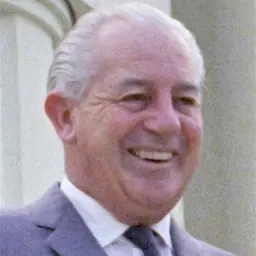
Busst also circulated an objection, addressed to Ernie Evans, the Minister for Mines, to the Premier Frank Nicklin, the Ministers for Tourism and Conservation, and the Director-General of the Queensland Government Tourist Bureau. He attracted wide press coverage for the case and enlisted the help of his long-time friend, Prime Minister Harold Holt, who, after being introduced to Bingil Bay by Busst, built a holiday home nearby. Six months after the hearings in the Innisfail Courthouse, Queensland Mines Minister Ron Camm rejected the mining application. That landmark case set a precedent that the reef should not be mined, brought the question of exploiting the Reef's resources into the public arena, and served as a cornerstone for the conservation movement in Queensland. In the meantime, legislation was drafted for sovereign control over underwater resources on the continental shelf. In a letter to Wisenet in the 1990s Wright described Busst as "the man whose energy and devotion had first sparked off, and largely continued" the fight to save the reef.
Death
Busst died on 5 April 1971
Don’t just read it —
keep it.
Full-length biographies made to live with: read them, listen on the way to work, watch them tonight.
- E-book
- Audio
- Video
Instant download · yours to keep · every purchase keeps this site free
Important facts
People in John Busst's life
Named in this biography and alive at the same time





Related people
Same field, nearest in time



Contemporaries
People whose lives overlapped John Busst's



Frequently asked questions
Who was John Busst?
Australian artist and conservationist
When was John Busst born?
John Busst was born in 1909.
When did John Busst die?
John Busst died in 1971.
What was John Busst's occupation?
John Busst was a conservationist.
Sources & further reading
Cite this page
APA: Biography.guide. (2026). John Busst. https://biography.guide/john-busst/
MLA: "John Busst." Biography.guide, https://biography.guide/john-busst/.
Chicago: "John Busst." Biography.guide. https://biography.guide/john-busst/.
Data last updated: 2026-09-20 · Spot an error? Report a correction.
Page generated 2026-09-27 05:27 UTC