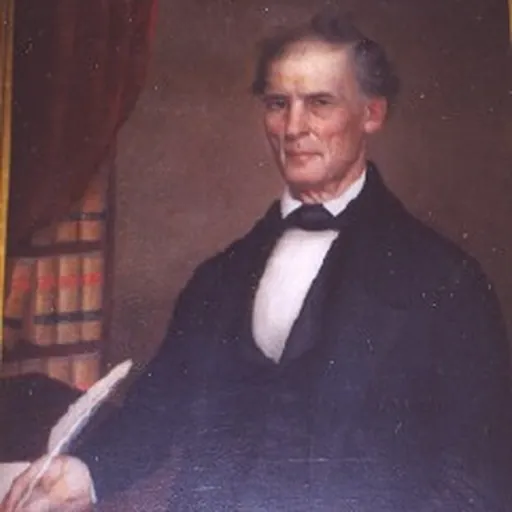
John Boyle
United States federal judge and member of the U.S. House of Representatives
About John Boyle
Lived 1774 – 1835 (aged 60). John Boyle was an American politician, lawyer and judge.
John Boyle (October 28, 1774 – February 28, 1834) was an American politician and judge who was a U.S. representative from Kentucky from 1803 to 1809. He was chief justice of the Kentucky Court of Appeals (now the Kentucky Supreme Court) from 1810 to 1826, and finally a United States district judge of the United States District Court for the District of Kentucky from 1826 to 1834.
Education and family life
Born on October 28, 1774, at "Castle Woods" in Botetourt County in the Virginia Colony, to the former Jane Black and her husband the patriot Major John Boyle. Boyle had an elder brother Alexander, and four sisters who also survived to adulthood. Their father moved his family to Whitleys Station, Kentucky in 1779, upon receiving land for his patriotic service, where his sons were educated by private tutors and in private schools. Although his elder brother continued as a farmer in Garrard County (moving to Lincoln County, Kentucky after the Civil War), John Boyle then read law with Congressman Thomas Terry Davis and was admitted to the Kentucky bar in 1797.
Congressman
In 1802, voters elected Boyle as a Democratic-Republican from Kentucky's 2nd congressional district to the United States House of Representatives, and later re-elected him, so he served in the 8th, 9th and 10th United States Congresses (from March 4, 1803, to March 3, 1809). Desha had campaigned for debt relief, since Kentucky was still suffering the effects of the Panic of 1819, and his party won majorities in both houses of the legislature, but could not find grounds to impeach Boyle and his two fellow judges. Instead, they purported to reorganize the judiciary. The legislature also refused to appropriate salaries for Boyle and his purportedly dismissed colleagues, although on December 24, 1826, the newly elected legislature (dominated by the "Old Court" party) repealed the two-year-old judicial reorganization act, restored the old judges (although Boyle had resigned on November 8, 1826, as discussed below) and awarded them backpay. Boyle would be succeeded briefly as Chief Judge by Bibb (whom he had also succeeded), then by former Congressman George Robertson (who had represented creditors in one of the controversial cases as well as succeeded to Boyle's house).
On May 29, 1829, Boyle accepted the position of Dean of the Transylvania University law school, notwithstanding his federal service (as discussed below), although he only continued in that position for a year.
Federal district judge John Boyle's home in Lancaster, Kentucky. This home was at different times owned by Robert Letcher, U.S. Congressman and Kentucky Governor, and George Robertson, U.S. Congressman, and a judge of the Kentucky Court of Appeals. Boyle received a recess appointment from President John Quincy Adams on October 20, 1826, to a seat on the United States District Court for the District of Kentucky vacated by Judge Robert Trimble. Boyle sold the house to Samuel McKee, who had read law with him and who also succeeded Boyle in Congress. McKee in turn sold the house to George Robertson, whom he had guided in reading law and who succeeded McKee in Congress and later succeeded Boyle as Chief Justice of the Kentucky Supreme Court. Robertson in turn sold the house to Robert P. Letcher, who became a Congressman and Kentucky governor
Boyle's legacy also included his lawyer son Jeremiah Boyle, who unsuccessfully argued for emancipation of slaves at Kentucky's Constitutional Convention of 1849, and later recruited troops and became a Brigadier General during the American Civil War, and thereafter became active in the booming railroad industry although some of Boyle's descendants would fight for the Confederacy. Furthermore, Judge Boyle taught law to his nephew John Boyle Gordon (the son of his young sister Jane who eloped), who moved to Missouri, where he served in the legislature for several terms, as well as taught law to relatives Oden Guitar and Stanley Matthews, who both became Union Army officers during the American Civil War, then became judges, Guitar in Missouri and Matthews on the United States Supreme Court.
Don’t just read it —
keep it.
Full-length biographies made to live with: read them, listen on the way to work, watch them tonight.
- E-book
- Audio
- Video
Instant download · yours to keep · every purchase keeps this site free
Important facts
People in John Boyle's life
Named in this biography and alive at the same time



Related people
Same field, nearest in time



Contemporaries
People whose lives overlapped John Boyle's




Frequently asked questions
Who was John Boyle?
United States federal judge and member of the U.S. House of Representatives
When was John Boyle born?
John Boyle was born on 28 October 1774 in Botetourt County.
When did John Boyle die?
John Boyle died on 28 February 1835 in Danville.
What was John Boyle's occupation?
John Boyle was a politician, lawyer and judge.
What nationality was John Boyle?
John Boyle was American.
Sources & further reading
· DBpedia: John Boyle (congressman)
Cite this page
APA: Biography.guide. (2026). John Boyle. https://biography.guide/john-boyle-politician-1774/
MLA: "John Boyle." Biography.guide, https://biography.guide/john-boyle-politician-1774/.
Chicago: "John Boyle." Biography.guide. https://biography.guide/john-boyle-politician-1774/.
Data last updated: 2026-09-20 · Spot an error? Report a correction.
Page generated 2026-09-27 05:10 UTC