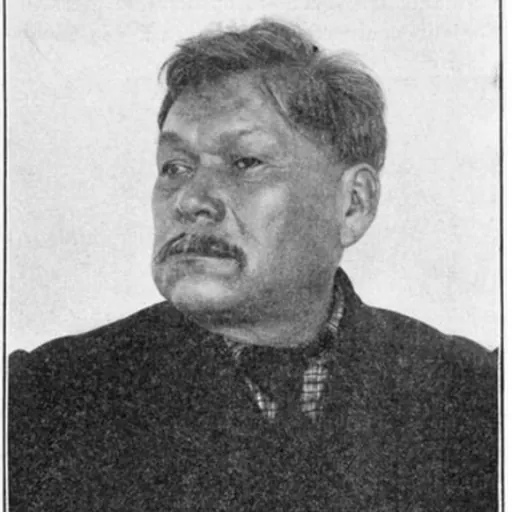
John Arthur Gibson
Seneca chief
About John Arthur Gibson
Lived 1850 – 1912 (aged 62). John Arthur Gibson was a Canadian, known for Great Law of Peace and Lacrosse.
John Arthur Gibson (1850–1912) was a chief of the Seneca nation of the North American Haudenosaunee (Iroquois) confederation. Part Onondaga and part Seneca, he resided within the reserve of the Six Nations of the Grand River in Ontario, Canada. Knowledgeable about Haudosaunee culture, he is best known for the versions he provided of the Haudenosaunee oral constitution, the Great Law of Peace. He acted as an advisor to the Canadian Department of Indian Affairs in matters relating both to Haudenosaunee and non-Haudenosaunee indigenous people. He was a well-respected player of the traditional Haudenosaunee sport of lacrosse until he was blinded during a game when he was 31.
Family and reservation life John Arthur Gibson (March 1, 1850 – November 1, 1912) was also known as Ganio dai io ("Promoter of the Code of Handsome Lake") and Skanyadehehyoh (or Skanyadai'iyo), was born to his father, also named John Gibson, who was an Onondaga chief the name given to the traditional Seneca office-chief of Handsome Lake. His father, also named John Gibson, was an Onondaga chief whose title was Atotarho, (or Thatótá•hoˀ) His mother was Hanna Gibson, of the Turtle clan of the Seneca nation. and is used far more often sometimes. Even so, the council felt they needed to defend the council's traditional form in the face of the Canadian government seeking to introduce a more Euro-American democratic system.
Gibson was born into this new context of reduced national councils and a strong central or federated council, with a committee system strongly controlled by Mohawks, and a division between Christianized, acculturated Haudenosaunee and the conservative part of the society.
The lacrosse player A biography by his wife (a member of the Cayuga nation),
Gibson's wife's account also highlights that Gibson was not simply a "traditional man", but introduced or demonstrated several innovations. For example, although their marriage was arranged in a traditional sense, it is "easy to see in her narrative that the (traditional) matrilocality was no longer in effect and the nuclear family was well introduced". It also noted he made a living making lacrosse sticks.
In 1895 Gibson was one of two tasked by the council to revise a list of chiefs kept by the council, a task he was again noted for in 1904. Gibson was known to have traveled to Cattaraugus Reservation or Allegany Indian Reservation Haudenosaunee communities to present the Code of Handsome Lake.
Among the best known "Keepers" of Gibson's era were himself and Seth Newhouse (1842–1921), also known as Da-yo-de-ka-ne. though segments were published in 1916 and 1944. Gibson's goal in delivering a rendition to Hewitt was possibly to have it circulate in the United States and impress upon the U.S. government to oppose the Canadian government's actions. as well as those of the American Philosophical Society Library.
Barbara Alice Mann examines the encounter with Jigonsaseh and Peacemaker's mission as part of a vegetarian-versus-carnivore approach to life and culture. and then by Arthur C. Parker in 1916. The only significant difference between these two is that Parker's version included punctuation marks. Both incorporate the original introduction included with the version the council endorsed; however, the commentary about borrowing miraculous qualities from Christianity was introduced at a second meeting of the committee when Gibson was not present and some Christian chiefs were. Regardless of the introduction, Gibson's "Chiefs' version" was considered authoritative and Parker's publication has been echoed many times on the internet.
The question arises that if the dispute between Christians and "Longhouse" traditionalist (whether Handsome Lake Code followers or not) Haudenosaunee was essentially an internal matter, why did the Chiefs present it in English? The Superintendent of the Canadian Department of Indian Affairs was aware of the tensions in the council and was against imposing external election mechanics upon the Haudenosaunee, but was prevented from asserting his position by his supervisor. The Superintendent's inability to act coincided with a period of serious confrontation among some Haudenosaunee over property. Confrontations were also taking place during protests over the possible imposition of the voting approach, with the shooting of Jake Fire May 1. A large part of Haudenosaunee society wanted matters settled not by the Superintendent but by their Council. It is possible the Chiefs' version was presented in English to communicate both outwardly and inwardly the vitality and authenticity of the traditional processes. However, a theological difference between Gibson's 1899 rendition and his Chiefs' version reflects the effect Christian chiefs were having on the committee: in the 1899 version both Peacemaker and his message are portrayed as coming from the sky world, while the Chiefs' 1900 version has only the message and not Peacemaker coming from the sky world.
1912 The 1912 version Gibson gave in Onondaga was transcribed onto 525 pages by Alexander Goldenweiser. The version ultimately published is not complete – some 14 pages of the original record are missing. Gibson died suddenly four months after offering the version to Goldenweiser. Goldenweiser himself never published a translation and in 1934 turned his notes over to Fenton. Fenton worked on a translation in consultation with Gibson's sons and others; Fenton referred to the results but never published his work on the translation itself, though Hanna Woodbury consulted his unpublished notes. Floyd Lounsbury also worked on a translation but only managed some 21 pages. Some unclarity in the notes required Woodbury to elicit the story from speakers between 1978 and 1990. Woodbury also had to deal with differences in the Onondaga language between New York and Six Nations speakers; she observed that the Six Nations Onondaga had more borrowed words from other Haudenosaunee nations and that Gibson's original was closer to the New York dialect by her time. In addition, Woodbury believed that the exact context of the kinship relationships among the Haudenosaunee nations has been lost since Gibson's use of the words, though the root meaning still implies relationships among speakers of Haudenosaunee languages. Woodbury calls the 1912 version Gibson's "most mature understanding."
In 1924 the Canadian government finally imposed a system based on voting by the male Haudenosaunee of the reserve, upsetting several Haudenosaunee standards in the process.
Don’t just read it —
keep it.
Full-length biographies made to live with: read them, listen on the way to work, watch them tonight.
- E-book
- Audio
- Video
Instant download · yours to keep · every purchase keeps this site free
Important facts
People in John Arthur Gibson's life
Named in this biography and alive at the same time



Contemporaries
People whose lives overlapped John Arthur Gibson's





Frequently asked questions
Who was John Arthur Gibson?
seneca chief (1850-1912)
When was John Arthur Gibson born?
John Arthur Gibson was born on 1 March 1850 in Six Nations of the Grand River.
When did John Arthur Gibson die?
John Arthur Gibson died on 1 November 1912 in Six Nations of the Grand River.
What was John Arthur Gibson known for?
John Arthur Gibson was known for Great Law of Peace and Lacrosse.
What nationality was John Arthur Gibson?
John Arthur Gibson was Canadian.
Sources & further reading
· Wikipedia: John Arthur Gibson
Cite this page
APA: Biography.guide. (2026). John Arthur Gibson. https://biography.guide/john-arthur-gibson/
MLA: "John Arthur Gibson." Biography.guide, https://biography.guide/john-arthur-gibson/.
Chicago: "John Arthur Gibson." Biography.guide. https://biography.guide/john-arthur-gibson/.
Data last updated: 2026-09-23 · Spot an error? Report a correction.
Portrait: Wikimedia Commons · author & licence
Page generated 2026-09-27 05:06 UTC