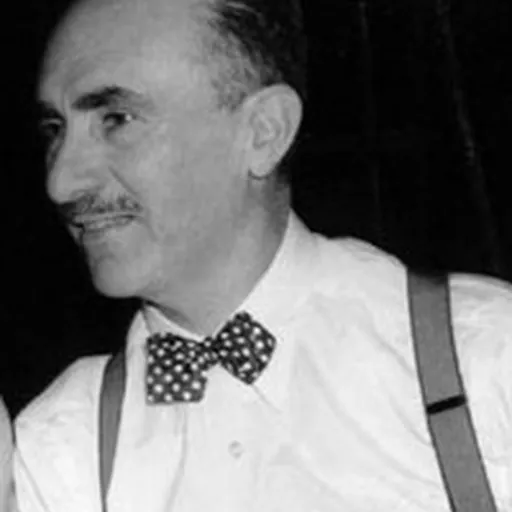
John Alton
American cinematographer of Austrian-Hungarian origin
About John Alton
Lived 1901 – 1996 (aged 94). John Alton was an American cinematographer, film director, screenwriter and film producer.
John Alton (born Johann Jacob Altmann; October 5, 1901 – June 2, 1996) was an American cinematographer of Hungarian-Austrian origin. Alton photographed some of the most famous films noir of the classic period and won an Academy Award for the cinematography of An American in Paris, becoming the first Hungarian-born person to do so in the cinematography category. He also worked as a director during the Golden Age of Argentine cinema. His work has been honored at film festivals in Vienna, Japan, Argentina, Telluride, and San Francisco, as well as in retrospectives at the American Museum of the Moving Image and the Pacific Film Archives. being known for unconventional camera angles—especially low camera shots.
As a cameraman, he preferred meticulously planning shots to effectively convey a film's emotional atmosphere, an approach that became a defining characteristic of his work. He had the strong belief that lighting in a scene must convey meaning and establish mood, rather than merely illuminating the set. In his opinion a studio lighting setup should mirror natural lighting. One of his particular talents was bringing a certain "blackness" into the picture and accentuating some parts with lights of higher intensity. One unusual concept was to achieve depth by placing the brightest light in the background - furthest from the camera. Shooting in Black and White was his preference, because he could "see more in the dark than I could in color,” he said. His style is most notable in the films noir: He Walked by Night (1948), The Amazing Mr. X (1948), Raw Deal (1948) and The Big Combo (1955).
Alton also photographed many color movies including Slightly Scarlet but ended up resigning a second and final time in March 1954 after a personal dispute with the president.
Book
Alton wrote Painting with Light (1949), one of the first books written by a working studio cinematographer. The book put forth several controversial theories for the day, such as depth is created by placing the brightest object in the scene furthest from the camera, and that studio lighting must always simulate natural light in texture and direction. It addresses both conventional and unconventional methods of studio motion-picture lighting. Despite the vast technical advances achieved within the motion picture industry much of the content is still pertinent. Painting with Light (1949) contains essential reading for any budding filmmaker with detailed information and ideas for lighting several difficult interior and exterior setups and situations. The table of contents includes chapters such as "Mystery Lighting", "Special Illumination", and "Visual Symphony", touching on topics like "What is thinking?" and Chinese ideograms. He stepped back into the public eye in 1993, answering questions and attending screenings at film festivals such as the Telluride Film Festival. After his retirement, John Alton remained a passionate reader and also began oil painting, creating over a hundred small canvases which he subsequently gave away.
Death John Alton died June 2, 1996, in Santa Monica, California. He was 94.
Filmography
The Student Prince in Old Heidelberg (1927) The Man Who Murdered (1930) (1930) Los tres berretines (1933) El hijo de papá (1933) Crimen a las tres (1935) Big Calibre (1935) Escala en la ciudad (1935) Puerto Nuevo (1936) Compañeros (1936) Loco lindo (1936) Tararira (1936) Goal (1936) Amalia (1936) El Pobre Pérez (1937) Palermo (1937) La vida bohemia (1938) Honeysuckle (1938) Puerta cerrada (1938) Cadetes de San Martín (1939) El último encuentro (1939) Caminito de Gloria (1939) Puerta cerrada (1939) Doce mujeres (1939) El matrero (1939) Remedy for Riches (1940) Dr. Christian Meets the Women (1940) Three Faces West (1940) The Courageous Dr. Christian (1940) The Devil Pays Off (1941) Forced Landing (1941) Melody for Three (1941) Power Dive (1941) Mr. District Attorney in the Carter Case (1941) The Affairs of Jimmy Valentine (1942) Ice-Capades Revue (1942) Johnny Doughboy (1942) Moonlight Masquerade (1942) Pardon My Stripes (1942) The Sultan's Daughter (1943) She's for Me (1943) The Lady and the Monster (1944) Lake Placid Serenade (1944) Storm Over Lisbon (1944) Enemy of Women (1944) Atlantic City (1944) The Captain from Köpenick (1945) Girls of the Big House (1945) Song of Mexico (1944) Love, Honor and Goodbye (1945) I Was a Criminal (1945) Affairs of Geraldine (1946) A Guy Could Change (1946) The Madonna's Secret (1946) Murder in the Music Hall (1946) One Exciting Week (1946) The Magnificent Rogue (1947) The Ghost Goes Wild (1947) Hit Parade of 1947 (1947) T-Men (1947) The Trespasser (1947) Winter Wonderland (1947) Wyoming (1947) Bury Me Dead (1947) The Pretender (1947) Driftwood (1947) He Walked by Night (1948) Hollow Triumph (1948) The Amazing Mr. X (1948) Canon City (1948) Raw Deal (1948) Border Incident (1949) The Crooked Way (1949) Captain China (1949) Reign of Terror (1949) Red Stallion in the Rockies (1949) Mystery Street (1950) Father of the Bride (1950) Grounds for Marriage (1950) Devil's Doorway (1950) An American in Paris (1951) (ballet photography) The People Against O'Hara (1951) Father's Little Dividend (1951) It's a Big Country (1951) Talk About a Stranger (1952) Washington Story (1952) Apache War Smoke (1952) Count the Hours (1952) Battle Circus (1953) Take the High Ground! (1953) I, the Jury (1953) Cattle Queen of Montana (1954) Silver Lode (1954) Witness to Murder (1954) Duffy of San Quentin (1954) Passion (1954) Tennessee's Partner (1955) The Big Combo (1955) Pearl of the South Pacific (1955) Escape to Burma (1955) The Teahouse of the August Moon (1956) Slightly Scarlet (1956) The Catered Affair (1956) Tea and Sympathy (1956) Designing Woman (1957) The Brothers Karamazov (1958) Lonelyhearts (1958) 12 to the Moon (1960) Elmer Gantry (1960)
Sources:
Accolades Wins Academy Awards: Oscar, Best Cinematography, Color; An American in Paris, shared with: Alfred Gilks; 1951.
Nominations Laurel Awards: Golden Laurel, Top Cinematography, Color, The Brothers Karamazov, 4th place; 1959.
Other honors Los Angeles Film Critics Association Awards: Career Achievement Award; 1992.
Don’t just read it —
keep it.
Full-length biographies made to live with: read them, listen on the way to work, watch them tonight.
- E-book
- Audio
- Video
Instant download · yours to keep · every purchase keeps this site free
Important facts
People in John Alton's life
Named in this biography and alive at the same time







Related people
Same field, nearest in time



Contemporaries
People whose lives overlapped John Alton's

Frequently asked questions
Who was John Alton?
American cinematographer of Austrian-Hungarian origin (1901-1996)
When was John Alton born?
John Alton was born on 5 October 1901 in Sopron.
When did John Alton die?
John Alton died on 2 June 1996 in Santa Monica.
What was John Alton's occupation?
John Alton was a cinematographer, film director, screenwriter and film producer.
What nationality was John Alton?
John Alton was American.
Sources & further reading
Cite this page
APA: Biography.guide. (2026). John Alton. https://biography.guide/john-alton/
MLA: "John Alton." Biography.guide, https://biography.guide/john-alton/.
Chicago: "John Alton." Biography.guide. https://biography.guide/john-alton/.
Data last updated: 2026-09-23 · Spot an error? Report a correction.
Portrait: Wikimedia Commons · author & licence
Page generated 2026-09-27 05:06 UTC