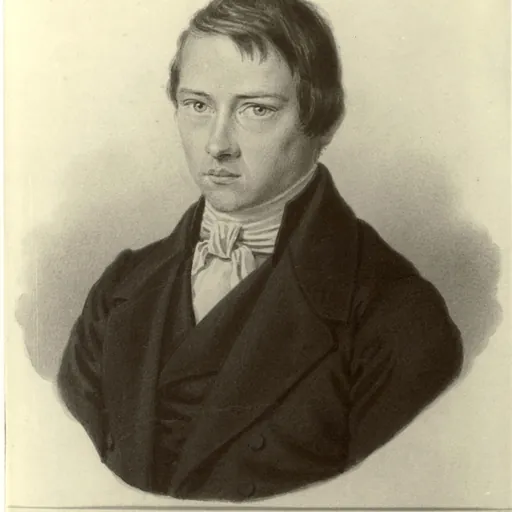
About Johannes Rebmann
Lived 1820 – 1876 (aged 56). Johannes Rebmann was an explorer and missionary.
Johannes Rebmann (January 16, 1820 – October 4, 1876), sometimes anglicised as John Rebman, was a German missionary, linguist, and explorer credited with feats including being the first European, along with his colleague Johann Ludwig Krapf, to enter Africa from the Indian Ocean coast. In addition, he was the first European to find Kilimanjaro. News of Rebmann's discovery was published in the Church Missionary Intelligencer in May 1849, but disregarded as mere fantasy for the next twelve years. The Geographical Society of London held that snow could not possibly occur let alone persist in such latitudes and considered the report to be the hallucination of a malaria-stricken missionary. It was only in 1861 that researchers began their efforts to measure Kilimanjaro. Expeditions to Tanganyika between 1861 and 1865, led by the German Baron Karl Klaus von der Decken, confirmed Rebmann's report. Together with his colleague Johann Ludwig Krapf they were also the first Europeans to visit and report Mount Kenya. Their work there is also thought to have had effects on future African expeditions by Europeans, including the exploits of Sir Richard Burton, John Hanning Speke, and David Livingstone.
Rebmann spent 29 years in East Africa. Much of his work there consisted in linguistic investigations, especially into the Swahili, Mijikenda, and Chichewa languages.
He returned to Germany only in 1875 for the final year of his life, by which time he had become blind. After entering into a brief second marriage, he died of pneumonia.
Early life Rebmann was born to a Swabian farmer and winegrower on January 16, 1820 in Gerlingen, Württemberg. The village he lived in was very small, with about 1,500 inhabitants. Even at an early age, he aspired to be a "preacher and canvasser of the gospel".
Later, when Rebmann became a young man, he chose to devote himself to being a missionary, and was trained in Basel. In 1844 he attended the Church Missionary Society College, Islington. The following year he was ordained as a priest by the Bishop of London and he became a member of the Church Missionary Society. Together with fellow missionary Johann Ludwig Krapf, Rebmann traveled in 1846 by a ship called "Arrow" to East Africa, where he worked in what is now Kenya, as well as at various other locations.
During his time in Africa, Rebmann kept a diary from 1848 until the end of his life. In the diary, Rebmann writes of the way his trust in his Christianity kept him stable in the continent of Africa, where only very few Europeans had ventured before him. An extract from the diary, which Rebmann in turn took from the Bible (Psalm: 51, 12) reflects Rebmann's belief in his faith: "Restore to me joy of your salvation and grant me a willing spirit, to sustain me."
On the October 16, 1847, the two men set out for the interior of Kenya. With them came eight tribesmen and a local caravan leader named Bwana Kheri. This expedition was designed with the goal of establishing some of the first mission posts in the region. The journey was successful, and the group of tribesmen and the missionaries returned to Mombasa on October 27. On November 10, 1848, Rebmann recorded an entry in his log about the mountain:
Also during his time in Africa he learned to speak several native languages, and completed a dictionary (started by his colleague Ludwig Krapf) of the Nika (Mijikenda) language, and a dictionary of Swahili (now lost, but of which some material may have been incorporated into Krapf's Dictionary of the Suaheli Language (1882)). He also translated the Gospel of Luke into Swahili. In addition, after meeting a Swahili-speaking slave known as Salimini, originally from Malawi, in 1853, he compiled the first ever Chichewa language dictionary, which was eventually published in 1877.
Slug map
During their time in Africa, Krapf and Rebmann worked their way into the interior of the continent. They traveled to several areas in the regions of Central and Eastern Africa, including to what is now known as the African Great Lakes. The finding of one especially large lake (Uniamési) is depicted in a map known as the 'Slug' map. It was known by this name because the layout of the water body suggested a shape similar to that of a slug. On the map that he and Rebmann drew, the three lakes of Victoria, Tanganyika and Nyasa are shown as one very large L-shaped lake. thumb leftOn the map, several subtle but interesting things can be discovered, including, in the northeast section of the cartograph, a reference to a stream flowing into Lake Victoria, then known by the missionaries as "the Ukerewa". A note describes how the waters of the stream were very sweet, but stained the teeth a sickly yellow. This note is probably the first known text referring to the drinking water, found primarily around Mount Meru, which has a high content of fluorine and causes a yellow-brown stain to the incisors which cannot be removed. The map is now in the care of the Royal Geographical Society in London. It is described by the Society as: He returned to Germany for the first time in 29 years after being persuaded to do so by a fellow missionary who was working in the area. He then proceeded to take up residence in Korntal near Stuttgart, where he was close to his old friend Krapf. In spring 1876, upon the advice of Krapf, he married the widow of another missionary from India, Louise Rebmann née Däuble. The marriage did not last long, as on October 4, 1876, Rebmann died of pneumonia. Engraved on Rebmann's tombstone in the cemetery of Korntal are the words (in English) "Saved in the arms of Jesus" (a photo can be seen here).
The legacy that he left behind him is preserved by the Johannes Rebmann Foundation, a religious society devoted to Rebmann and his memory. Rebmann's work in Africa, both as a missionary and as an explorer, allowed other Europeans to follow in his footsteps.
Don’t just read it —
keep it.
Full-length biographies made to live with: read them, listen on the way to work, watch them tonight.
- E-book
- Audio
- Video
Instant download · yours to keep · every purchase keeps this site free
Important facts
People in Johannes Rebmann's life
Named in this biography and alive at the same time
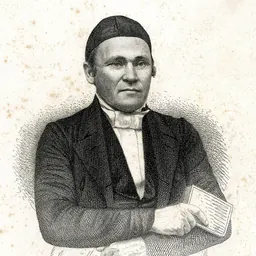

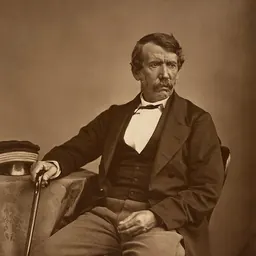
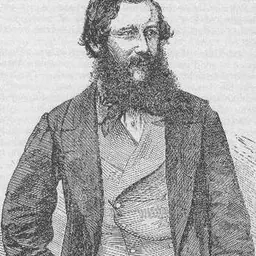
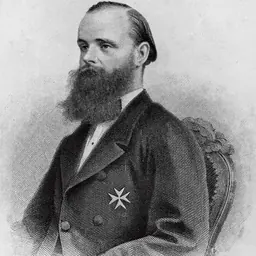
Related people
Same field, nearest in time


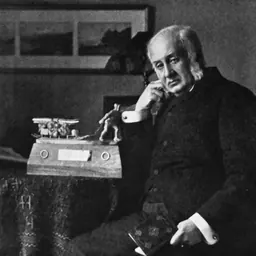
Contemporaries
People whose lives overlapped Johannes Rebmann's





Frequently asked questions
Who was Johannes Rebmann?
German missionary and African explorer (1820-1876)
When was Johannes Rebmann born?
Johannes Rebmann was born on 16 January 1820 in Gerlingen.
When did Johannes Rebmann die?
Johannes Rebmann died on 4 October 1876 in Korntal-Münchingen.
What was Johannes Rebmann's occupation?
Johannes Rebmann was an explorer and missionary.
What nationality was Johannes Rebmann?
Johannes Rebmann's recorded nationality: Kingdom of Württemberg.
Sources & further reading
Cite this page
APA: Biography.guide. (2026). Johannes Rebmann. https://biography.guide/johannes-rebmann/
MLA: "Johannes Rebmann." Biography.guide, https://biography.guide/johannes-rebmann/.
Chicago: "Johannes Rebmann." Biography.guide. https://biography.guide/johannes-rebmann/.
Data last updated: 2026-09-22 · Spot an error? Report a correction.
Portrait: Wikimedia Commons · author & licence
Page generated 2026-09-27 05:00 UTC