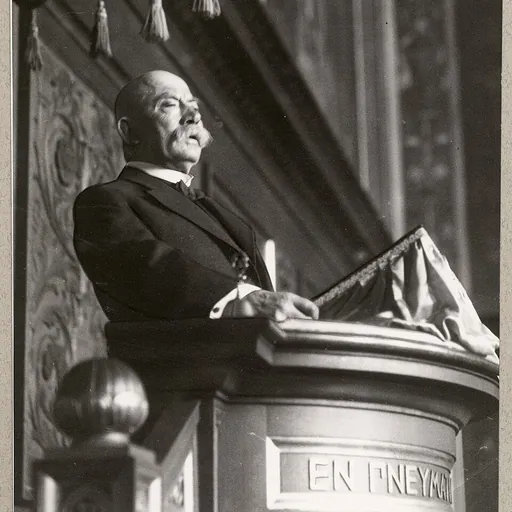
About Johannes Østrup
Lived 1867 – 1938 (aged 70). Johannes Østrup was a Danish philologist, professor, autobiographer and orientalist.
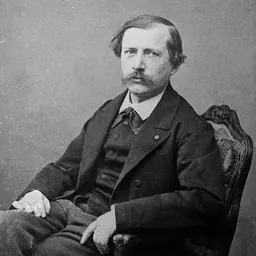
Johannes Elith Østrup (27 July 1867 – 5 May 1938) was a Danish philologist and professor at the University of Copenhagen where he served as rector from 1934 to 1935. In 1893, after a study tour in the Middle East, he rode on horseback back to Copenhagen, crossing much of Asia Minor and continental Europe.
Early life and education Born in Copenhagen, Østrup was the son of farmer Hans Frederik Østrup. In 1890, he matriculated from Copenhagen's Metropolitan School (Metropolitanskolen) in Greek, Latin and Danish. In his own time, he had also read works on Sanskrit by the leading philologists of the day and had studied A.F. van Mehren's literature on Semitic languages. While still a student, in 1889 he published a collection of translations titled Arabiske Sange og Eventyr (Arabic Songs and Fairy Tales). When 24, he became the youngest student ever to receive a doctorate as a result of his Studier over Tusind og en Nat (Studies of A Thousand and One Nights). His travels, including his 60-day return from Istanbul to Copenhagen on horseback in August 1893, are vividly described in his Skiftende Horizonter (Changing Horizons, 1894). The trips represented an important stage in his development, not only as he was able to assimilate modern Turkish language and the Arabic dialects of Egypt and Syria but above all because he became fully adapted to the Middle Eastern way of life, showing special interest in local customs and traditions rather than just in language. He openly admitted he far preferred field trips to library-based research.
Academic career
In 1898, Østrup attempted to obtain van Mehren's professorship at the University of Copenhagen but was unsuccessful, apparently owing to his preference for modern Arabic dialects rather than the traditionally taught classical idiom. He became a lecturer on Semitic language and literature until 1918 when an extraordinary professorship in Islamic culture was created for him. Based on his own travels, he was able to teach the modern spoken dialects of Arabic and Ottoman Turkish. His principal works include Contes de Damas (1897), a collection of Syrian folktales; the first translation directly into Danish of One Thousand and One Nights (Tusind og een Nats Æventyr, 1928) and Arabiens Historie (History of Arabia, 1933).
Heidelberg visit Despite his early elitist orientations, Østrup showed no sympathy for antisemitism or for German national socialism in the 1930s. When on an official visit to Heidelberg in 1936, he refused to give the Nazi salute and avoided speaking German to his hosts. Instead he gave his address in Latin, the traditional language of academics, praising the achievements of the university and commenting on the illustrious Danes who had benefited from its curriculum. Exchanges with his hosts, however, cast some doubt as to how many of them had followed his presentation as they appeared mainly interested in discussing how National Socialism had combated Bolshevism.
Later life Østrup was interested in Arabic coins. He spent several years cataloguing the large collection found in Terslev (Zealand) in 1911. The results were published posthumously in Catalogue des monnaies Arabes et Turques du Cabinet Royal des Médailles du Musée National de Copenhague (1938).
Don’t just read it —
keep it.
Full-length biographies made to live with: read them, listen on the way to work, watch them tonight.
- E-book
- Audio
- Video
Instant download · yours to keep · every purchase keeps this site free
Important facts
Related people
Same field, nearest in time



Contemporaries
People whose lives overlapped Johannes Østrup's



Frequently asked questions
Who was Johannes Østrup?
Danish philologist and professor
When was Johannes Østrup born?
Johannes Østrup was born on 27 July 1867 in Copenhagen.
When did Johannes Østrup die?
Johannes Østrup died on 5 May 1938 in Copenhagen.
What was Johannes Østrup's occupation?
Johannes Østrup was a philologist, professor, autobiographer and orientalist.
What nationality was Johannes Østrup?
Johannes Østrup was Danish.
Sources & further reading
Cite this page
APA: Biography.guide. (2026). Johannes Østrup. https://biography.guide/johannes-ostrup/
MLA: "Johannes Østrup." Biography.guide, https://biography.guide/johannes-ostrup/.
Chicago: "Johannes Østrup." Biography.guide. https://biography.guide/johannes-ostrup/.
Data last updated: 2026-09-21 · Spot an error? Report a correction.
Portrait: Wikimedia Commons · author & licence
Page generated 2026-09-27 05:00 UTC