
Johannes Oecolampadius
German religious reformer
About Johannes Oecolampadius
Lived 1482 – 1531 (aged 48–49). Johannes Oecolampadius was a German university teacher, protestant reformer, humanist, parson, protestant theologian and theologian.
Johannes Oecolampadius (also Œcolampadius, in German also Oekolampadius, Oekolampad; 1482 – 24 November 1531) was a German Protestant reformer in the Reformed tradition from the Electoral Palatinate. He was the leader of the Protestant faction in the Baden Disputation of 1526, and he was one of the founders of Protestant theology, engaging in disputes with Erasmus, Huldrych Zwingli, Martin Luther and Martin Bucer.
His German surname was Hussgen (or Heussgen, Huszgen), which he etymologized to Hausschein ("house-shine") and hellenized (as was the custom at the time) to Οἰκολαμπάδιος (Oikolampádios, from οἶκος oîkos, "house," and λαμπάς lampás, "torch, lamp", and -ιος, -ios, "pertaining to"; this was then Latinised as Oecolampadius).
Early life and education Oecolampadius was born as Johannes Heussgen (variously written as Husschyn, Hussgen, Huszgen or Hausschein) in Weinsberg, then part of the Electorate of the Palatinate. He was the son of Johannes Heussgen, a wealthy burgher of Weinberg, and Anna Pfister, from Basel. Oecolampadius attended a latin school at Heilbronn and studied humanities at Heidelberg from 1499 to 1503.
Oecolampadius died on 24 November 1531.
Theology
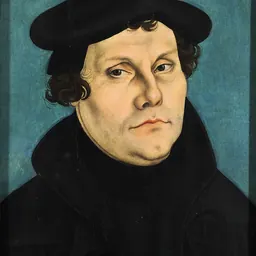
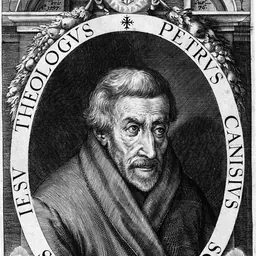
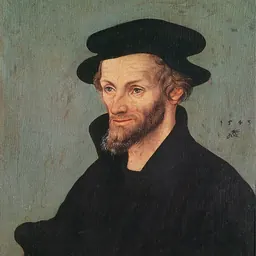
Oecolampadius, a Protestant theologian, conversed with notables such as Johannes Eck and Philipp Melanchthon, and was professor of theology at the University of Basel. As a theologian, he lacked the glamour of Luther, Zwingli and Calvin, but nonetheless became a trusted religious leader. He was respected even among Catholic scholars of his time and was quoted over forty years after his death by the Jesuit St. Peter Canisius in his work De Maria Virgine. With Zwingli he represented the Swiss at the Marburg Colloquy. His views on the Eucharist upheld the metaphorical against the literal interpretation of the word "body," but he asserted that believers partook of the sacrament more for the sake of others than for their own, though later he emphasized it as a means of grace for the Christian life. To Luther's doctrine of the ubiquity of Christ's body he opposed that of the presence and activity of the Holy Spirit in the church. His views on the Eucharist prompted Luther to publish several sermons on the subject in his 1526 The Sacrament of the Body and Blood of Christ—Against the Fanatics. He did not minutely analyse the doctrine of predestination as Luther, Calvin and Zwingli did, contenting himself with the summary "Our Salvation is of God, our perdition of ourselves."
Theologically he was considered to be close to Zwingli, with whom he shared a friendly attitude towards Mary and Marian veneration. He is considered an example of Protestant Marian piety of his time, largely in light of his sermons. He calls Mary the mediatrix or mediator (Mittlerin) of all graces, to whom the Lord had entrusted the treasure of Grace Thesaurus gratiarum. Oecolampadius borrowed from Radulfus Ardens (d. 1200) and others the image of Mary as the neck who mediates all graces of Christ (the Head) to his mystical body, the church. This view was defended in the 20th century by Gabriel Roschini, and more generally, by Pope Pius XII in his encyclical Mystici corporis as official doctrine of the Catholic Church.
In De laudando in Maria Deo given in Augsburg in 1521, he states that God cannot be praised more in any creature than through Mary. His gifts and graces are expressed in her. God honoured her by becoming human through her. Mary surpassed Abraham with her faith, Isaac with her patience and Joseph with her chastity. She is queen of all heavenly powers. Yet, according to Oecolampadius, Catholic veneration of Mary went too far, because of the numerous titles given to Mary: they surpass in number and content the veneration of Christ himself. The rosary is cited as an example with its 150 Hail Marys and only ten prayers to God. He is also critical of popular customs, by which every Saturday is solemnly observed in her honour, with abstinence from wine and sexual relations, while the following Lord’s day is characterized by heavy drinking and varied entertainments. Throughout his life, Oecolampadius preached the perpetual virginity of Mary, who through her life and her works gave a shining example of Christian virtues. Mary’s life was a life of service and compassion as documented in her visit to Elizabeth.
Don’t just read it —
keep it.
Full-length biographies made to live with: read them, listen on the way to work, watch them tonight.
- E-book
- Audio
- Video
Instant download · yours to keep · every purchase keeps this site free
Important facts
more
Joannes Oecolampadius, Johannes OekolampadPeople in Johannes Oecolampadius's life
Named in this biography and alive at the same time



Related people
Same field, nearest in time


Contemporaries
People whose lives overlapped Johannes Oecolampadius's


Frequently asked questions
Who was Johannes Oecolampadius?
German religious reformer (1482-1531)
When was Johannes Oecolampadius born?
Johannes Oecolampadius was born in 1482 in Weinsberg.
When did Johannes Oecolampadius die?
Johannes Oecolampadius died on 24 November 1531 in Basel.
What was Johannes Oecolampadius's occupation?
Johannes Oecolampadius was a university teacher, protestant reformer, humanist, parson, protestant theologian and theologian.
What nationality was Johannes Oecolampadius?
Johannes Oecolampadius was German.
Sources & further reading
· Wikipedia: Johannes Oecolampadius
· DBpedia: Johannes Oecolampadius
Cite this page
APA: Biography.guide. (2026). Johannes Oecolampadius. https://biography.guide/johannes-oecolampadius/
MLA: "Johannes Oecolampadius." Biography.guide, https://biography.guide/johannes-oecolampadius/.
Chicago: "Johannes Oecolampadius." Biography.guide. https://biography.guide/johannes-oecolampadius/.
Data last updated: 2026-09-20 · Spot an error? Report a correction.
Page generated 2026-09-27 05:22 UTC