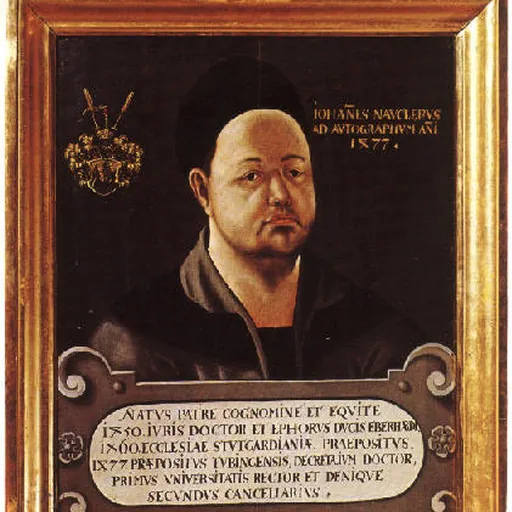
About Johannes Nauclerus
Lived 1425 – 1510 (aged 84–85). Johannes Nauclerus was a German historian, university teacher, theologian, jurist, humanist and cleric.
Johannes Nauclerus (Naucler, Naukler) ( 1425 – May 1, 1510) was a 16th-century Swabian historian and humanist. He was born Johann Vergenhans to a noble (or knighted) man of the same name. As was the fashion of the time, the family's name had been Latinized, with nauclerus, meaning "skipper," being a close translation of Vergenhans, meaning "ferryman." The family's coat of arms depicted a man on a sailing ship.
Nauclerus became a doctor of law in 1450 and supervisor to Count Eberhard V of Württemberg. In 1460, he was head of the church in Stuttgart. He seems to have spent some time in Italy, and had contact with Pope Pius II. From 1464 to 1465 he taught at the University of Basel, and in 1466 he was in Rome.
In 1477 he became first rector at the University of Tübingen and subsequently its second chancellor.
In 1502, Nauclerus assumed the office of a judge of the Swabian League, which he held until his death.
Work He is the author of the World Chronicle (Memorabilium omnis aetatis et omnium gentium chronici commentarii, 1516), printed posthumously, with its foreword written by Johann Reuchlin. The work chronicled the centuries from the time of Adam to the year 1500. This work did not follow the traditional temporal divisions of "ages" (aetates) and "realms" (regna), but adhered to a division based on generations.
Written in Latin and on the suggestion of Maximilian I, Holy Roman Emperor, it described Biblical events, such as the building of the Tower of Babel, as well as events from Greek mythology, such as the Trojan War. Also included were historical events such as the burning of Girolamo Savonarola in Florence (1498).
Nauclerus consulted an unusually large number of different sources (such as an account by Eilmer of Malmesbury), indicating that he was already committed to the new spirit of humanism. Some of the sources he consulted no longer exist; their contents are only known through Nauclerus' work.
This work was known to Ortelius through Franciscus Irenicus. Erasmus also wrote a laudatory foreword.
Other works include his Tractatus de symonia perutilis (Tübingen, 1500).
Legacy Nauklerstraße ("Naukler Street"), in Tübingen, is named after him.
Don’t just read it —
keep it.
Full-length biographies made to live with: read them, listen on the way to work, watch them tonight.
- E-book
- Audio
- Video
Instant download · yours to keep · every purchase keeps this site free
Important facts
People in Johannes Nauclerus's life
Named in this biography and alive at the same time



Related people
Same field, nearest in time



Contemporaries
People whose lives overlapped Johannes Nauclerus's


Frequently asked questions
Who was Johannes Nauclerus?
German historian (died 1510)
When was Johannes Nauclerus born?
Johannes Nauclerus was born in 1425 in Swabia.
When did Johannes Nauclerus die?
Johannes Nauclerus died on 5 January 1510 in Tübingen.
What was Johannes Nauclerus's occupation?
Johannes Nauclerus was a historian, university teacher, theologian, jurist, humanist and cleric.
What nationality was Johannes Nauclerus?
Johannes Nauclerus was German.
Sources & further reading
· Wikipedia: Johannes Nauclerus
Cite this page
APA: Biography.guide. (2026). Johannes Nauclerus. https://biography.guide/johannes-nauclerus/
MLA: "Johannes Nauclerus." Biography.guide, https://biography.guide/johannes-nauclerus/.
Chicago: "Johannes Nauclerus." Biography.guide. https://biography.guide/johannes-nauclerus/.
Data last updated: 2026-09-23 · Spot an error? Report a correction.
Portrait: Wikimedia Commons · author & licence
Page generated 2026-09-27 05:07 UTC