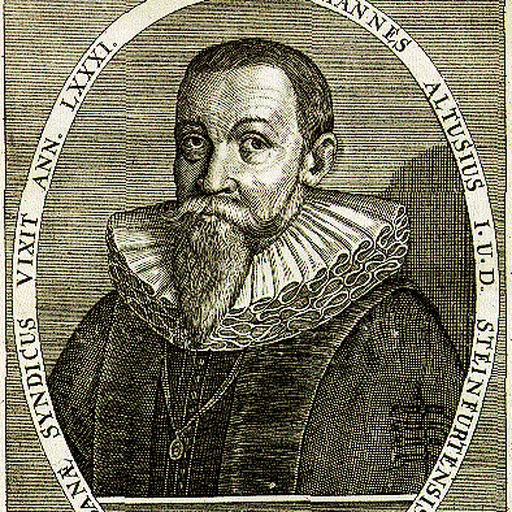
Johannes Althusius
German–Dutch jurist and Calvinist political philosopher and father of modern federalism
About Johannes Althusius
Lived 1557 – 1638 (aged 80–81). Johannes Althusius was a jurist, theologian, writer, philosopher, university teacher and politician.
Johannes Althusius (1563 – August 12, 1638) was a German–Dutch jurist and Calvinist political philosopher In 1586, Althusius received his doctorate in civil and canon law from the University of Basel. While studying at Basel, Althusius lived with Johannes Grynaeus for a period of time, with whom he studied theology. . In 1599 he was appointed president of the Nassau College in its temporary location in Siegen, returning with it to Herborn in 1602.
In 1617 Althusius published his principal judicial work, Dicaeologicae. In this work, he categorized laws into two main types: natural laws and positive laws, and argued that natural law is "the will of God for men." Althusius contended that terms such as "common law" and "moral law" were other names for natural law. To know the true dictates of natural law, he argued, we must carefully study Scripture and tradition, as well as revelation and reason.
Johannes Althusius died on August 12, 1638, in Emden. Interest in Althusius' theories continued into the second half of the 17th century, but Althusius was forgotten once the European wars of religion had ended.
Althusius had published in Latin using fashionable Ramist logic. As time passed, his political canon was read less and the barriers to interpreting Althusian politics increased. In the second half of the 19th century Althusius was rediscovered when Otto von Gierke published research on Politica. In Germany, an academic society was founded to research Althusius and his times. At a time when Otto von Bismarck worked towards unifying Germany Gierke promoted Althusius' preoccupation with political order based on majority decisions, traditional European relationships, and negotiated agreements as a timely theory on procedural federalism. In 1871 most German states unified to form the German Empire under Bismarck's imperial constitution. Gierke's book on Althusian federalism went on to become a source of inspiration for pluralism in Britain, with John Neville Figgis and Harold Laski adapting Gierke.
In 1932 the German–American professor Carl Joachim Friedrich published a new, slightly abridged edition of Althusius' Politica. After World War II Friedrich helped to draft the German constitution, the Basic Law for the Federal Republic of Germany, while working as adviser in Allied-occupied Germany. Friedrich praised Althusius for having written the first "full-bodied concept of federalism" and so generated renewed interest in Althusius on both sides of the Atlantic. In 1964 Frederick Smith Carney published an abridged English translation of Politica, exposing Althusius to a wider readership. In 1968 Althusisus was credited as "the real father of modern federalism" by Daniel J. Elazar.
Althusian federalism Johannes Althusius saw confederations as feasible and successful cooperative constitutional orders. In his view, a confederation could be built on successive levels of political community where each community pursues common interests. A village was a union of families, a town was a union of guilds, a province was a union of towns, a state was a union of provinces, and an empire was a union of states. Althusius' understanding of society as a community of communities informed his views on the nature of politics and federalism (consociatio symbiotica). For Althusius the purpose of politics was the "science of those matters which pertain to the living together" and federations perfectly put the purpose of politics into practice. Althusius's federalism did not involve the surrendering of power, instead it rested on responsibly sharing power.
Althusius became one of the principal European thinkers on federalism at the start of the 17th century while the European continent was ravaged by religious wars. Against the backdrop of the Reformation and the rise of absolutist monarchies, Althusius identified the German Holy Roman Empire as a commonwealth where the majority could decide matters for all. In reference to Aristotle, Althusius examined the confederate institutions of the Holy Roman Empire and established a theory of federalism where power is shared among autonomous smaller and larger political communities. In 1603 Althusius published Politica Methodice Digesta, setting out his theory on building a federal political system out of political associations that were grounded in the free initiative of citizens.
Althusius relied on the neo-Platonian idea of a universal brotherhood, thus he combined the Greco-Roman ideal of an association that was governed by reciprocal relationships with the Catholic Christian principle of subsidiarity. Althusius' teachings presented an alternative to the theories of his contemporary Jean Bodin on sovereignty. According to Althusus, natural law gave citizens the right to resist tyrannical government and sovereignty rested with the community, not the ruler. Therefore Althusius maintained that legitimate political authority was founded on smaller communities.
Major works Civilis conversationis libri duo, 1601 Politica, the first edition of which was completed in 1603, is considered not only the most fully developed scheme of Calvinist political theory, but also the only systematic justification of the Dutch Revolt. Althusius took from thinkers in various fields, including Aristotle, Calvin, Bodin, Machiavelli, Grotius, and Peter Ramus; Politica cited close to 200 books in all; the first edition of Politica was received with wide acclaim in Emden and in the Netherlands beyond. It may have been influential on American via Alexander Henderson. Dicaeologica libri tres, totum et universum Jus, Frankfurt, 1618. Sections of this work have been translated into English and published by Christian's Library Press as On Law and Power (2013).
Selected Bibliography
Primary Works
Republished Latin version of the complete Politica. The first part (Tomo I) is an Italian translation.
Translations of Works Full Translations Introduction by Corrado Malandrino.
Abridged or Partial Translations (German, English, Spanish) Also issued London, 1965. Abridged English translation of Politica; translated by Frederick Smith Carney with a preface by Carl J. Friedrich. Abridged English translation of Politica (trans. Frederick S. Carney; preface by Daniel J. Elazar).
Abridged German translation of Politica; includes an Althusius biography and literature survey. Shorter German translation of Politica. Spanish translation (1990), based on the 1932 abridged Latin edition, with introduction and critical remarks by Primitivo Mariño and presentation by Antonio Truyol y Serra.
Commentaries (First published in the series Untersuchungen zur deutschen Staats- und Rechtsgeschichte, Heft VII; subsequently reprinted.) English translation of Gierke's German work.
Two-volume bibliography on Althusius.
Poetry
Research Literature In English
In German
Conference proceedings (18–19 September 1988), Steinfurter Schriften, 17.
Volume 131 of Beiträge zur politischen Wissenschaft. Conference proceedings.
Conference proceedings of the Johannes‑Althusius‑Gesellschaft.
In French
In Italian
In Korean — [A Study of Johannes Althusius' Theory of State and Law]. Includes a German summary "Ein Studium Über die Staats- und Rechtslehre des Johannes Althusius" (pp. 189–191).
Don’t just read it —
keep it.
Full-length biographies made to live with: read them, listen on the way to work, watch them tonight.
- E-book
- Audio
- Video
Instant download · yours to keep · every purchase keeps this site free
Important facts
People in Johannes Althusius's life
Named in this biography and alive at the same time


Related people
Same field, nearest in time


Contemporaries
People whose lives overlapped Johannes Althusius's



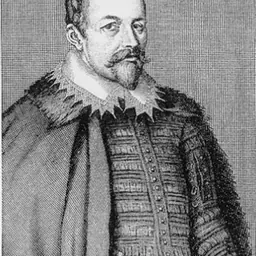
Frequently asked questions
Who was Johannes Althusius?
German–Dutch jurist and Calvinist political philosopher and father of modern federalism (1563-1638)
When was Johannes Althusius born?
Johannes Althusius was born in 1557 in Diedenshausen.
When did Johannes Althusius die?
Johannes Althusius died on 12 August 1638 in Emden.
What was Johannes Althusius's occupation?
Johannes Althusius was a jurist, theologian, writer, philosopher, university teacher and politician.
What nationality was Johannes Althusius?
Johannes Althusius's recorded nationality: Sayn-Wittgenstein-Berleburg.
Sources & further reading
· Wikipedia: Johannes Althusius
Cite this page
APA: Biography.guide. (2026). Johannes Althusius. https://biography.guide/johannes-althusius/
MLA: "Johannes Althusius." Biography.guide, https://biography.guide/johannes-althusius/.
Chicago: "Johannes Althusius." Biography.guide. https://biography.guide/johannes-althusius/.
Data last updated: 2026-09-22 · Spot an error? Report a correction.
Portrait: Wikimedia Commons · author & licence
Page generated 2026-09-27 05:04 UTC