
Johann Wenzel
German blacksmith
About Johann Wenzel
Lived 1902 – 1969 (aged 66). Johann Wenzel was a German blacksmith.
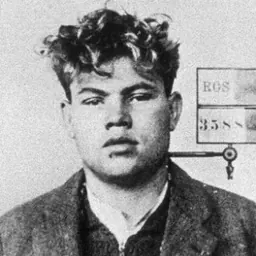
Johann Wenzel (9 March 1902, Nidowo, Nowy Staw – 2 February 1969, Berlin) was a German Communist, highly professional GRU agent and radio operator of the espionage group that was later called the Red Orchestra by the Abwehr in Belgium and the Netherlands. His aliases were Professor, Charles, Bergmann, Hans, and Hermann. Wenzel was most notable as the person who exposed the Red Orchestra after his transmissions were discovered by the Funkabwehr, later leading to his capture by the Gestapo on 29–30 June 1942.
Life Wenzel came from a working-class family and was the son of a farmer.
Career
In 1929–30, Wenzel travelled to Moscow to take a military-political course as a Kursant, under the pseudonym Horst, that was run by the AM Apparat of the Communist International (Comintern). When Wenzel returned, he worked as a full-time instructor for communist military issues in Hamburg, Bremen, Essen, Düsseldorf, and Cologne using the pseudonym Hermann, for the next several years.
In the summer of 1933, Wenzel travelled to the Netherlands with Theodor Bottländer, an official of the AM Apparat department of the Central Committee of the KPD, to obtain information on Marinus van der Lubbe, who was in Berlin and who was among those accused of setting the Reichstag fire. In 1939, he became a technical advisor on WT procedures and codes to Anatoly Gurevich and trained a number of WT operators in the Low Countries. Wenzel was a technical advisor to Konstantin Jeffremov, who was a Soviet agent who ran a separate network in the Netherlands.
From December 1940 to July 1942, Wenzel transmitted intelligence by WT to the Soviet Union. that had formed a triangulation azimuth, the Funkabwehr were able to identify an illegal radio transmission that came from the home of Wenzel at his Brussels home at 12 Rue de Namur. along with some men, including policemen and Luftwaffe personnel, sealed off the street in Laeken, in Brussels.
During the search of the apartment, it was found that Wenzel had left a series of coded messages and two messages written in German that were waiting to be enciphered. In Belgium, Soviet intelligence was likely given an early warning when Germaine Schneider informed Trepper of the raid at 12 Rue de Namur in July 1942.
Escape Over several months, the Sonderkommando guards at Rue de l'Aurore became lulled into a false sense of security and either on the 17 or 18 November 1942, Wenzel managed to escape, when they failed to lock an outside door. Wenzel noticed this, fled and locked the door behind him and managed to get away.
Don’t just read it —
keep it.
Full-length biographies made to live with: read them, listen on the way to work, watch them tonight.
- E-book
- Audio
- Video
Instant download · yours to keep · every purchase keeps this site free
Important facts
People in Johann Wenzel's life
Named in this biography and alive at the same time



Related people
Same field, nearest in time





Contemporaries
People whose lives overlapped Johann Wenzel's


Frequently asked questions
Who was Johann Wenzel?
German blacksmith (1902–1969)
When was Johann Wenzel born?
Johann Wenzel was born on 9 March 1902.
When did Johann Wenzel die?
Johann Wenzel died on 2 February 1969 in Berlin.
What was Johann Wenzel's occupation?
Johann Wenzel was a blacksmith.
What nationality was Johann Wenzel?
Johann Wenzel was German.
Sources & further reading
Cite this page
APA: Biography.guide. (2026). Johann Wenzel. https://biography.guide/johann-wenzel/
MLA: "Johann Wenzel." Biography.guide, https://biography.guide/johann-wenzel/.
Chicago: "Johann Wenzel." Biography.guide. https://biography.guide/johann-wenzel/.
Data last updated: 2026-09-20 · Spot an error? Report a correction.
Page generated 2026-09-27 05:06 UTC