
About Johann Schreck
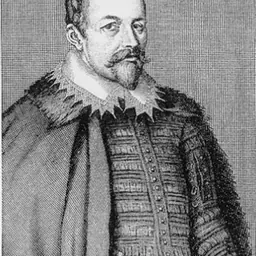
Lived 1576 – 1630 (aged 53–54). Johann Schreck was a German physician, naturalist, botanist, astronomer and translator.
Johann(es) Schreck, also Terrenz or Terrentius Constantiensis, Deng Yuhan Hanpo (鄧玉函), Deng Zhen Lohan (1576, Bingen, Baden-Württemberg or Constance – 11 May 1630, Beijing) was a German Jesuit, missionary to China and polymath. He is credited with the development of scientific-technical terminology in Chinese.
Early life
Schreck studied medicine starting in 1590 at the Albert Ludwigs University of Freiburg, the University of Altdorf. After graduating, he is also known to have worked as an assistant to the mathematician François Viète in Paris in around 1600. After Viète's death in 1603, he moved to the University of Padua, where he was a student of Galileo Galilei, but studied medicine.
Schreck had an exceptional facility with languages; he spoke German, Italian, Portuguese, French and English. Like most educated men of his time, he wrote his letters in Latin. He also mastered Ancient Greek, Hebrew and Biblical Aramaic. Later in his life, he learned Chinese. Trigault met Schreck in Rome in 1614, while Schreck was studying theology, and persuaded him to go to China. To raise money and equipment for their mission, they travelled around Europe in 1616, soliciting donations and collecting books, mechanical equipment and scientific instruments. One of their donors was Cardinal Federico Borromeo of Milan, who gave them what was to be the first western telescope in China.
In April 1618, Schreck sailed from Lisbon with a group of Jesuits Trigault had assembled, including Giacomo Rho and Johann Adam Schall von Bell. After several pirate attacks and outbreaks of disease Schreck arrived at Goa in October 1618. He continued on his way, collecting samples of flora and fauna wherever he stopped en route; Giulio Aleni later claimed that alone he had discovered more than five hundred new plants. His plan was to produce a compendium with the title Plinius Indicus (The Indian Pliny), similar to Hernandez's volume on Mexico. He worked on this project throughout his stay in China, and expanded it to include descriptions of more than 8,000 varieties of plant, but his early death meant it was never finished. His manuscripts were preserved, perhaps into the eighteenth century, in the collections of the Portuguese College in Beijing, but are now lost.
Early work in China Schreck reached Macau on 22 July 1619 during a period towards the end of the reign of the Ming Emperor Wanli, when Jesuits had been expelled from Beijing and Nanjing. He, therefore, spent nearly two years in Macau learning Chinese before continuing to Hangzhou in June 1621. There, probably in collaboration with a Christian convert named Li Zhizao, he wrote Taixi renshen shuogai (An Outline of Western Theories of the Human Body), based on Theatrum anatomicum by Caspar Bauhin. This work described the human body, the senses and language, including an outline of Matteo Ricci's famous memory palace. The book was edited by another convert, Bi Gongchen, and published after Schreck's death.
After reaching Beijing in late 1623 Schreck began collaborating closely with a judge and military inspector from Shaanxi named Wang Zheng. In 1627 the two of them published the Diagrams and Explanations of the Wonderful Machines of the Far West. and enclosing a copy of his new Rudolphine Tables. In advance of the solar eclipse of 21 June 1629 over Beijing, Schreck and Nicolò Longobardo competed with Chinese astronomers to predict the timing with the greatest accuracy. The Jesuits' calculations were more accurate, and on this basis, the Emperor Chongzhen asked them to undertake a revision of the Chinese calendar.
Schreck also produced plans for building astronomical instruments, which were approved by the Emperor. However he died shortly afterwards, and the project was completed by Johann Adam Schall von Bell and Giacomo Rho. Schall also published a manuscript by Schreck containing much of his knowledge of astronomy and related mathematics, called Ce tian yue shuo (; Brief Description of the Measurement of the Heavens). This describes the basics of astronomy, the movements of heavenly bodies, the working of the telescope, and sunspots, although the existence of these had been known in China for some time. Schall likewise revised and published two works by Schreck on trigonometry, Da ce (; The Great Measurement) and Ge-yuan ba-xian biao (; A Table of Eight Lines), the latter together with Rho.
Death Schreck is said to have died as a result of a medical experiment on himself. He is buried in the Zhalan Cemetery in Beijing.
Don’t just read it —
keep it.
Full-length biographies made to live with: read them, listen on the way to work, watch them tonight.
- E-book
- Audio
- Video
Instant download · yours to keep · every purchase keeps this site free
Important facts
People in Johann Schreck's life
Named in this biography and alive at the same time


Related people
Same field, nearest in time




Contemporaries
People whose lives overlapped Johann Schreck's



Frequently asked questions
Who was Johann Schreck?
German missionary active in China (1576-1630)
When was Johann Schreck born?
Johann Schreck was born in 1576 in Bingen.
When did Johann Schreck die?
Johann Schreck died on 11 May 1630 in Beijing.
What was Johann Schreck's occupation?
Johann Schreck was a physician, naturalist, botanist, astronomer and translator.
What nationality was Johann Schreck?
Johann Schreck was German.
Sources & further reading
Cite this page
APA: Biography.guide. (2026). Johann Schreck. https://biography.guide/johann-schreck/
MLA: "Johann Schreck." Biography.guide, https://biography.guide/johann-schreck/.
Chicago: "Johann Schreck." Biography.guide. https://biography.guide/johann-schreck/.
Data last updated: 2026-09-20 · Spot an error? Report a correction.
Page generated 2026-09-27 05:03 UTC