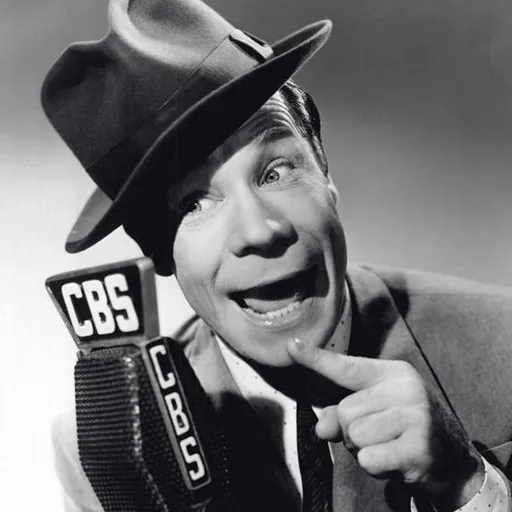
About Joe E. Brown
Lived 1891 – 1973 (aged 81). Joe E. Brown was an American stage actor, film actor, television actor, actor, comedian and baseball player.
Early life Brown was born on July 28, 1891 in Holgate, Ohio, near Toledo, into a large family of Welsh descent. He spent most of his childhood in Toledo. In 1902, at the age of ten, he joined a troupe of circus tumblers known as the Five Marvelous Ashtons, who toured the country on both the circus and vaudeville circuits. Later, he became a professional baseball player. Despite his skill, he declined an opportunity to sign with the New York Yankees to pursue his career as an entertainer. After three seasons, he returned to the circus, then went into vaudeville and finally starred on Broadway. He gradually added comedy to his act, and transformed himself into a comedian. He moved to Broadway in the 1920s, first appearing in the musical comedy Jim Jam Jems.
Film career
In late 1928, Brown began making silent films and early sound films for various companies, but scored his biggest successes with Warner Bros., which offered him a seven-year contract. He quickly became a favorite with family audiences,
In the mid-1930s Joe E. Brown's films had become established commodities, and the studio began to economize on their production. By this time the Brown comedies were merely "program pictures"—something to fill out a moviehouse program—instead of the major-motion-picture status they formerly enjoyed. Brown's high-salary contract had become too expensive for Warner Bros. to sustain. The writing was already on the wall in mid-1936, when a magazine reported that "Joe E. Brown is making his next-to-last picture for Warner Brothers. This one is called “Earthworm Tractors”." The next and last Brown feature for Warner was Polo Joe (1936). By November trade publisher Pete Harrison cautioned exhibitors that "Joe E. Brown [is] not in the employ of this company for the 1936-37 season."
Brown had already prepared for his imminent departure. In April 1936 he signed with independent producer David L. Loew for a series of comedies. This was front-page news in the trade: "Brown goes over to Loew about August, or perhaps slightly later this year. The producing alliance between Loew and the comic runs for a period of two years and calls for the production of three features a year. Distribution through RKO is assumed to preclude a deal now in negotiation", Motion Picture Daily observed, "and was seen as merely one in a series of outside deals to come." That's exactly what happened: the six Loew-Brown features were ultimately handled in turn by three different studios: RKO, Columbia, and MGM.
Joe E. Brown left Loew in 1938 when his two-year contract lapsed. While his brand of broad comedy was still popular, it was somewhat old-fashioned, much like the slapstick efforts of Laurel and Hardy. As a result, Brown was now being handed "B" pictures for Paramount (one film), Columbia (three films), and finally Republic (four films). The Republics were his last starring vehicles. From this point on, Brown continued in films but in guest appearances and character roles.
Radio Beginning in 1938 Brown had a comedy-variety radio show, The Joe E. Brown Show, on the CBS network. The September 21, 1939 episode was captured in the 1939 WJSV broadcast day recordings. In 1944, on the Blue Network (soon to become ABC Radio), he hosted Stop Or Go, a radio quiz show aimed at servicemen.
World War II
In 1939, Brown testified before the House Immigration Committee in support of a bill that would allow 20,000 German-Jewish refugee children into the U.S. He later adopted two refugee children.
At age 50 when the U.S. entered World War II, Brown was too old to enlist. Both of his biological sons served in the military during the war. In 1942, Captain Don E. Brown was killed when his Douglas A-20 Havoc crashed near Palm Springs, California.
Even before the USO was organized, Brown spent a great deal of time traveling, at his own expense, to entertain troops in the South Pacific, including Guadalcanal, New Zealand, and Australia, as well as the Caribbean and Alaska. He was the first to tour in this way, before Bob Hope made similar journeys. Brown also spent many nights working and meeting servicemen at the Hollywood Canteen.
Brown became known for touring in the role of Elwood P. Dowd, the lead in Mary Chase's Harvey:The comic said that sometime during the run of Harvey at Elitch, he’ll have invoked the character of the lovable Elwood for the 2,000th time. This means that he’ll have played the part more than any other living person as well as performed it in more countries than anyone. “I’ve performed it in Australia, Canada, England, and Hawaii,” said Brown. “I took over the part in the New York company when Frank Fay, the originator, gave it up, and played it seven months before it went on the road. In 1948, he was awarded a Special Tony Award for his work in the touring company of Harvey. In 1951 he starred as the main character, the widower Samuel Rilling, in the William Roos, Jack Lawrence, and Don Walker Broadway musical Courtin' Time.
In 1954, Brown appeared in Milestones of Motoring, a made-for-television industrial musical produced by Cinécraft Productions, with Merv Griffin and Rita Farrell.
He had a cameo in Around the World in 80 Days (1956), as the Fort Kearney stationmaster talking to Fogg (David Niven) and his entourage in a small town in Nebraska. In the similarly epic film It's a Mad, Mad, Mad, Mad World (1963), he had a cameo as a union official giving a speech at a construction site in the climactic scene. On television, he was the mystery guest on What's My Line? during the episode of January 11, 1953.
His best known postwar role was that of aging millionaire Osgood Fielding III in Billy Wilder's 1959 comedy Some Like It Hot. Fielding falls for Daphne (Jerry), played by Jack Lemmon in drag; at the end of the film, Lemmon takes off his wig and reveals to Brown that he is a man, to which Brown responds "Well, nobody's perfect," one of the more celebrated punchlines in film.
Another of his notable postwar roles was that of Cap'n Andy Hawks in MGM's 1951 remake of Show Boat, a role that he reprised onstage in the 1961 New York City Center revival of the musical and on tour. Brown performed several dance routines in the film, and famed choreographer Gower Champion appeared along with first wife Marge. Brown's final film appearance was in The Comedy of Terrors (1964).
Other activities
Brown was a sports enthusiast, on and off the screen. He has a place in Boston's sports history. On April 14, 1925, radio station WBZ (AM) broadcast a local Major League baseball game for the first time. The Boston Braves played against the New York Giants, a game that the Braves won 5–4. The radio announcer for that day was Joe E. Brown. Brown was a devoted baseball fan, and some sportswriters who had seen him when he was a semi-pro player still believed he could have become a successful major-league player one day. In April 1925, he was in the Boston area, starring in a stage performance of "Betty Lee" at Boston's Majestic Theater. Brown knew several of the Boston sportswriters, especially sports cartoonist Abe Savrann ("SAV") of the Boston Traveler. Brown was a member of the Benevolent and Protective Order of Elks, and so was Savrann, who brought him in as a guest speaker at the mid-April 1925 meeting of the Cambridge, Massachusetts Elks Lodge. Savrann noted in his Traveler cartoon on April 15, 1925 (p. 20) that Brown had been the game announcer that day. And the radio critic for the New Britain (CT) Daily Herald wrote that "It is too bad that Joe E. Brown, who announced the game yesterday, could not fill that place during the entire season," noting that Brown not only described the game well but also offered amusing and interesting anecdotes in the process.
While there is no information that he did any further radio play-by-play announcing, he did return to the broadcast booth in television, in 1953. He served as a commentator for the New York Yankees games on WPIX-TV, replacing Joe DiMaggio. His TV duties included a 15-minute pre-game show and a 10-minute post-game show throughout the season. At the end of the season, he was replaced by Red Barber.
Brown befriended many ballplayers over the years. He spent Ty Cobb's last days with him, discussing Cobb's life and times.
Brown's son Joe L. Brown shared his father's love of baseball, serving as general manager of the Pittsburgh Pirates from 1955 to 1976, and briefly in 1985, also building the 1960 and 1971 World Series champions. Joe L. Brown's '71 Pirates featured baseball's first starting lineup consisting of only Black and Latino players.
Joe E. Brown's enthusiasm for baseball also led to his becoming the first president of PONY Baseball and Softball (at the time named Pony League) when the organization was incorporated in 1953. He continued in the post until late 1964, when he retired. Later he traveled additional thousands of miles telling the story of PONY League, hoping to interest adults in organizing baseball programs for young people. He was a fan of thoroughbred horse racing, a regular at the racetracks in Del Mar and Santa Anita.
Brown was also an aviation enthusiast. Zack Mosley, creator of the comic strip The Adventures of Smilin' Jack, tributed Brown with the fictional lookalike character Flannelmouth Don; an air show announcer who did not need a microphone to be heard over the roar of multiple plane engines. The character appeared in the strip from the mid-1940s until the mid 1950s.
In popular culture Brown was caricatured in the Disney cartoons Mickey's Gala Premiere (1933), Mother Goose Goes Hollywood (1938), and The Autograph Hound (1939); all contain a scene in which he is seen laughing so loud that his mouth opens extremely wide. Daws Butler used Joe E. Brown as inspiration for the voices of two Hanna-Barbera cartoon characters: Lippy the Lion (1962) and Peter Potamus (19631966).
He also starred in his own comic strip in the British comic Film Fun for a 20-year run, beginning in 1933.
Later life and family Brown married Kathryn Francis McGraw in 1915. The marriage lasted until his death in 1973. The couple had four children: two sons, Don Evan Brown (December 25, 1916 October 8, 1942; captain in the United States Army Air Force, who was killed in the crash of an A-20B Havoc bomber while serving as a ferry pilot) and Joe LeRoy "Joe L." Brown (September 1, 1918 August 15, 2010), and two daughters, Mary Katherine Ann (b. 1930) and Kathryn Francis (b. 1934). Both daughters were adopted as infants.
Brown was a Freemason. He became a member of Rubicon Lodge in Toledo in 1915.
In November 1961, a brush fire destroyed his home, including all the memorabilia from his career.
Death and legacy
Brown began having heart problems in 1968 after suffering a severe heart attack, and underwent cardiac surgery. He died from complications from arteriosclerosis on July 6, 1973 at his home in Brentwood, California. He is interred at Forest Lawn Memorial Park in Glendale, California.
For his contributions to the film industry, Brown was inducted into the Hollywood Walk of Fame in 1960 with a motion pictures star located at 1680 Vine Street.
In 1961, Bowling Green State University renamed the theatre in which Brown appeared in Harvey in the 1950s as the Joe E. Brown Theatre. It closed in 2011.
Holgate, Ohio, his birthplace, has a street named Joe E. Brown Avenue. Toledo, Ohio, has a city park named Joe E. Brown Park at 150 West Oakland Street.
Rose Naftalin's popular 1975 cookbook includes a cookie named the Joe E. Brown. Brown was a frequent customer of Naftalin's Toledo restaurant.
Filmography
Crooks Can't Win (1928) as Jimmy Wells Hit of the Show (1928) as Twisty The Circus Kid (1928) as King Kruger Take Me Home (1928) as Bunny Molly and Me (1929) as Jim Wilson My Lady's Past (1929) as Sam Young On with the Show! (1929) as Joe Beaton Painted Faces (1929) as Hermann / Beppo Sally (1929) as Grand Duke Constantine of Czechoslovenia Song of the West (1930) as Hasty Hold Everything (1930) as Gink Schiner Top Speed (1930) as Elmer Peters Maybe It's Love (1930) as Yates The Lottery Bride (1930) as Hoke Going Wild (1930) as Rollo Smith Sit Tight (1931) as Jojo Broadminded (1931) as Ossie Simpson Local Boy Makes Good (1931) as John Augustus Miller Fireman, Save My Child (1932) as Joe Grant The Tenderfoot (1932) as Calvin Jones You Said a Mouthful (1932) as Joe Holt Elmer, the Great (1933) as Elmer Son of a Sailor (1933) as 'Handsome' Callahan A Very Honorable Guy (1934) as 'Feet' Samuels The Circus Clown (1934) as Happy Howard 6 Day Bike Rider (1934) as Wilfred Simpson Alibi Ike (1935) as Frank X. Farrell Bright Lights (1935) as Joe Wilson A Midsummer Night's Dream (1935) as Flute, the Bellows-Mender Sons o' Guns (1936) as Jimmy Canfield Earthworm Tractors (1936) as Alexander Botts Polo Joe (1936) as Joe Bolton When's Your Birthday? (1937) as Dustin Willoughby Riding on Air (1937) as Elmer Lane Fit for a King (1937) as Virgil Ambrose Jeremiah Christopher 'Scoop' Jones Wide Open Faces (1938) as Wilbur Meeks The Gladiator (1938) as Hugo Kipp Flirting with Fate (1938) as Dan Dixon $1000 a Touchdown (1939) as Marlowe Mansfield Booth Beware Spooks! (1939) as Roy L. Gifford So You Won't Talk (1940) as Whiskers / 'Brute' Hanson Shut My Big Mouth (1942) as Wellington Holmes Joan of Ozark (1942) as Cliff Little Daring Young Man (1942) as Jonathan Peckinpaw / Grandma Peckinpaw Chatterbox (1943) as Rex Vane Casanova in Burlesque (1944) as Joseph M. Kelly Jr. Pin Up Girl (1944) as Eddie Hall Hollywood Canteen (1944) as Joe E. Brown The Tender Years (1948) as Rev. Will Norris Show Boat (1951) as Cap'n Andy Hawks Around the World in 80 Days (1956) as the Fort Kearney stationmaster Some Like It Hot (1959) as Osgood Fielding III It's a Mad, Mad, Mad, Mad World (1963) as the union official giving a speech at a construction site The Comedy of Terrors (1964) as the Cemetery Keeper
Television roles The Buick Circus Hour, episode "Premiere Show" (1952) as The Clown The Eddie Cantor Comedy Theatre, episode "The Practical Joker" (1955) Schlitz Playhouse, episode "Meet Mr. Justice" (1955) The Christophers, episodes "Washington as a Young Man" (1955) and "Basis of Law and Order" (1964) (final appearance) Screen Directors Playhouse, episode "The Silent Partner" (1955) as Arthur Vail The People's Choice, episode "Sox and the Proxy Marriage (1956) as Charles Hollister General Electric Theater, episode "The Golden Key" (1956) as Earl Hall G.E. Summer Originals, episode "Country Store" (1956) as Joe Brown (unsold pilot for The Joe E. Brown Show) The Ann Sothern Show, episode "Olive's Dream Man" (1960) as Mitchell Carson Westinghouse Preview Theatre, episode "Five's a Family" (1961) as Harry Canover Route 66, episode "Journey to Nineveh" (1962) as Sam Butler The Greatest Show on Earth, episode "You're All Right, Ivy" (1964) as Diamond "Dimey" Vine
Books published Your Kids and Mine (1944) Your Kids and Mine was published as an Armed Services Edition during World War II. Laughter Is a Wonderful Thing (1956)
Don’t just read it —
keep it.
Full-length biographies made to live with: read them, listen on the way to work, watch them tonight.
- E-book
- Audio
- Video
Instant download · yours to keep · every purchase keeps this site free
Important facts
Family & relationships
People in Joe E. Brown's life
Named in this biography and alive at the same time





Related people
Same field, nearest in time


Contemporaries
People whose lives overlapped Joe E. Brown's


Frequently asked questions
Who was Joe E. Brown?
American actor (1891–1973)
When was Joe E. Brown born?
Joe E. Brown was born on 28 July 1891 in Holgate.
When did Joe E. Brown die?
Joe E. Brown died on 6 July 1973 in Brentwood.
What was Joe E. Brown's occupation?
Joe E. Brown was a stage actor, film actor, television actor, actor, comedian and baseball player.
What nationality was Joe E. Brown?
Joe E. Brown was American.
Sources & further reading
Cite this page
APA: Biography.guide. (2026). Joe E. Brown. https://biography.guide/joe-e-brown/
MLA: "Joe E. Brown." Biography.guide, https://biography.guide/joe-e-brown/.
Chicago: "Joe E. Brown." Biography.guide. https://biography.guide/joe-e-brown/.
Data last updated: 2026-09-23 · Spot an error? Report a correction.
Portrait: Wikimedia Commons · author & licence
Page generated 2026-09-27 05:08 UTC