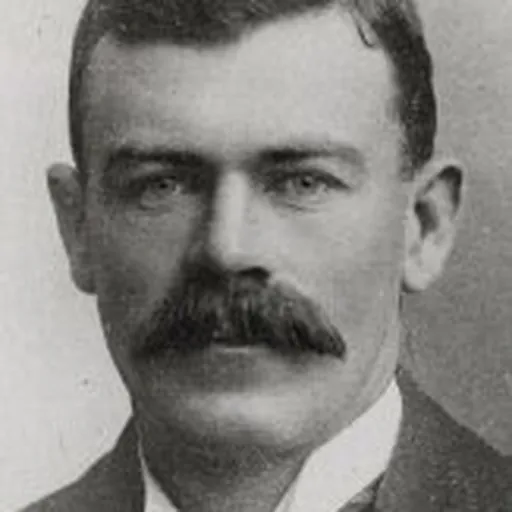
About Joe Darling
Lived 1870 – 1946 (aged 75). Joe Darling was an Australian cricketer, farmer and politician.
Test career
Consolidation
The First Test of 1894–95 against England, at the Sydney Cricket Ground, saw Darling make his Test debut. In an innings where Australia make 586 runs, including centuries for George Giffen and Syd Gregory, Darling was dismissed for a golden duck, bowled first ball by Tom Richardson. He made 53 runs in the second innings of his maiden Test. He played in all five Tests in the series, scoring 258 runs at an average of 28.66 per innings. He was included in the Australian team to tour England in 1896, where he topped the scoring aggregates for the tour with 1555 runs at an average of 29.90, including three centuries. Wisden Cricketers' Almanack stated that Darling "proved himself perhaps the best of present-day left-handed batsmen" during the tour. England won the series two Tests to one. Darling started the season poorly, scoring a duck and one against the tourists for South Australia in a match in which teammate Clem Hill scored a double century. Darling went on, however, to dominate the series with the bat. His maiden Test century, 101 in the First Test at the Sydney Cricket Ground after Australia was made to follow-on, was the first made by a left-hander in Tests.
In the Third Test in his home town of Adelaide, Darling scored 178 runs and Australia won the match by an innings and 13 runs. He reached his century by hitting Johnny Briggs over the eastern gate and into the nearby park. This is the only time in Ashes Tests where a player has reached 100 with a hit out of the ground. Returning to Sydney for the Fifth and final Test, Darling scored 160 runs from 253 scored in total. He batted for 165 minutes, hitting 30 boundaries as Australia successfully chased 273 in the fourth innings. His first 100 came in 91 minutes; at the time, the fastest Test century scored. The only Test to reach a decisive result was the Second Test at Lord's, where Australia won by ten wickets due in part to centuries by Hill and Victor Trumper and a ten wicket haul by fast bowler Ernie Jones. Aside from Hill, Darling was seen by Wisden as the best batsman among the Australians. Wisden claimed, "Up to a certain point the responsibilities of captaincy seemed to tell against Darling, but during the last weeks of the tour he played marvellous cricket." Over the tour, he scored 1941 runs at an average of 41.29, topping both the averages and the aggregate for his team, and was named as one of the Wisden Cricketers of the Year.
Darling's deeds as a cricketer had reconciled his father to his sporting endeavours, but not to his sports store operation. In 1900, his father purchased "Stonehenge", a sheep station covering in central Tasmania and ordered Darling to run the property on pain of exclusion from his will. Darling complied with his father's wishes and moved his family to the remote station, along a dirt track from the nearest town, tiny Oatlands.
It was not until December 1901 that Darling was convinced to return by the Melbourne Cricket Club to captain the Australians against the touring English for the first three Tests only. The English, captained by Archie MacLaren, won the First Test in Sydney convincingly by an innings and 124 runs. The Second Test in Melbourne was played on a rain-affected pitch. MacLaren won the toss and sent Australia in to bat on the "sticky wicket". Within three hours, both teams had been dismissed; Australia holding a lead on the first innings of 51 runs. when stumps was called. Twenty five wickets fell in the day's play. Importantly, Australia had a 99-run lead and batsmen of the calibre of Hill, Trumper, Reggie Duff and Warwick Armstrong still to bat. The next day, on a perfect pitch, the Australian batsmen established a match-winning lead, eventually winning the Test by 229 runs. Hugh Trumble captained the final two Tests as Darling returned to his farm. Australia won both Tests and the series to retain The Ashes.
Return to cricket Darling agreed to once again lead the Australian cricket team in England in 1902. In what was a very cold and wet summer, the Australian team won a close fought series against the strong English team two Tests to one. Given the strength of the opposition, this Australian team is often referred to as one of the best Australian teams ever assembled.
The First Test at Edgbaston finished in a draw. Rain saved the Australians after they were dismissed for only 36 in their first innings; Wilfred Rhodes took seven wickets for only 17 runs. Rain again ruined the Second Test at Lord's when the final two days were washed out. The Third Test, the only Test match played at Bramall Lane, saw Australia win by 143 runs due in part to a century by Hill and Noble taking 5/51. Darling was dismissed twice by Barnes without scoring, the first Test captain to make a "pair". Australia won the Fourth Test at Old Trafford by three runs; Trumble took ten wickets for the match. The last batsman, Fred Tate, came in with England needing eight runs to secure victory. Darling brought the field in and Trumble prevented Rhodes scoring from the last three balls of his over. This left Tate to face Jack Saunders, who dismissed him with the fourth ball of his over to win the match for Australia. Chasing 263, England were 5/48 when Gilbert Jessop scored a century in 75 minutes to help England to victory.
The star for the Australians was Trumper who scored 2,570 runs, easily beating Darling's own record for a colonial batsman in an English season set in 1899. At Old Trafford in the Fourth Test, he made 73 out of 105 in less than ninety minutes. His innings included thirteen boundaries, all but one of them being drives. Despite his efforts, England still won the Test by an innings and 80 runs.
After losing six tosses against his English opposite number Stanley Jackson during the summer, Darling decided on a different approach before the Scarborough Festival match late in the tour. At the toss, he approached Jackson stripped to the waist and suggested, in fun, a wrestle for choice of innings. In club cricket in Adelaide, Joe scored heavily. He averaged 144 for East Torrens Cricket Club in 1899–1900, 98.66 for Adelaide Cricket Club in 1896–97 and 86.20 for Sturt Cricket Club in 1904–05.
Outside cricket
Following his retirement from big cricket, Darling returned to his Tasmanian sheep station, where he was involved in a range of agricultural activities. He pioneered measures to eradicate rabbits, an introduced pest then in plague proportions throughout Australia. In Parliament, one of his colleagues was Charles Eady, his teammate from the 1896 tour of England.
Darling married Alice Minna Blanche Francis, a wheat farmer's daughter from Mundoora, South Australia in 1893.
Darling had a strong personality and an independent outlook. Those who knew him well thought him destined to be a leader in whatever he undertook. He shunned strong drink and tobacco and found it difficult to tolerate overindulgence in alcohol. Normally even-tempered, he did show displeasure at the heckling from the crowd at Lord's at his obstinate defensive effort in the face of an Australian batting collapse. As a captain he was a reformer, suggesting rule changes that included making six runs the reward for clearing the boundary rather than the entire ground, and using of sawdust to fill holes in bowler's run-ups.
Don’t just read it —
keep it.
Full-length biographies made to live with: read them, listen on the way to work, watch them tonight.
- E-book
- Audio
- Video
Instant download · yours to keep · every purchase keeps this site free
Important facts
People in Joe Darling's life
Named in this biography and alive at the same time




Related people
Same field, nearest in time



Contemporaries
People whose lives overlapped Joe Darling's



Frequently asked questions
Who was Joe Darling?
Australian cricketer (1870-1946)
When was Joe Darling born?
Joe Darling was born on 21 November 1870 in Glen Osmond.
When did Joe Darling die?
Joe Darling died on 2 January 1946 in Hobart.
What was Joe Darling's occupation?
Joe Darling was a cricketer, farmer and politician.
What nationality was Joe Darling?
Joe Darling was Australian.
Sources & further reading
Cite this page
APA: Biography.guide. (2026). Joe Darling. https://biography.guide/joe-darling/
MLA: "Joe Darling." Biography.guide, https://biography.guide/joe-darling/.
Chicago: "Joe Darling." Biography.guide. https://biography.guide/joe-darling/.
Data last updated: 2026-09-23 · Spot an error? Report a correction.
Portrait: Wikimedia Commons · author & licence
Page generated 2026-09-27 05:06 UTC