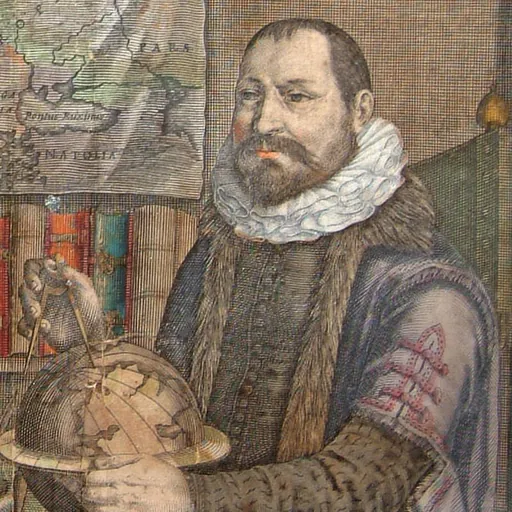
Jodocus Hondius I
Flemish-Dutch engraver and cartographer
About Jodocus Hondius I
Lived 1563 – 1612 (aged 48). Jodocus Hondius I was a Dutch cartographer, printmaker, publisher, instrument maker, astronomer and printer.
Jodocus Hondius (Latinised version of his Dutch name: Joost de Hondt) (17 October 1563 – 12 February 1612) was a Flemish engraver and cartographer. He is sometimes called Jodocus Hondius the Elder to distinguish him from his son Jodocus Hondius II. Hondius is best known for his early maps of the New World and Europe, for re-establishing the reputation of the work of Gerardus Mercator, and for his portraits of Francis Drake. He inherited and republished the plates of Mercator, thus reviving his legacy, also making sure to include independent revisions to his work. One of the notable figures in the Golden Age of Dutch cartography (c. 1570s–1670s), he helped establish Amsterdam as the centre of cartography in Europe in the 17th century.
Biography
Early life and training Jodocus Hondius was born in Wakken in the County of Flanders (now Belgium), the son of Olivier de Hondt and Petronella van Havertuyn.
He was raised in Ghent and trained there as an engraver, developing the drawing skills that supported his later work. By the early 1580s he was working as an engraver and also producing scientific instruments and globes.
In 1584 he left Flanders for London with his sister Jacomina to escape religious difficulties. In 1587 in the Dutch Church of London, he married cartographer Colette van den Keere, the daughter of the engraver Hendrik van den Keere. He also worked with her brother Pieter van den Keere, a mapmaker and engraver.
Work in England While in England, Hondius was instrumental in publicising the work of Francis Drake, who had made a circumnavigation of the world in the late 1570s. In particular, in 1589 Hondius produced a now famous map of the bay of New Albion at Drake's Cove, where Drake briefly established a settlement on the west coast of North America.
Hondius is also thought to be the artist of several well-known portraits of Drake that are now in the National Portrait Gallery in London. Also Hondius had engraved charts in the Mariners Mirrour (1588) and the gores for the first English globes, those of Emery Molyneux completed in 1592.
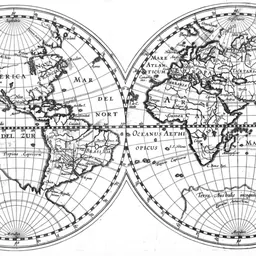
Mercator/Hondius series In 1604 Hondius acquired the copperplates of Gerardus Mercator's Atlas from Mercator's heirs and prepared a revised edition in Amsterdam. The new atlas, published in 1606, retained the 107 maps that had appeared in Mercator's 1595 edition but added 37 newly engraved maps produced by Hondius and other cartographers. Several of these new maps were engraved by Hondius himself.
Through these additions Hondius expanded the geographic scope of the work. The atlas included new regional maps of Africa, Asia, and the Americas, as well as additional maps of European regions. Hondius also introduced four new continent maps while retaining the earlier continent maps from Mercator's atlas.
Hondius's new edition of Mercator's work was a great success, selling out after a year. Hondius later published a second edition, as well as a pocket version Atlas Minor. The maps have since become known as the "Mercator/Hondius series".
After Hondius's death in 1612 the atlas continued to be published by his sons and later in partnership with his son-in-law Jan Janssonius.
Hondius used copper plates to print John Speed's atlas The Theatre of the Empire of Great Britaine, which was published in 1611/2.
End of life and legacy Hondius died, aged 48 (1612), in Amsterdam. After his death, his publishing work in Amsterdam was continued by his widow, two sons, Jodocus II and Henricus, and son-in-law Jan Janssonius, whose name appears on the Atlas as co-publisher after 1633. His grandson Jodocus III would also follow in his family's footsteps.
Eventually, starting with the first 1606 edition in Latin, about 50 editions of the Atlas were released in the main European languages. In the Islamic world, the atlas was partially translated by the Turkish scholar Kâtip Çelebi. The series is sometimes called the "Mercator/Hondius/Janssonius" series because of Janssonius's later contributions.
Portrayal of globes in Vermeer's paintings
Scholars have argued that the globes depicted in celebrated 17th-century painter Johannes Vermeer's 1668 The Astronomer and 1669 The Geographer were based on a pair of globes by Hondius. Close inspection of these two globes reveals striking similarities to a pair of globes made in 1618 by Hondius. The globes were made as pendants, one depicting the earth while the other depicted the constellations. In Vermeer's The Astronomer the scholar consults a version of Hondius' celestial globe and in The Geographer Hondius' terrestrial globe can be seen placed atop the back cabinet. A version of Hondius' celestial globe can be found in the Scheepvaartmuseum in Amsterdam, and the terrestrial globe can be found in the Hispanic Society Museum & Library in New York City.
Honours The Hondius Inlet in Antarctica is named after Jodocus Hondius. 457248 Hondius, a 3.2 km main-belt asteroid discovered by Vincenzo Silvano Casulli was named in his honour. The Dutch expedition cruise ship MV Hondius is also named after him.
Don’t just read it —
keep it.
Full-length biographies made to live with: read them, listen on the way to work, watch them tonight.
- E-book
- Audio
- Video
Instant download · yours to keep · every purchase keeps this site free
Important facts
more
Jodocus, the elder Hondius, Jodocus de Hondt, Joost de Hondt, Jodoso Hondio, Jodocus Hondius sr., Iodocus Hondius, Jodocus HondiusPeople in Jodocus Hondius I's life
Named in this biography and alive at the same time






Related people
Same field, nearest in time

Contemporaries
People whose lives overlapped Jodocus Hondius I's



Frequently asked questions
Who was Jodocus Hondius I?
Flemish-Dutch engraver and cartographer (1563–1612)
When was Jodocus Hondius I born?
Jodocus Hondius I was born on 17 October 1563 in Wakken.
When did Jodocus Hondius I die?
Jodocus Hondius I died on 12 February 1612 in Amsterdam.
What was Jodocus Hondius I's occupation?
Jodocus Hondius I was a cartographer, printmaker, publisher, instrument maker, astronomer and printer.
What nationality was Jodocus Hondius I?
Jodocus Hondius I was Dutch.
Sources & further reading
· Wikipedia: Jodocus Hondius I
Cite this page
APA: Biography.guide. (2026). Jodocus Hondius I. https://biography.guide/jodocus-hondius-i/
MLA: "Jodocus Hondius I." Biography.guide, https://biography.guide/jodocus-hondius-i/.
Chicago: "Jodocus Hondius I." Biography.guide. https://biography.guide/jodocus-hondius-i/.
Data last updated: 2026-09-23 · Spot an error? Report a correction.
Portrait: Wikimedia Commons · author & licence
Page generated 2026-09-27 05:05 UTC