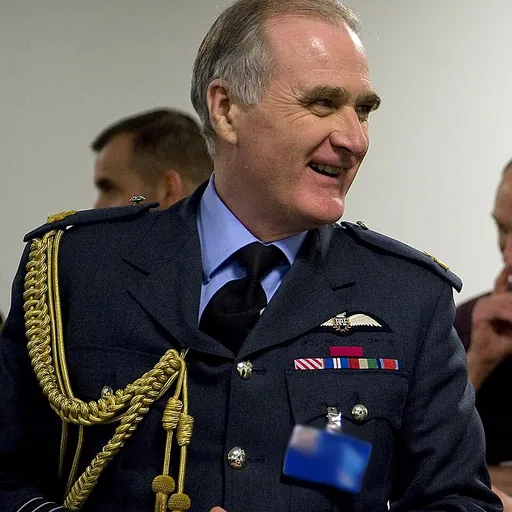
Jock Stirrup
Retired senior Royal Air Force commander and now a Crossbench member of the House of Lords. (born 1949)
About Jock Stirrup
Born 1949. Jock Stirrup is a British politician and military officer.
Marshal of the Royal Air Force Graham Eric Stirrup, Baron Stirrup (born 4 December 1949), informally known as Jock Stirrup, is a former senior Royal Air Force commander who was the Chief of the Defence Staff from 2006 until his retirement in late 2010. He is now a Crossbench member of the House of Lords. In April 2013, he was appointed a Knight Companion of the Order of the Garter by Queen Elizabeth II.
As a junior RAF officer, Stirrup was a jet pilot, and saw action in the Dhofar War. Later in his career, he commanded No. 2 Squadron and RAF Marham. After several senior air force appointments, Stirrup was made the Deputy Commander-in-Chief of Strike Command and during this time he served as the first commander of British forces engaged in fighting the Taliban. In 2002, Stirrup was appointed the Deputy Chief of the Defence Staff responsible for equipment and capability and was heavily involved in procuring equipment for the invasion of Iraq. Spending a little over a year in that role, he was then appointed the Chief of the Air Staff, in which capacity he served from 2003 to 2006. He became Chief of the Defence Staff in 2006: during his time in office the British Armed Forces faced significant commitments both to Iraq (Operation Telic) and Afghanistan (Operation Herrick). Stirrup retired as Chief of the Defence Staff on 29 October 2010, taking a seat in the House of Lords in 2011.
Early and personal life Graham Eric Stirrup was born on 4 December 1949, the son of William Hamilton Stirrup and his wife, Jacqueline Brenda Stirrup (née Coulson). He was educated at Merchant Taylors' School in Northwood, Hertfordshire.
RAF career Stirrup started his military career at the RAF College Cranwell in Lincolnshire on 1 April 1968 and it was from Cranwell that he received his commission on 31 July 1970. He was promoted to flying officer on 31 July 1971 with seniority backdated to 31 January, and to flight lieutenant from 31 July 1973. From 1973 to 1975, Stirrup was on loan service with the Sultan of Oman's Air Force.
In Oman, Stirrup flew BAC Strikemasters during the Dhofar War in the close air support and interdiction roles, giving him valuable battle experience of the use of air power in counter-insurgency operations. After he returned to the United Kingdom in 1975, Stirrup was posted to No. 41 Squadron where he flew the SEPECAT Jaguar in the fighter reconnaissance role.
Promoted to squadron leader on 1 January 1980, Stirrup was serving as a flight commander on No. 226 Operational Conversion Unit which was based at RAF Lossiemouth in March 1983: his duties centred around the instruction of trainee pilots on the SEPECAT Jaguar and, on 7 March 1983, Stirrup was carrying out a student progress check from the rear seat of his aircraft when they suffered a serious bird strike. Stirrup was unable to ascertain whether his student was conscious and forward vision through the canopy was obscured: one of his engines caught fire, and although ejecting from the aircraft would have been justified, not knowing whether the student was conscious or not, Stirrup managed to land at RAF Leuchars. In 1985 Stirrup received a command appointment, as the Officer Commanding No. 2 Squadron which at that time was operating the Jaguar from RAF Laarbruch in West Germany: along with other NATO air units, his squadron's role was low-level tactical reconnaissance in the face of the Soviet Cold War threat. from 1990 to 1992, Stirrup served as Station Commander of RAF Marham and during his time in command, RAF Marham's strike aircraft were dispatched to the Middle East, seeing action in the Gulf War air campaign. and appointed Director of Air Force Plans and Programmes that year. he became Air Officer Commanding No. 1 Group in April 1997, Assistant Chief of the Air Staff in August 1998 and, having been promoted to air marshal on 6 November 2000, he was made Deputy Commander-in-Chief RAF Strike Command that year. At MacDill Air Force Base, Stirrup headed the 60 strong British team who were contributing to the US-led operational planning. Stirrup was replaced by Lieutenant General Cedric Delves.
Stirrup was promoted to air chief marshal and appointed Chief of the Air Staff on 1 August 2003.
Chief of the Defence Staff Stirrup was appointed Chief of the Defence Staff – just when the British Armed Forces were facing significant commitments both to Iraq (Operation Telic) and Afghanistan (Operation Herrick) – on 28 April 2006. By early September all British troops had been withdrawn from Basra city to the airport to perform what was dubbed an "overwatch" role.
After British troops had been withdrawn from Basra city, violence continued and General Mohan took some time to produce a plan for improving security. Notwithstanding the difficulties, the Basra Governorate was handed over to Provincial Iraqi Control in December 2007. By early March 2008, General Mohan had produced a security plan with British support which was presented to General Petraeus and Prime Minister Maliki in Baghdad. The plan called for a six-week period of disarmament, demobilisation and reintegration starting in June 2008 before forcibly disarming the Mahdi Army and other non-Government/Coalition forces afterwards. Later in March Stirrup was in Baghdad and he met with General Petraeus and General Austin, the commander of the Multi-National Corps – Iraq. Stirrup strongly backed Mohan's plan but noted that Mohan would need to be pressed hard to deliver and also supported with Corps forces. Austin was reluctant to provide support, wishing to focus on Mosul, but Petraeus agreed with Stirrup. However, this plan was overtaken by Maliki's decision to launch Operation Charge of the Knights. Both Stirrup and the American commanders were taken by surprise and were concerned about the lack of planning but Maliki was determined to launch his operation in late March.
After the conclusion of Operation Charge of the Knights the British were involved in helping to rebuild those Iraq Army units which had suffered from poor cohesion, or even dissolved. In hindsight, Stirrup took the view that the British forces would have been usefully employed in mentoring the Iraq Army to greater extent earlier in the campaign.
Operations in Afghanistan Stirrup at an ISAF Regional Command South meeting in Istanbul, Turkey. After his appointment as CDS, Stirrup travelled to Helmand Province in May 2006. At that stage, the British effort consisted of a small tented base at Camp Bastion, an operating base at Lashkar Gah and several isolated platoon houses in the north of Helmand. Much of the rest of the Province was not under British or other ISAF control. At that time the insurgency was starting to gain strength and although by 2009 the British Armed Forces and the United States Marine Corps had greatly expanded their role and were providing security for over 50% of Helmand, speaking in 2009 Stirrup conceded that in some areas security had worsened. While, highlighting the inadequate force levels provided by NATO and the competing demands on Coalition political and military resources that Iraq had posed until 2008, Stirrup believed that by 2009 NATO forces were successfully taking the fight to the insurgents, driving them out of towns and villages and thereby allowing governance to improve which would lead to the defeat of the insurgency.
Speaking generally on operations in Afghanistan, Stirrup has noted that whilst "the military is a key, an essential element in dealing with those problems, but by and large these problems can only be resolved politically" and that he favoured a pragmatic approach to dealing with former members of the Taliban. By December 2009, Stirrup was expressing his concern about falling levels of public support for the war in Afghanistan which he believed risked undermining the British effort. In particular Stirrup called for a spirit of resolution and stated that the mission was achievable, noting that the British Armed Forces had finally now got a properly resourced plan to achieve the strategic aim.
Extended term of office and retirement On 14 July 2010, the Defence Secretary Liam Fox announced that General Sir David Richards, the then Chief of the General Staff, would succeed Stirrup as Chief of the Defence Staff in October 2010. Richards took over on 29 October 2010 and Stirrup was created a life peer as Baron Stirrup, of Marylebone in the City of Westminster. He was introduced into the House of Lords on 1 February 2011, where he sits as a crossbencher. Stirrup officially retired from the RAF on 4 April 2011. The following month Stirrup gave detailed evidence to the Commons Defence Select Committee on the UK's recent Strategic Defence and Security Review.
In April 2013, Stirrup was appointed Knight Companion of the Order of the Garter by the Queen Elizabeth II. He was appointed as an honorary Marshal of the Royal Air Force in the Queen's 2014 Birthday Honours.
Activities as a peer
In 2013 Stirrup, along with Field Marshal Lord Guthrie and Admiral of the Fleet Lord Boyce, called upon the British Government to derogate from the European Convention on Human Rights for the duration of deployed operations. They were concerned that the increased risk of prosecution faced by commanders would lead to a generation of risk-averse military leaders. In August 2014, Stirrup was one of 200 public figures who were signatories to a letter to The Guardian opposing Scottish independence in the run-up to September's referendum on that issue. In June 2015 Stirrup joined the House of Lords' EU External Affairs Sub-Committee. From October 2015 Stirrup has been the president of the Pilgrims Society.
On Remembrance Sunday 2014, it was announced that Stirrup would lead the efforts to raise one million pounds to enable a national memorial to the British service personnel who fought in Iraq and Afghanistan to be erected in central London. By March 2015 Stirrup was confident that the full amount needed could be raised and by July 2016 work had begun on the memorial in the Victoria Embankment Gardens. The Iraq and Afghanistan Memorial was unveiled in March 2017.
In July 2016, Stirrup gave an interview to Sky News in which he accused Russia of running a "gangster regime" and a "gangster foreign policy" in regard to their ongoing Ukrainian intervention. Noting that the Kremlin viewed NATO as weak, Stirrup called for the West to develop a long-term strategy to counter Russia's actions. In particular Stirrup urged that NATO countries spend more on defence.
Stirrup carried the Sword of State in the procession for the 2019 State opening of Parliament.
Honorary appointments Stirrup has held the following honorary appointments: Honorary Colonel 73 Engineer Regiment (Volunteers) (1 April 2002 – 1 June 2008) Doctor of Science from Cranfield University
adopted = coronet = Coronet of a Baron crest = A peregrine falcon Or, holding in the dexter claw a winged stirrup Azure. torse = Mantling Or and Azure. helm = escutcheon = Azure a bend Or between two stirrups Argent winged Or. supporters = On either side a Peregrine Falcon supporting with the interior foot a Caduceus erect Or. motto =HONOR PRAEMIUM VIRTUTIS (Honour is the reward of virtue) orders =The Order of the Garter circlet.The collar as Grand Cross Knight of the Order of the Bath (Appointed CB 2000, KCB 2002 & GCB 2005)Air Force Cross other_elements = banner = The banner of the Baron's arms used as Knight Companion of the Garter depicted at St George's Chapel. badge = symbolism = previous_versions =
Don’t just read it —
keep it.
Full-length biographies made to live with: read them, listen on the way to work, watch them tonight.
- E-book
- Audio
- Video
Instant download · yours to keep · every purchase keeps this site free
Important facts
People in Jock Stirrup's life
Named in this biography and alive at the same time



Related people
Same field, nearest in time






Contemporaries
People whose lives overlapped Jock Stirrup's

Frequently asked questions
Who is Jock Stirrup?
Retired senior Royal Air Force commander and now a Crossbench member of the House of Lords. (born 1949)
When was Jock Stirrup born?
Jock Stirrup was born on 4 December 1949 in Paddington.
What is Jock Stirrup's occupation?
Jock Stirrup is a politician and military officer.
What nationality is Jock Stirrup?
Jock Stirrup is British.
Sources & further reading
Cite this page
APA: Biography.guide. (2026). Jock Stirrup. https://biography.guide/jock-stirrup/
MLA: "Jock Stirrup." Biography.guide, https://biography.guide/jock-stirrup/.
Chicago: "Jock Stirrup." Biography.guide. https://biography.guide/jock-stirrup/.
Data last updated: 2026-09-22 · Spot an error? Report a correction.
Portrait: Wikimedia Commons · author & licence
Page generated 2026-09-27 05:04 UTC