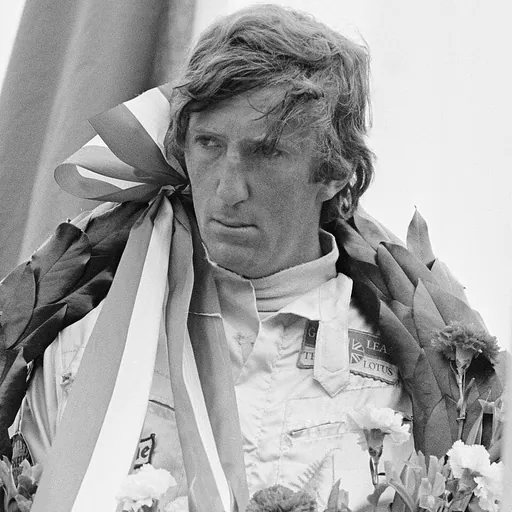
About Jochen Rindt
Lived 1942 – 1970 (aged 28). Jochen Rindt was an Austrian and German formula One driver and racing automobile driver.
Karl Jochen Rindt (; 18 April 1942 – 5 September 1970) was a racing driver who competed under the Austrian flag in Formula One from to . Rindt won the Formula One World Drivers' Championship in with Lotus, and remains the only driver to have won the World Drivers' Championship posthumously, following his death at the ; he won six Grands Prix across seven seasons. In endurance racing, Rindt won the 24 Hours of Le Mans in 1965 with NART.
Born in Germany and raised in Austria, Rindt started motor racing in 1961. Switching to single-seaters in 1963, he was successful in both Formula Junior and Formula Two. In , Rindt made his debut in Formula One at the Austrian Grand Prix, before securing a full drive with Cooper for . After mixed results with the team, he moved to Brabham for and then Lotus in . It was at Lotus that Rindt found a competitive car, although he was often concerned about the safety of the notoriously unreliable Lotus vehicles. He won his first Formula One race at the 1969 United States Grand Prix. He had a very successful 1970 season, mainly racing the revolutionary Lotus 72, and won five of the first nine races. In practice for the Italian Grand Prix at Monza, he spun into the guardrails after a failure on his car's brake shaft, and a poorly installed crash barrier gave way. Rindt was pronounced dead while on the way to hospital. As his closest competitor Jacky Ickx was unable to score sufficient points in the remaining races of the season, Rindt was awarded the World Championship posthumously. Rindt left behind his wife, Nina, and a daughter, Natasha.
Overall, Rindt competed in 62 Grands Prix, winning six and achieving 13 podium finishes. He was also successful in sports car racing, winning the 1965 24 Hours of Le Mans paired with Masten Gregory in a Ferrari 250LM. Rindt was a popular figure in Austria and his success resulted in increased interest in motorsport and Formula One in particular. He hosted a monthly television show titled Motorama and set up a successful exhibition of racing cars in Vienna. During his time in Formula One, he was involved alongside Jackie Stewart in a campaign to improve safety in Formula One.
Early life and family Jochen Rindt was born on 18 April 1942 in Mainz, Germany, to an Austrian mother and German father. when he was 15 months old, after which he was raised by his maternal grandparents in Graz, Austria. Although his grandfather chose to retain Rindt's German citizenship, for his entire career he drove under an Austrian racing licence. In an interview, he described his heritage as a "terrible mixture" and, when asked if he felt more Austrian or German, said that he felt "like a European". Rindt had one half-brother, Uwe, through his mother.
Rindt's childhood friends and his brother described him as a "laddish child" who often performed tricks to amuse others. While on a skiing holiday, he broke his femoral neck, leading to several surgeries that left one leg shorter than the other. As a result of this, Rindt limped slightly for the rest of his life. At the age of sixteen, he received a moped and started racing his friends on motocross tracks. His time in school was troubled and he was excluded from schools several times. He said:
In the end I got thrown out and went to England to learn English. I learned to drive while I was in England but I was too young to get a licence. When I went back home I broke my leg skiing but I decided I was more than capable of driving myself – even though I had one leg in plaster. I actually drove without a licence for 18 months and then got caught the day before I was eligible to collect it.
Racing career Beginnings Rindt drove his first race at the Flugplatzrennen in 1961, in his grandmother's Simca Montlhéry. After missing the official application period, he only entered after a friendly high-ranking motorsport functionary from Graz intervened on his behalf. The international motor racing world first took notice of him on 18 May 1964, when Rindt won the London Trophy race at the Crystal Palace circuit in a Brabham BT10 ahead of Graham Hill.
Like many other drivers at the time, Rindt continued to race in Formula Two races alongside his duties in Formula One; his last F2 appearance was the Festspielpreis der Salzburg in August 1970. In 1967, he dominated Formula Two, winning nine races in his Brabham BT23. As an experienced Formula One driver, he was graded "A", meaning his results did not count towards the championship, and the title went to Jacky Ickx. Still, his performances led him to be called "king of Formula 2" by the racing press. He had a long-standing relationship with Roy Winkelmann, and drove with his team until it closed at the end of 1969.
Rindt's best result came the following year at the 1965 24 Hours of Le Mans. Sharing the drive of a Ferrari 250LM with American Masten Gregory for the North American Racing Team, Rindt won the event. Neither driver was happy to race in a seemingly uncompetitive car. A 1998 article in Motor Sport stated that neither appeared to show much interest in the race, but instead it was "more a case of 'hope it breaks soon' so they could draw their money and split". At the start, the drivers had to run to their cars; Rindt entered with a forward roll that allowed him to get his foot on the throttle instantly and take an early lead. The pair experienced considerable trouble in the early part of the race; the car did not restart during Gregory's first pit stop. Later, the engine failed partially and Gregory brought the car into the pits on only six of twelve cylinders. After thirty minutes of repairs, the car restarted and Rindt and Gregory agreed to drive the rest of the event "flat out", at full speed and with the accompanying risk.
Later that year, Rindt drove, again in a Ferrari 250LM, at the 500 kilometre race at Zeltweg. He was able to win ahead of the better powered Ferrari of Mike Parkes owing to a special lever that manually activated the brake lights. Using the tool shortly before his actual braking point, Rindt was able to force Parkes to brake earlier than him which allowed him to stay ahead.
Apart from his 1965 victory, Rindt never finished the race in Le Mans. In 1966, his Ford GT40 (shared with Innes Ireland) suffered an engine failure. A year later, he drove a Porsche 907 with Gerhard Mitter until their camshaft failed.
Formula One Cooper (1964–1967) Rindt made his Formula One debut at his home race, the 1964 Austrian Grand Prix, in a loaned Brabham BT11 supplied by the Rob Walker Racing Team. He retired on the 58th lap with a broken steering column in his only Grand Prix of the season.
For the 1965 Formula One season, Rindt signed as a permanent driver with Cooper, paired with Bruce McLaren. He was not immediately successful as Cooper, formerly a top team, were struggling at the time. In his first race, the 1965 South African Grand Prix, he developed transistor trouble; the damage was initially repaired but the problem recurred and Rindt had to retire from the race. His best result was a fourth place at the German Grand Prix at the Nürburgring.
For , Cooper introduced the T81 chassis and used nine-year old Maserati V12 engines, which were powerful but heavy. A new engine formula was introduced for the season, with the capacity doubled to three litres. Many teams struggled with the new rules, leaving Cooper competitive even with their old Maserati V12s. After McLaren left, Rindt became team leader until world champion John Surtees joined from Ferrari. Overall, he achieved three podium positions, handing him third place in the championship at the end of the year.
was less successful, as Rindt only finished two races, the Belgian and Italian Grands Prix, both in fourth place.
Brabham (1968) Prior to , Rindt received offers from every team except Lotus and Honda, and moved to Brabham, who had been world champions in the two previous seasons. Technical problems restricted him that year. Brabham's Repco V8 engine was not competitive against the now widely used Cosworth DFV The race was won by Jim Clark, a close friend of Rindt's. It was Clark's final Formula One race; he died three months later at a Formula Two race at Hockenheim. Rindt was deeply affected by his death, telling Austrian journalist Heinz Prüller: "If Jim Clark is not safe, what can happen to us?" His second podium finish came in heavy rain and fog at the Nürburgring at the , a race dominated by Stewart, who finished four minutes ahead of Hill in second place. Rindt had closed on Hill in the latter stages of the race after the Englishman spun, and finished just four seconds behind after a close battle during the last lap. His eight points placed him twelfth in the championship at the end of the season.
During these years, he also raced in the Indianapolis 500 in both 1967 and 1968, but finished only 24th and 32nd, completing only five laps in 1968 after finishing slightly more than half of the 1967 race. After dropping out of the 1967 race, Rindt was interviewed on the radio network by Luke Walton. When asked what he thought of the "500", he said "not much". In an interview in 2014, Heinz Prüller recalled Rindt speaking about Indianapolis in 1967: "In Indianapolis, I always feel like I am on my way to my own funeral." At another occasion, he said about the track: "It is catastrophic, I only drive there because of the money." When Rindt joined Lotus, his friend and de facto manager Bernie Ecclestone, who had negotiated the deal, remarked that they were aware that Brabham may have been a better choice of team but the speed of the Lotus gave Rindt a chance to win the championship. Rindt commented: "At Lotus, I can either be world champion or die." Although Rindt only suffered a broken nose, one marshal lost an eye and another had his foot broken. Rindt was furious with Lotus's team owner, Colin Chapman, over the failure; he told a reporter after the accident: "I place the blame on him [Chapman] and rightfully so, because he should have calculated that the wing would break." In an interview on Austrian television a day later, he said: "These wings are insanity [ein Wahnsinn] in my eyes and should not be allowed on racing cars. ... But to get any wisdom into Colin Chapman's head is impossible." Asked whether he had lost trust in Lotus after the accident, he replied: "I never had any trust in Lotus", going on to describe his relationship with the team as "purely business". His accident left him sidelined for the , a race that Hill won.
Jackie Stewart later described Rindt's 1969 season as the year that he "came of age". At the end of the year, Motor Sport magazine called him "he only driver to challenge Stewart seriously throughout the season", albeit placing only fourth in the championship. The poor reliability of the Lotus 49B affected him; he retired from seven races. At the , Rindt fought a close battle with Stewart for the lead; both men were 90 seconds ahead of third-placed Jacky Ickx. The race was decided in Stewart's favour only when Rindt had to enter the pits after part of his car's bodywork started to rub on the tyre; he finished fourth. At the , he was involved in a memorable finish. Having started from pole position, he traded the lead with Stewart and Piers Courage several times. During the last lap, Rindt, Stewart, McLaren, and Jean-Pierre Beltoise were running close together as they approached the finish line. Stewart took the win, only eight hundredths of a second ahead of Rindt, while fourth placed McLaren was also within two tenths of a second. It was the closest 1–2–3–4 finish in the history of the sport. Rindt recorded his maiden Grand Prix win at the penultimate race of the season at Watkins Glen, winning $50,000—the largest monetary prize in Formula One history at the time. His victory was overshadowed by a serious accident involving his teammate Hill, who crashed after a high speed puncture and suffered major leg injuries.
1970 season For , Rindt's partner at Lotus was John Miles; Graham Hill had left the team to drive for Rob Walker's customer franchise. Rindt became the clear team leader. At the first Grand Prix of the season in South Africa, he qualified fourth, but eventually retired with an engine failure after a first lap incident with Chris Amon and Jack Brabham, the latter of whom went on to win for the final time in his career. At the following race, the , Lotus introduced their revolutionary new car design. Instead of one conventional front radiator, the Lotus 72 featured two, one on each side of the cockpit. Further innovations included torsion bar suspension in place of the widely used coil-springs, and all four brakes mounted inboard to reduce unsprung weight. During its first practice session, the left semi-axle of the car broke, sending Rindt into a spin. The car also proved ineffective in the race; Rindt retired after nine laps.
Rindt took the Lotus 72's maiden victory at the 1970 Dutch Grand Prix. At the , Rindt eventually used the new Lotus 72, better sorted after alterations had been made. He set pole position in the final practice session, almost a quarter of a second ahead of his closest challenger, Stewart. Rindt went on to take his maiden victory in the Lotus 72, but it was not a joyful occasion for him; on lap 23, his close friend Piers Courage, with whom he had eaten dinner just the night before, died in a fiery crash. Rindt was heavily shaken by the loss of yet another fellow driver and contemplated retirement.
After the success at Zandvoort, Rindt gained confidence in the new Lotus 72, describing it as "the best racing car that exists at the moment". But he continued to have problems. During practice for the , Rindt opted to drop his new all-enveloping Bell-Star crash helmet, finding it too hot. He went back to using his open-front helmet, only to be hit in the face by a stone from another car, causing a deep cut on his right cheek. He also suffered a steering failure on his car. Furious over yet another mechanical problem, he stormed into the Lotus garage and yelled at Colin Chapman: "If this happens again and I survive, I will kill all of you!" Rindt was still able to win the race, taking the lead in the championship.
The was originally set to take place at its traditional venue, the Nürburgring. The Grand Prix Drivers' Association (GPDA), represented by Rindt and Graham Hill, demanded changes to the circuit to increase safety, including Armco barriers along the entire of the Nordschleife. No agreement was reached and the Grand Prix moved to Hockenheim, where Rindt took his fourth victory in succession. The race was another two-way fight, this time between Rindt and Ickx, who exchanged the lead several times. This meant that he could have secured the drivers' title at his home event at the . He set the Lotus 72 on pole position, to the delight of the crowd, but retired from the race with an engine failure. The title decision was therefore postponed to the next race in Monza.
Death and legacy
The paddock moved to the at Monza, a track known for high speeds; drivers often used the slipstream of cars in front to increase their pace. Because of this, many teams, including Lotus, opted to remove the rear wings mounted on the cars to reduce drag and further increase speeds. The more powerful flat-12 Ferraris of Jacky Ickx and Clay Regazzoni had been up to faster than the Lotus at the previous race in Austria. Rindt's teammate John Miles was unhappy with the wingless setup in Friday practice, reporting that the car "wouldn't run straight". Rindt reported no such problems, and Chapman recalled that Rindt reported the car to be "almost 800 rpm faster on the straight" without wings.
On the following day (5 September 1970), Rindt ran with higher gear ratios fitted to his car to take advantage of the reduced drag, increasing the car's potential top speed to . On his fifth lap of his practice session, he crashed heavily at the approach to the Parabolica corner. Denny Hulme, who was following Rindt at the time, described the accident as follows:
Upon impact, a joint in the crash barrier parted, the suspension of the vehicle went under the barrier, and the car hit a stanchion head-on. The front end was destroyed. Rindt was in the habit of using only four points on the five-point harness then available and did not wear the crotch straps, as he wanted to be able to exit the car quickly in the event of fire. As a result, upon impact he slid under the belts, and the belts fatally slit open Rindt's throat.
Rindt was pronounced dead on the way to hospital in Milan and Lotus withdrew all cars from the race, including the Lotus 72 entered by Rob Walker. The Grand Prix went ahead and Clay Regazzoni took his maiden victory, but celebrations were muted. There was a lengthy investigation into Rindt's death in Italy, leading to a trial against Colin Chapman; he was cleared of all charges in 1976. The destroyed Lotus 72 remained in Italy after the trial, going to a scrapyard near Monza. In 1985, a real estate agent found the wreckage and bought it from the authorities, later trading it in 1993 for a Lola Formula 3 car. Since then, the car has rested in a garage near Milan.
Rindt was the last Austrian Formula One driver to die during qualifying until the 1994 San Marino Grand Prix, which saw the death of Roland Ratzenberger.
Rindt was buried at the central cemetery (Zentralfriedhof) in Graz on 11 September 1970. At his funeral, Joakim Bonnier gave the eulogy, saying:
At the time he died, Rindt had won five of that year's ten Grands Prix, which meant that he had a substantial lead in the Drivers' Championship. After winning the next race in Canada, Jacky Ickx moved within 17 points of Rindt in the Championship, giving him a chance to win the title if he won the two remaining races. At the , a race won by Rindt's replacement at Lotus, Emerson Fittipaldi, Ickx placed only fourth, making Rindt motor racing's only posthumous world champion. The championship trophy was handed to his widow Nina by Jackie Stewart on 18 November 1970 in a ceremony near the Place de la Concorde in Paris.
On November 1970, the UEFA Euro 1972 qualifying football matches in Austria held one minute of silence in remembrance of Rindt before the matches.
Rindt was commemorated in many ways. The early season BARC 200 Formula Two race was renamed the Jochen Rindt Memorial Trophy for as long as the series existed. In 2000, on the 30th anniversary of his death, the city of Graz unveiled a bronze plaque in remembrance of Rindt, with wife Nina and daughter Natasha present.
The Historic Sports Car Club in the United Kingdom hosts a historic Formula 2 championship, whose pre-1972 category is called the "Class A Jochen Rindt Trophy".
Personal life In March 1967, Rindt married Nina Lincoln, a Finnish model and daughter of racing driver Curt Lincoln, whom he had raced in the early part of his career. The couple moved to Switzerland, near Begnins, where they built a house together. Their daughter Natasha later worked with Bernie Ecclestone for several years after he had taken over the commercial rights of Formula One.
Rindt had met Bernie Ecclestone during his time at Cooper and the two became friends. Noticing his commercial talent, Rindt allowed Ecclestone to manage his professional contracts, without ever officially employing him as a manager. Ecclestone said of the relationship: "I was never his manager, we were good friends. I helped him with any help he ever needed." After Rindt's accident, it was Ecclestone who carried his bloody helmet back to the pit lane.
In Formula One, Rindt had several friendly relationships with other drivers, most notably Jackie Stewart. They met at a Formula Two event in 1964 and soon became friends, often going on holiday together and living near each other in Switzerland. Until his death, they were sometimes accompanied by Jim Clark. Rindt became involved in Stewart's fight for increased safety in Formula One, being one of the leading figures of the GPDA. For his role in the safety campaign, Rindt was criticised by fellow drivers and the press alike; reporters derogatively called Stewart, Rindt and Joakim Bonnier the "Geneva connection", due to their residence in Switzerland. Stewart said that it took Rindt some time to understand the graveness of the situation but after that, he was a "good ally". After Rindt's death, his wife Nina stayed close with the Stewarts and can be seen visiting them at the 1971 Monaco Grand Prix in the Roman Polanski-produced film Weekend of a Champion.
Privately, Rindt was known to family and friends as an often reckless driver when on public roads. During the early years of his career, he took his Jaguar E-Type out in the streets of Vienna, where he lived, and drifted through the streets. He sparked public criticism in 1968 when he flipped over a Mini Cooper during a demonstration run at an autocross event in Großhöflein, while his pregnant wife was on board.
Rindt's success popularised motorsport in Austria. Helmut Zwickl called him "the driving instructor of the nation". In 1965, Rindt put together the first exhibition of racing cars in Austria, the Jochen-Rindt-Show in Vienna. It was an immediate success, with 30,000 visitors on the first weekend alone. Using his connections, he brought in his friend Joakim Bonnier and former Mercedes Grand Prix manager Alfred Neubauer as opening speakers, with other drivers such as Jackie Stewart attending. The show soon became an annual event and later moved to the German city of Essen in 1970, shortly after Rindt's death, and remains there as the Essen Motor Show.
Complete Formula One World Championship results (key) (Races in bold indicate pole position; races in italics indicate fastest lap)
Non-championship Formula One results (key) (Races in bold indicate pole position) (Races in italics indicate fastest lap)
Tasman Series results (key)
Complete 24 Hours of Le Mans results Year Team Co-drivers Car Class Laps North American Racing Team David Piper Ferrari 250LM P 5.0 0 DNF DNF North American Racing Team Masten Gregory Ferrari 250LM P 5.0 348 1st 1st F.R. English Ltd. \ Comstock Racing Innes Ireland Ford GT40 Mk I S 5.0 8 DNF DNF Porsche System Engineering Gerhard Mitter Porsche 907 P 2.0 103 DNF DNF
Complete Indianapolis 500 results Year Chassis Engine Start Finish 1967 Eagle Ford 32nd 24th 1968 Brabham Repco 16th 32nd
Don’t just read it —
keep it.
Full-length biographies made to live with: read them, listen on the way to work, watch them tonight.
- E-book
- Audio
- Video
Instant download · yours to keep · every purchase keeps this site free
Important facts
People in Jochen Rindt's life
Named in this biography and alive at the same time




Related people
Same field, nearest in time

Contemporaries
People whose lives overlapped Jochen Rindt's


Frequently asked questions
Who was Jochen Rindt?
German racing driver (1942–1970)
When was Jochen Rindt born?
Jochen Rindt was born on 18 April 1942 in Mainz.
When did Jochen Rindt die?
Jochen Rindt died on 5 September 1970 in Monza Circuit.
What was Jochen Rindt's occupation?
Jochen Rindt was a formula One driver and racing automobile driver.
What nationality was Jochen Rindt?
Jochen Rindt was Austrian and German.
Sources & further reading
Cite this page
APA: Biography.guide. (2026). Jochen Rindt. https://biography.guide/jochen-rindt/
MLA: "Jochen Rindt." Biography.guide, https://biography.guide/jochen-rindt/.
Chicago: "Jochen Rindt." Biography.guide. https://biography.guide/jochen-rindt/.
Data last updated: 2026-09-23 · Spot an error? Report a correction.
Portrait: Wikimedia Commons · author & licence
Page generated 2026-09-27 05:04 UTC