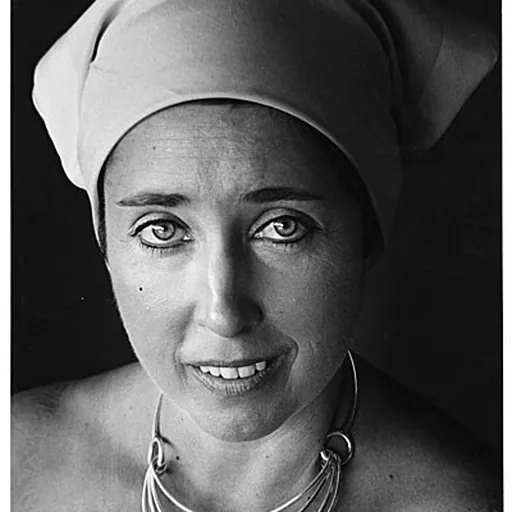
About Joan Brown
Lived 1938 – 1990 (aged 52). Joan Brown was an American painter and artist.
Joan Brown (born Joan Vivien Beatty; February 13, 1938 – October 26, 1990) was an American figurative painter who lived and worked in Northern California. She was a member of the "second generation" of the Bay Area Figurative Movement.
Background In the late 1950s, Joan Brown was a maturing artist who helped make California, and the Bay Area in particular, an important artistic center. Brown worked with multiple other artists to make popular the concepts of figurative painting, Beat Generation culture, and Funk art.
Education and early life Joan Brown was born on February 19, 1938, in San Francisco to a second-generation Irish father and a native Californian mother. Brown's family life was very unhappy. Her father drank heavily and her mother, who had intended to have a career instead of a family, frequently threatened suicide. Brown could not wait to grow up and move out.
Growing up, Brown acquired her education through Catholic Schools in San Francisco—first St. Vincent de Paul School and then Presentation High School—which engendered in her a revulsion toward Catholic education and religion. She studied at the California School of Fine Arts (now San Francisco Art Institute), graduating with a Bachelor of Fine Arts degree in 1959 and a Master of Arts in 1960. There she met her instructor and mentor Elmer Bischoff. While still a student she had her first solo gallery exhibition in 1958.
In 1956 she married her first husband, Bill Brown, a fellow student who had encouraged her to complete her course and work with Bischoff. She was married to Bay Area Figurative sculptor Manuel Neri from 1962 to 1966, though their relationship and artistic collaboration dated back several years prior to this.
Career Brown achieved prominence with a style of figurative painting that combined bright color, sometimes cartoonish drawing, and personal symbolism. Her first museum show occurred at the Whitney annual show in New York (now the Whitney Biennial) in 1960 when she was 22. She was the youngest artist to be exhibited that year.
Early career As a teenager, Brown would flip through magazines and make pencil sketches of any celebrities she found to be sophisticatedly dressed. In 1956, Brown took a summer class at CSFA with Elmer Bischoff. Bischoff was the teacher that influenced Brown the most through his motivation, encouragement, and overall mentorship. He told her to follow her heart and to not focus on small details and academic rules. She noted that his instructional methods allowed her to make mistakes and learn from them. Bischoff led Brown to think more about the actual art and the struggles that come along with producing her paintings. This inspired Brown to become more serious and focused on exploring and discovering her talents and techniques.
Her interests began to alter as she progressed through her work and through her life. Leading up to her death, she focused heavily on ancient cultures and spirituality. Her painting The Sky Blew Up in Salinas (1960) had many abstract shapes inspired by Peter Voulkos's ceramic works and Frank Lobdell's handling of paint.
In 1962, Brown had a son, Noel Elmer Neri, with her second husband, Manuel Neri. She produced few paintings in 1964 because she was occupied with teaching, as well as dealing with the disintegration of her marriage to Neri, whom she divorced in 1966.
In 1965, Brown decided to completely change her painting style. Believing that the thick impasto, large scale, and brilliant color of her previous works had become a routine, she switched to painting more intimate, detailed, less spontaneous, black and white paintings.
Later career In 1968, she married artist Gordon Cook. While seemingly very different, the two artists respected and inspired each other's work. Brown went back to using color again in her paintings. Her paintings, at this time, were produced for self-reflection. She kept her technique as figurative and representational, but she focused more metaphorically now. This had to do with many recent events in her life, including the death of both of her parents. Her love for cats began to show in her works. She started to include more animals and more symbolism than she had done previously.
In the 1970s Brown produced autobiographical works based on actual and imagined events. In 1974, she joined the faculty of the University of California, Berkeley teaching art. she painted After the Alcatraz Swim in 1975 to help her cope with almost drowning. for Fine Arts.
As a teacher From 1961 until 1969, Brown taught introductory painting and drawing classes at the California School of Fine Arts, San Francisco. In 1964, she was invited to University of Colorado at Boulder to teach during the summer. Brown taught painting to both undergraduate and graduate students. She also taught at the Academy of Art College in San Francisco (1966–1967 and 1971–1973), the University of Victoria, British Columbia (1969), Sacramento State College (1970–1971), and Mills College, Oakland (1973). From 1974 to 1990, she was an art professor in the Department of Art Practice at the University of California, Berkeley with tenure.
Death In the late 1970s, Brown became increasingly interested in spirituality and New Age ideas, eventually becoming a friend of Sathya Sai Baba. She made a number of trips to his ashram in Puttaparthi, India. She withdrew from painting later on and concentrated on public sculpture. Her influences were Egyptian and Hindu icons. Brown then travelled all over the world, producing paintings from the different cultures and experiences she was having. In 1990, Brown travelled to India to help with the installation of one of her obelisks. Brown died along with Bonnie Lynn Mainric, 43, of San Francisco, and Michael Oliver, 25, a Santa Cruz comedian on 26 October 1990 when a concrete turret from the floor above collapsed while they were installing the mosaic obelisk at Sai Baba's Eternal Heritage Museum in Puttaparthi, India. At the time of her death, Brown was married to Mike Hebel, a police officer.
Legacy In 2016 her biography was included in the exhibition catalogue Women of Abstract Expressionism organized by the Denver Art Museum. Her work was included in the 2022 exhibition Women Painting Women at the Modern Art Museum of Fort Worth. The San Francisco Museum of Modern Art (SFMOMA) holds twenty-five of her works in its collection and, in November 2022, recognized her legacy with a major retrospective, including approximately eighty of Brown's paintings and sculptures. This retrospective of Brown's work is the first of its kind in more than twenty years.
Don’t just read it —
keep it.
Full-length biographies made to live with: read them, listen on the way to work, watch them tonight.
- E-book
- Audio
- Video
Instant download · yours to keep · every purchase keeps this site free
Important facts
People in Joan Brown's life
Named in this biography and alive at the same time





Related people
Same field, nearest in time

Contemporaries
People whose lives overlapped Joan Brown's



Frequently asked questions
Who was Joan Brown?
American artist (1938-1990)
When was Joan Brown born?
Joan Brown was born on 13 February 1938 in San Francisco.
When did Joan Brown die?
Joan Brown died on 26 October 1990 in Puttaparthi.
What was Joan Brown's occupation?
Joan Brown was a painter and artist.
What nationality was Joan Brown?
Joan Brown was American.
Sources & further reading
Cite this page
APA: Biography.guide. (2026). Joan Brown. https://biography.guide/joan-brown-painter-1938/
MLA: "Joan Brown." Biography.guide, https://biography.guide/joan-brown-painter-1938/.
Chicago: "Joan Brown." Biography.guide. https://biography.guide/joan-brown-painter-1938/.
Data last updated: 2026-09-20 · Spot an error? Report a correction.
Page generated 2026-09-27 05:10 UTC