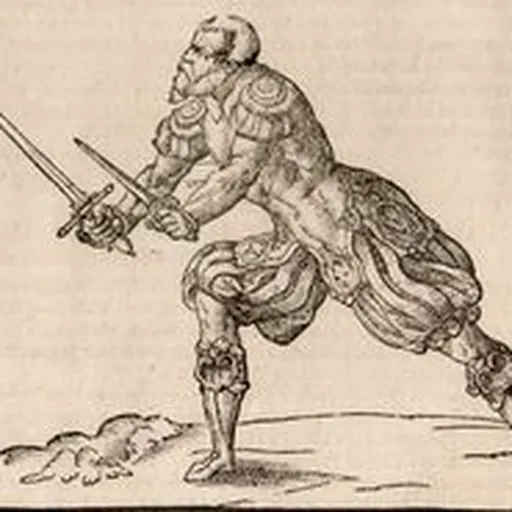
About Joachim Meyer
Lived 1537 – 1571 (aged 33–34). Joachim Meyer was a German fencer, fencing master, bladesmith and freifechter.
Joachim Meyer (ca. 1537–1571) was a self-described Freifechter (literally, Free Fencer) living in the then Free Imperial City of Strasbourg in the 16th century and the author of a fechtbuch Gründtliche Beschreibung der Kunst des Fechtens (in English, Thorough Descriptions of the Art of Fencing) first published in 1570.
Works
In 1570, Joachim Meyer wrote a comprehensive, multi-weapon treatise entitled Gründtliche Beschreibung der Kunst des Fechtens or, in English, Thorough Descriptions of the Art of Fencing. It is seen as one of the most complete systems within medieval German martial arts. Meyer's book was reprinted in 1600, and may have been an influential source for other 16th- and 17th-century German fencing books, including a 1612 book by Jacob Sutor. His book mostly consists of descriptive text, with only a few dozen woodcuts, each of which depicts several players enacting various techniques described in the text itself. The book consists of five chapters, covering the long sword, dussack (a training weapon not unlike the messer), rapier, dagger, and polearms.
Meyer's system generally flows from, and uses the terminology of, the German school of swordsmanship as set down by Johannes Lichtenauer, though Meyer's civilian system also appears to draw from contemporary Italian swordplay, including Achille Marozzo.
Meyer's book itself consists of detailed explanatory text describing the guards or postures (huten) for each weapon, cuts, footwork and specific and often quite complex plays or devices (stücke), accompanied by a series of finely executed woodcuts, each of which depicts scenes set amongst somewhat fantastical fight school (fechtschule) settings. These woodcuts typically depict the postures, cutting schemes (signs or 'segno' in Italian) as well as several players enacting various techniques described in the text itself. The book consists of five sections, covering the longsword, dussack (a training weapon not unlike the Messer), rapier (in Meyer's case, a single-handed sword utilised for both cut and thrust), dagger and wrestling, and polearms including the quarterstaff, halberd and pike. In common with earlier German sources, Meyer's system gives pride of place to the longsword, which is both the first weapon discussed, and the weapon treated in most detail, forming an exemplar-teaching tool for the rest of the system. However, the rapier, dagger and polearm techniques and devices described in Meyer's book do not appear to concede much to sporting considerations, featuring as they do the thrusts omitted from the longsword section, as well as a range of possibly lethal fight ending techniques. Furthermore, the longsword section of Meyer's book in particular shows definite descent from the earlier corpus of the Liechtenauer tradition (Meyer mentions Liechtenauer by name), and remains one of the most detailed, systematic and complete sources for this weapon.
Life
Meyer's book was reprinted in 1600 in Augsburg, and became a highly influential source for other 16th- and 17th-century German fencing books, including the aforementioned book by Jacob Sutor and a book from 1672 by an Italian, Theodor Verolinus. Both versions were simplified redactions of Meyer's more detailed work. Meyer is mentioned in a brief Latin treatise on martial arts by Heinrich von Gunterrodt (1579) and is also the only German among the famous masters listed in the late 17th century fencing treatise by Giuseppe Morsicato Pallavicini.
Little is known about Meyer himself. Some information on Meyer's life has come to light as a result of recent scholarship (Dupuis). "Originally from Basel, he (Meyer) became a burgher of Strasbourg by marrying a widow in 1560, most likely during his apprenticeship as a cutler. He made a living as both a cutler and a professional fencer until 1570, in which year he published the book that was to make him famous. The making of this book left him deeply indebted, and the search for potential buyers led him to leave Strasbourg and work as a Master-of-Arms at the court of the Duke of Schwerin. Unfortunately, death seized him a short time after his arrival, leaving the burden of his debt to his widow and brother-in-law."
Don’t just read it —
keep it.
Full-length biographies made to live with: read them, listen on the way to work, watch them tonight.
- E-book
- Audio
- Video
Instant download · yours to keep · every purchase keeps this site free
Important facts
People in Joachim Meyer's life
Named in this biography and alive at the same time
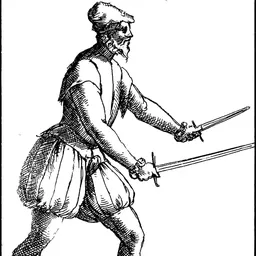
Related people
Same field, nearest in time

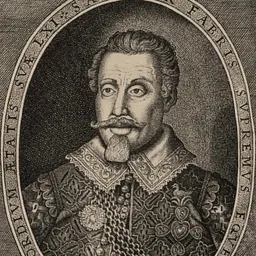




Contemporaries
People whose lives overlapped Joachim Meyer's

Frequently asked questions
Who was Joachim Meyer?
German fencing master (1537–1571)
When was Joachim Meyer born?
Joachim Meyer was born in 1537 in Basel.
When did Joachim Meyer die?
Joachim Meyer died on 24 February 1571 in Schwerin.
What was Joachim Meyer's occupation?
Joachim Meyer was a fencer, fencing master, bladesmith and freifechter.
What nationality was Joachim Meyer?
Joachim Meyer was German.
Sources & further reading
Cite this page
APA: Biography.guide. (2026). Joachim Meyer. https://biography.guide/joachim-meyer-fencer/
MLA: "Joachim Meyer." Biography.guide, https://biography.guide/joachim-meyer-fencer/.
Chicago: "Joachim Meyer." Biography.guide. https://biography.guide/joachim-meyer-fencer/.
Data last updated: 2026-09-20 · Spot an error? Report a correction.
Page generated 2026-09-27 05:10 UTC