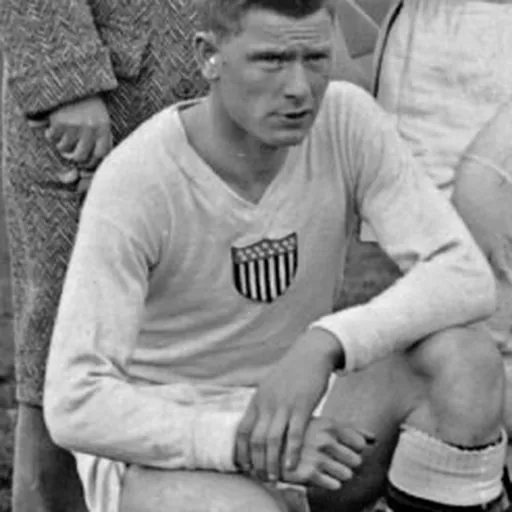
Jim Brown
Scottish-American soccer player
About Jim Brown
Lived 1908 – 1994 (aged 85). Jim Brown was an American and British association football player and association football coach.
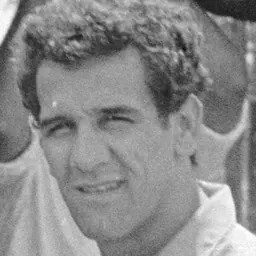
James Brown (December 31, 1908 – November 9, 1994) was a soccer player and coach who played as an outside forward. Born in Scotland, he played for the United States men's national soccer team at the 1930 FIFA World Cup, scoring the only goal of the American team in their 6–1 semi-final loss to Argentina. He began his career in the American Soccer League before moving to England and then Scotland. After retiring from playing, he coached at the youth, senior amateur, and professional levels. He was inducted into the U.S. National Soccer Hall of Fame in 1986.
Youth While born in Kilmarnock, Brown grew up in Troon, and became an apprentice riveter at the Troon Shipyard when he was 13. In 1920, his father deserted the family and moved to the United States. In 1927, Brown left Scotland to search for his father, settling in Westfield, New Jersey and finding work on the production floor of a metal box factory, where his riveting skills were handy. He was the oldest of four brothers, two of whom played professionally as goalkeepers: John earned a cap with Scotland and won the 1939 Scottish Cup with Clyde, while his youngest brother Tom played professionally in England for Ipswich Town. Their uncle Alex Lambie (husband of their mother's sister) was an imposing professional center-half and captain of Partick Thistle in the 1920s.
Amateur career Brown never played organized soccer in Scotland as a youth. When he arrived in the United States, he joined the Plainfield Soccer Club scoring 4 goals in one game and then a 5th goal in the next match. He then played with Bayonne Rovers, a local amateur team in the spring of 1928. They were a top team in the Northern New Jersey League and had playing for them, Henry Carroll, known as "Razzo", the 16 year old U.S. Olympic Team striker, who had participated in the 1928 Summer Olympics in Amsterdam. Brown, known in the local Bayonne Courier newspaper as "Red" or "Ginger", was the fiery thatched youngster who scored a goal in every match he played with Bayonne. In September 1928, he signed with the Newark Skeeters of the American Soccer League. However, the league suspended the Skeeters in September 1928 as part of the "Soccer War". Newark then joined two other suspended ASL teams and several others from the Southern New York Soccer Association to form the Eastern Professional Soccer League. Brown played 42 games and scored 12 goals with Newark in the ASL and the EPSL, or ESL as it was better known. In the middle of the season, James was listed as the 18th leading goalscorer, out of 18 players in the league. However, at the end of the season, he returned to the ASL when he signed with the New York Nationals, but only played one game and scored no goals.
Professional career
United States In 1930, Brown became a professional with the New York Giants, scoring 13 goals in 26 appearances. Soon after, he was called up to the U.S. national team for the 1930 World Cup. On his return from Uruguay, he rejoined his team that was renamed the New York Soccer Club, where he scored 6 goals in 25 appearances. He then moved to the Brooklyn Wanderers for the 1931 spring season with his old teammate, Razzo Carroll, where James scored 10 goals in 31 appearances. Brown moved to the Newark Americans in the fall 1931 season, but by this time the ASL was collapsing, and he played 13 games and scored 7 goals. Because of the decline in U.S. soccer, he decided to return to the UK in August 1932.
England Based on his success in the U.S. both professionally and with the national team, several teams from both England and Scotland expressed an interest in signing Brown. In August 1932, as the Caledonia Cruise liner neared the dock, representatives from these teams awaited him. However, Scott Duncan, manager of Manchester United, took a tugboat out to the liner and signed Brown on board. Brown played from 1932 to 1934 with United, scoring 17 goals in 40 games, the second highest on the team. Notably, he scored directly from a corner kick in his first game against Grimsby Town within 90 seconds. While Brown scored regularly with United, he alienated the team management with his outspoken support for a players' union. On May 6, 1934, before United transferred Brown to Second Division Brentford for £300, he scored the only goal in the Manchester (Senior) Cup final match against cross-town rival, Manchester City, at Old Trafford, 1–0. Unfortunately, as with Manchester, his union sentiments quickly soured his relationship with the Brentford's team ownership. He made only one appearance for the first team, but scored 53 goals in 74 games for the reserves and won the 1934–35 London Challenge Cup.
In September 1936, newly promoted, First Division Brentford sent Brown to Tottenham Hotspur for a transfer fee of £1,200. In his one season there, he played only four first team games, but scored twenty-one goals in thirty games for the reserves. In July 1937, Brown moved to semi-professional Guildford City of the Southern Football League for a fee of £750. Over his two seasons with Guildford City, Brown scored 148 goals in 150 games and helped the club win the Southern League title during the 1937–38 season.
International goals United States' goal tally first Date Venue Opponent Score Result Competition 1. July 26, 1930 Estadio Centenario, Montevideo, Uruguay 1–6 1–6 1930 FIFA World Cup
Coaching career In late 1948, he returned to the United States where he became the head coach of the Greenwich High School soccer team. In September 1949, James played one match in an attempted come-back with powerhouse Hispano, alongside a young goalie tending the sticks by the name of Gene Olaff. Two years later, James joined several other men in forming the Connecticut State Amateur League as well as Greenport United. When his son, George began playing for Greenport, Brown joined him for two seasons as a player-coach. He then coached the Brunswick School soccer team for twenty-two years and the Elizabeth Falcons of the American Soccer League from 1956 to 1958. Brown was inducted into the National Soccer Hall of Fame in 1986, the Connecticut State Hall of Fame, and New England Hall of Fame. His son George was inducted in 1995.
Personal life Having retired from playing professionally in 1941, Brown resumed his trade as a riveter in the Troon Shipyard and then moved back to the U.S. to coach Varsity soccer and Riflery.
Honors Manchester United Reserves Manchester Senior Cup (1): 1933–34
Brentford Reserves London Challenge Cup (1): 1934–35
Individual National Soccer Hall of Fame: 1986 Connecticut State Hall of Fame: 2000 New England Hall of Fame: 2005
Don’t just read it —
keep it.
Full-length biographies made to live with: read them, listen on the way to work, watch them tonight.
- E-book
- Audio
- Video
Instant download · yours to keep · every purchase keeps this site free
Important facts
People in Jim Brown's life
Named in this biography and alive at the same time






Related people
Same field, nearest in time

Contemporaries
People whose lives overlapped Jim Brown's


Frequently asked questions
Who was Jim Brown?
Scottish-American soccer player (1908-1994)
When was Jim Brown born?
Jim Brown was born on 31 December 1908 in Kilmarnock.
When did Jim Brown die?
Jim Brown died on 9 November 1994 in Berkeley Heights.
What was Jim Brown's occupation?
Jim Brown was an association football player and association football coach.
What nationality was Jim Brown?
Jim Brown was American and British.
Sources & further reading
· DBpedia: Jim Brown (soccer, born 1908)
Cite this page
APA: Biography.guide. (2026). Jim Brown. https://biography.guide/jim-brown/
MLA: "Jim Brown." Biography.guide, https://biography.guide/jim-brown/.
Chicago: "Jim Brown." Biography.guide. https://biography.guide/jim-brown/.
Data last updated: 2026-09-20 · Spot an error? Report a correction.
Portrait: Wikimedia Commons · author & licence
Page generated 2026-09-27 04:57 UTC