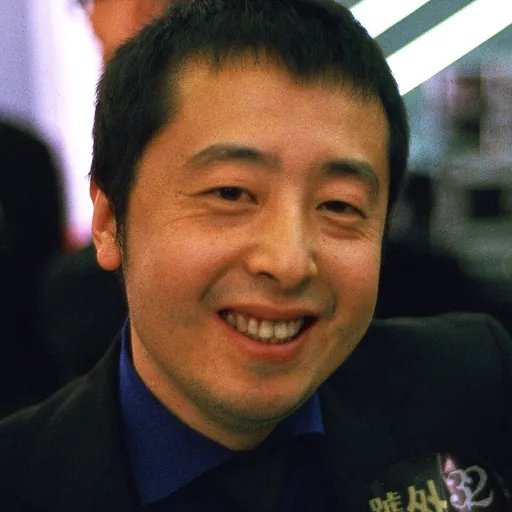
Jia Zhangke
Chinese film director and screenwriter (born 1970)
About Jia Zhangke
Born 1970. Jia Zhangke is a Chinese film director, film actor, screenwriter, actor, film producer and film screenwriter.
Early life Jia Zhangke was born in Fenyang, Shanxi, China. His interest in film began in the early 1990s, as an art student at the Shanxi University in Taiyuan. On a lark, Jia attended a screening of Chen Kaige's Yellow Earth. The film, according to Jia, was life changing, and convinced the young man that he wanted to be a director. Jia would eventually make it to China's prestigious Beijing Film Academy in 1993, as a film theory major, giving him access to both western and eastern classics, as well as an extensive film library. More significantly, the film's success brought Jia in contact with cinematographer Yu Lik-wai and producer Li Kit Ming, Shot on a mere 400,000 RMB budget (or about US$50,000). Platform is about a provincial dance and music troupe transitioning from the 1970s to the early 1990s. The film has been called the masterpiece of the entire sixth generation movement. Starring Wang Hongwei, Jia's classmate and star of Xiao Shan Going Home and Xiao Wu, Platform was also the first of Jia's films to star actress Zhao Tao, a former dance teacher. Zhao would go on to serve as Jia's muse as the lead female role in Unknown Pleasures, The World, and Still Life, as well as acting in 24 City and the short film Cry Me a River.
With 2002's Unknown Pleasures, Jia began a foray into filming in digital video (although his first experimentation with the medium came a year before, in 2001's short documentary In Public). Xiao Wu, Platform and Unknown Pleasures are sometimes seen collectively as an informal trilogy of China's transition into modernity. All this despite limited theatrical runs and obscurity in mainland China. Indeed, none of the three films was ever publicly released in the PRC, although unlicensed DVD sales were brisk, a fact commented on by Jia near the end of Unknown Pleasures when Xiao Wu, the character (Wang Hongwei again), attempts to buy the DVD of Xiao Wu, the film.
Wider success Beginning with 2004's The World, Jia began to work with official approval from the Chinese government. The shift from independent to state-approved was not in isolation, however, but was part of a broader movement by many "underground" film directors turning legitimate. For many critics, the shift to legitimacy did not blunt Jia's critical eye, and The World was well received both abroad and – somewhat surprisingly – by the Chinese government. The film, a diptych film about two people searching for their spouses in the backdrop of the Three Gorges Dam, was accompanied by the companion documentary Dong, about artist Liu Xiaodong.
The 2000s have seen Jia at a prolific period of his career. Following the success of Still Life, Jia was reported to be working on a gangster film, The Age of Tattoo ("Ciqing shidai"). Originally planned to be released in 2007, production on The Age of Tattoo was delayed after lead Jay Chou pulled out of the project, with Jia moving on to other films. These included a second documentary, Useless, about China's clothing manufacturing business, which garnered the director the Orizzonti Doc Prize at Venice in 2008, and 24 City, an ambitious work that conveys the historic changes that have swept across China in the last half-century through the lens of a single factory and the people connected to it by labor and blood. At the London Film Festival, 24 City was accompanied by another Jia short film, Cry Me a River, a romance starring Summer Palace actors, Hao Lei and Guo Xiaodong, and Jia regulars Zhao Tao and Wang Hongwei.
I Wish I Knew is a documentary exploring the changing face of Shanghai. I Wish I Knew debuted in the Un certain regard competition in the 2010 Cannes Film Festival.
During the press conference of 18 April 2013, Jia's film Tian Zhu Ding (A Touch of Sin) was nominated for the Palme d'Or at the 2013 Cannes Film Festival. He won the award for Best Screenplay. In April 2014, he was announced as a member of the main competition jury at the 2014 Cannes Film Festival.
His 2015 film Mountains May Depart was selected to compete for the Palme d'Or at the 2015 Cannes Film Festival.
In August 2016, Jia was appointed dean of the Shanghai Vancouver Film School at Shanghai University.
In October 2017, Jia announced the establishment of the Pingyao International Film Festival (PYIFF) in Shanxi.
In April 2021, Jia was appointed dean of the Shanxi Film Academy of Shanxi Media College.
In April 2024, Jia's new film Caught by the Tides was selected into the main competition of the Cannes Film Festival and participated in the competition for the highest award "Palme d'Or".
Style and influences Compared to other sixth generation directors, Jia's works are more experimental and durational.
Jia's work speaks to a vision of "authentic" Chinese life, and his consistent return to the themes of alienation and disorientation fly in the face of the work of older filmmakers who present more idealized understandings of Chinese society. Critic Howard Feinstein described the director as a "rare breed of filmmaker capable of combining stunning artifice with documentary truth."
Jia argues that the longshot is "democratic" as the viewer is able to freely navigate the screen and is not ordered by zooms, cuts and close-ups. Slowness, deliberate long-takes, minimal cuts and an often stationary camera appear in his films.
fontsize = 90%
Critics have noted that whereas "Fifth Generation" filmmakers such as Zhang Yimou churn out export-friendly and lushly-colored wuxia dramas, Jia, as a "Sixth Generation" filmmaker, rejects the idealization of these narratives in favor of a more nuanced style. His films—from Xiao Wu and Unknown Pleasures to Platform and The World—eschew the son et lumière that characterizes so many contemporary Chinese exports. But the films' recurrent and reflexive use of "pop" motifs ensure that they are more self-aware than the similarly documentarian Chinese films of Jia's Sixth Generation peers.
Jia's works are often compared with Italian neorealism. He is deeply affected by Robert Bresson's use of nonprofessional actors. I Wish I Knew, a 2010 documentary of his, features a segment about the 1972 documentary Chung Kuo, by Michelangelo Antonioni – another filmmaker to whose work Jia's own has been compared. Contemporary Chinese film director Wei Shujun also noted a European influence on Sixth Generation directors, highlighting Jia. thumb Jia and his wife, the Chinese actress Zhao Tao at the 2008 Cannes Film Festival.
Personal life He is married to his long-time collaborator and muse Zhao Tao in 2012. She starred in all of his films since Platform (2000).
Political views In 2011, Jia criticised Chinese film censorship at a cultural forum in Shanghai, and described it as "cultural over-cleanliness". When China's National Radio and Television Administration in 2021 published guidelines that limited actors with the "wrong" politics, morals, or aesthetics, while TV show hosts would need to be licensed by authorities, Jia spoke out against the proposed regulation, and said art creation should be "eclectic".
In December 2023, alongside 50 other filmmakers, Jia Zhangke signed an open letter published in Libération demanding a ceasefire and an end to the killing of civilians amid the 2023 Israeli invasion of the Gaza Strip, and for a humanitarian corridor into Gaza to be established for humanitarian aid, and the release of hostages.
Filmography
Feature films
Documentaries
Short films
As actor
As producer (Excluding production credits for Jia's own directorial efforts.)
Don’t just read it —
keep it.
Full-length biographies made to live with: read them, listen on the way to work, watch them tonight.
- E-book
- Audio
- Video
Instant download · yours to keep · every purchase keeps this site free
Important facts
Family & relationships
People in Jia Zhangke's life
Named in this biography and alive at the same time

Related people
Same field, nearest in time


Contemporaries
People whose lives overlapped Jia Zhangke's

Frequently asked questions
Who is Jia Zhangke?
Chinese film director and screenwriter (born 1970)
When was Jia Zhangke born?
Jia Zhangke was born on 24 May 1970 in Fenyang.
What is Jia Zhangke's occupation?
Jia Zhangke is a film director, film actor, screenwriter, actor, film producer and film screenwriter.
What nationality is Jia Zhangke?
Jia Zhangke is Chinese.
Sources & further reading
Cite this page
APA: Biography.guide. (2026). Jia Zhangke. https://biography.guide/jia-zhangke/
MLA: "Jia Zhangke." Biography.guide, https://biography.guide/jia-zhangke/.
Chicago: "Jia Zhangke." Biography.guide. https://biography.guide/jia-zhangke/.
Data last updated: 2026-09-22 · Spot an error? Report a correction.
Portrait: Wikimedia Commons · author & licence
Page generated 2026-09-27 05:02 UTC