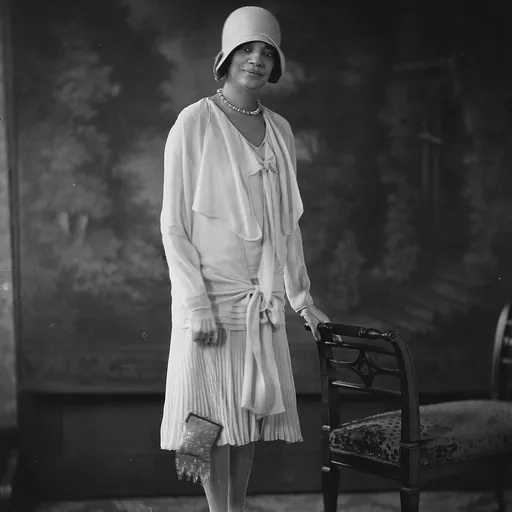
Jessie De Priest
African American music teacher
About Jessie De Priest
Lived 1870 – 1961 (aged 90). Jessie De Priest was an American.
Jessie De Priest (née Williams; September 3, 1870 – March 31, 1961) was an American music teacher who was married to Oscar Stanton De Priest, the first African American to be elected to the United States Congress in the 20th century. Jessie De Priest was the first African-American wife of a U.S. congressman elected in the 1900s. She is best known for her involvement in an incident known as the "Tea at the White House". First Lady Lou Henry Hoover invited De Priest to the traditional tea along with several other congressmen's wives, resulting in racist backlash from media outlets and the public.
Personal life
Family and career Little is known about Jessie De Priest's early life. She was born Jessie Williams in Rockford, Illinois, on September 3, 1870, one of four daughters. Her parents, Mary Ann Scott and James Williams, were originally from Pennsylvania. Mary Ann "Emma" Williams was recorded as a Mulatto and housewife in the 1880 U.S. Federal Census records, while James Williams was recorded as white and a barber. The De Priests remained at this address throughout the entirety of Oscar's three terms in Congress. Designated a National Historic Landmark in 1975, this building is now known as the Oscar Stanton De Priest House.
De Priest resided in Chicago, Cook County, Illinois, for the remainder of her life, and her final resting place was a family plot in a rural area of the city.
Tea at the White House
Background
Politics Jessie De Priest's husband, Oscar, represented the Illinois Republican Party as a U.S. Representative to Congress under Herbert Hoover as President. In addition to being the only Black representative to serve during his three terms, he was the first Black Congressman elected in a state outside the South.
Jessie De Priest public image As seen in professional photographs taken during the De Priests' congressional years, Jessie De Priest was well-dressed and attuned to the fashion of the time. Her elegant self-presentation was seen as countering negative visual stereotypes of Black Americans in the media. The event and guest list were carefully planned to avoid embarrassment of the Hoovers or the De Priests during the tea and to avoid political fallout from citizens and representatives holding beliefs of white superiority.
Event On the day of the Congressional tea, June 12, 1929, Jessie De Priest was described by Time magazine as "wearing an afternoon dress of Capri blue chiffon, a grey coat trimmed in moleskin, a small grey hat, moonlight grey hose, [and] snakeskin slippers." Guests were served tea, sandwiches, cake, and punch, while conversing with one another in an intimate setting. The group of women invited were those whose views on racial politics were known and were ensured to be hospitable toward De Priest. They consisted of spouses of Cabinet members and Congressional wives from New York, Pennsylvania, and California, as well as Lou Hoover's sister and secretary. and celebrate the planning on the part of Hoover and her aides to avoid any potential embarrassment or ridicule to De Priest during the tea.
Other sources note that Lou Hoover initially left De Priest off the guest list for several teas with Republican Congress representatives' wives, and it was only after Oscar De Priest publicized the slight that Hoover invited De Priest to the final of a series of five White House teas. Evidenced by the written correspondence between aides of First Lady Hoover and President Hoover regarding the potential attendance of De Priest, consideration was given to political implications of the invitation. The guest list for the tea at which De Priest was eventually present was carefully vetted to ensure each of the 14 other women would not create a scene over socializing with a Black woman. It was substantially smaller than the four other teas, after 180 to 220 women were invited to attend each of these prior events.
Media portrayal
Mixed reception Letters found in the documents in the Herbert Hoover Presidential Library and Museum show a mixture of positive and negative reactions to First Lady Hoover's invitation of Jessie De Priest to the White House tea. One critical letter to the president says: "Just because the Republican Party is in power does not make it right to attempt to force such an abhorrently low standard of social appraisement of our [White] race down our throats." A citizen with an opposing view wrote, "The reception of Mrs. Oscar De Priest, at the White House by Mrs. Hoover, is a great victory for the principles, of social, and political equality of all races, upon which this nation was founded." Several more letters are on record from both citizens and government officials supporting each of the two contrasting viewpoints.
Southern officials and media outlets had a predominantly negative view of De Priest dining with the First Lady in the White House. Democratic Senators Simmons and Overman of North Carolina called the event unfortunate and stressed that it was a threat to social stability and approval in the Southern United States. Texas Senator Sheppard was even more overt in his criticism, stating this was "recognition of social equality between the white and black races and is fraught with infinite danger to our white civilization."
In response to the backlash and criticism, the Hoover administration asserted this was an official rather than a social function as a means of minimizing the event. The White House was wary of potential political losses in both the North and South.
Other notable events During the time Jessie De Priest and her family were living in Washington, D.C., social clubs and on Capitol Hill were hesitant to grant membership to Black members of Congress and their families. One of these groups was The Congressional Club, made up of spouses and daughters of high level federal government officials. The club considered revising their bylaws to refuse access to Jessie De Priest, but eventually decided against the change when faced with "national scrutiny".
Later years
Death
The final resting site of Jessie De Priest is a grave in Graceland Cemetery located in Chicago, Illinois, USA. This is the same cemetery in which her husband, Oscar Stanton De Priest, and one of her sons, Laurence De Priest, are buried. De Priest lived for 10 years after her husband had died as the result of complications associated with a bus accident. She died on March 31, 1961, following a stroke.
In an interview discussing Jessie De Priest's character and reputation, her greatgrandson characterizes De Priest as "reserved", saying unfortunately little was known of her personality beyond her being gracious and well-groomed, even within the De Priest family. He does, however, share an anecdote of De Priest's considerate nature. She always insisted on sending a plate of food out to the driver, Henry, when she and her husband were chauffeured to family dinners on Sunday nights.
Don’t just read it —
keep it.
Full-length biographies made to live with: read them, listen on the way to work, watch them tonight.
- E-book
- Audio
- Video
Instant download · yours to keep · every purchase keeps this site free
Important facts
Family & relationships
People in Jessie De Priest's life
Named in this biography and alive at the same time



Contemporaries
People whose lives overlapped Jessie De Priest's


Frequently asked questions
Who was Jessie De Priest?
African American music teacher
When was Jessie De Priest born?
Jessie De Priest was born on 3 September 1870 in Pennsylvania.
When did Jessie De Priest die?
Jessie De Priest died on 31 March 1961 in Chicago.
What nationality was Jessie De Priest?
Jessie De Priest was American.
Sources & further reading
Cite this page
APA: Biography.guide. (2026). Jessie De Priest. https://biography.guide/jessie-de-priest/
MLA: "Jessie De Priest." Biography.guide, https://biography.guide/jessie-de-priest/.
Chicago: "Jessie De Priest." Biography.guide. https://biography.guide/jessie-de-priest/.
Data last updated: 2026-09-22 · Spot an error? Report a correction.
Portrait: Wikimedia Commons · author & licence
Page generated 2026-09-27 05:01 UTC