
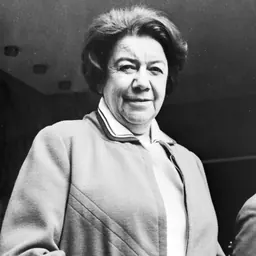
Jenny Margetts
Advocate for Indigenous women and children
About Jenny Margetts
Lived 1936 – 1991 (aged 55).
Jenny Margetts (born Jane Maria Shirt, 14 June 1936 – 18 October 1991) was a Canadian indigenous woman who advocated for women and children.
Biography Margetts was born to Felix and Louisa Doghead Shirt on the Saddle Lake Reserve in Alberta, Canada. Growing up in a family of ten, she attended Blue Quills Indian Residential School for nine years. Following graduation from Victoria Composite High School in Edmonton, Alberta. she decided to enter the Dominican Order. Jenny traveled with Bishop Lussier by train and arrived in Quebec City, Quebec on April 22, 1954. After six months as a postulant she became a novice and chose the name Louisa in honor of her mother. Sister Louisa spent the next two years in religious formation, learning French. Shortly after taking her First Vows returned to Saddle Lake to work in a newly established mission. She told of having a dream of a man crying, and her phoning home to Saddle Lake, and being told, "Come back. You do not belong there. We need you here." During this period, she decided the religious life was not for her, and left the Order in June 1957. She remembered taking a social justice course from a priest who told her that even one person who is concerned can make changes. Three years later she married, started a family, and became an activist for Indigenous women and children.
Achievements
Women's rights activist The Voice of Alberta Native Women's Society was founded in 1968 by Indigenous activists, including Jenny, to advocate on behalf of Status and Non-Status women. Women's organizations focused on many issues and it's been noted that urban women from Edmonton, Alberta, like Jenny, focused on political, social, and economic concerns while those from Calgary, Alberta, focused more on social and cultural activities for youth. Jenny left the organization in 1970 because she felt they weren't doing enough, saying, "It’s a Native women’s rights organization, but it’s not even trying to fulfill its mandate to work for Native women’s rights. You don’t even know what women’s rights are. You’ve got to learn. I am willing to learn and I’m getting out, but you haven’t heard the last of me." (6) At the national level women were not always in agreement, including delegates who wanted to include Quebec's rights to self-determination. "IRIW President, Jenny Margetts, also spoke and stated (to huge applause) that while she wished ‘Marlene and her group success, I realize that we have to be specific about Native women’s rights and we should stick to women’s rights.’"
The IRIW association continued until 1985 when section 12 (1) (b) was finally repealed to adhere to the new Canadian Charter of Rights and Freedoms. In 1985, Jenny got back her Indian status that she had lost when she married Gordon Margetts. She was still co-president of the IRIW association when she died in 1991.
Educator One day in the early 1970s, Margetts' mother called her and expressed concern that her grandchildren were not learning the Cree language and that the school system was not offering enough cultural teaching. She was supported by a school superintendent who offered to help Jenny in setting up a program. They wrote a proposal and submitted it to the Edmonton School Board. Jenny recounted, "With missionary zeal, we set out to outline all the reasons why Native kids needed their own kindergarten. Cree language would be taught, a cultural component would be added to the existing curricula, but most of all, there would be the opportunity for these little Native children to feel good about being Native, in their own Native setting." The Awasis Program was launched in March 1972 with a kindergarten, and six years later included children up to Grade 6. Awasis is the Cree word for child.
After establishing the first Indigenous elementary school program in Canada, Jenny helped create the Sacred Circle Project, a program to develop initiatives and provide support to all activities related to the education of or about Indigenous people. Elders, the Indigenous community, and the Edmonton Public School District staff formed the nucleus of the project, which focused on eight areas: curriculum development, summer activities, lead teachers, classroom aides, a resource centre, cross-cultural awareness services for teachers and the community, and a home-school liaison component. From its start in one urban setting, it soon expanded to other cities and included both public and Catholic schools. As a result of lobbying by concerned Indigenous people as well as school system personnel throughout Alberta, in the summer of 1980 the Department of Education ear-marked funding for such programs, resulting in large urban school systems developing programs on a much broader scale to meet the needs of Indigenous students. One review identified two major areas of concern with these programs: burnout resulting from Indigenous staff placed in schools that never had Indigenous people working in them before, and the limited cultural knowledge of Indigenous students raised in urban settings. These were issues Jenny understood well and used them in her presentations at conferences and before provincial and federal education task forces.
The Province of Alberta honored Jenny posthumously as one of the great Edmontonians of the century for "establishing the Awasis kindergarten, the first Canadian aboriginal kindergarten within a public school system, and for her work for post-secondary education access for aboriginals."
Foster parent From her early years of involvement with the Voice of Alberta Native Women Society, foster care was a major issue. The Society received a grant to employ Indigenous women on a part-time basis to promote foster care and recruit foster homes, and to survey the number of Indigenous families who did not receive any financial assistance while providing care to children who were not their own. Jenny and Gordon became foster parents in April 1983 and took in three children (ages 16, 13, and 12). Three years later she described one foster son as very loving, still hyperactive, who had finally stopped nightly bed-wetting. She wrote that she dealt with him "in the Indian way and had him doctored in the sweat lodge by a medicine man. He shook like a leaf – I held him close to me and vowed I would raise him as my own." Jenny is buried in Evergreen Memorial Gardens in Edmonton, Alberta.
Don’t just read it —
keep it.
Full-length biographies made to live with: read them, listen on the way to work, watch them tonight.
- E-book
- Audio
- Video
Instant download · yours to keep · every purchase keeps this site free
Important facts
Contemporaries
People whose lives overlapped Jenny Margetts's





Frequently asked questions
Who was Jenny Margetts?
advocate for Indigenous women and children
When was Jenny Margetts born?
Jenny Margetts was born on 14 June 1936.
When did Jenny Margetts die?
Jenny Margetts died on 18 October 1991.
Sources & further reading
Cite this page
APA: Biography.guide. (2026). Jenny Margetts. https://biography.guide/jenny-margetts/
MLA: "Jenny Margetts." Biography.guide, https://biography.guide/jenny-margetts/.
Chicago: "Jenny Margetts." Biography.guide. https://biography.guide/jenny-margetts/.
Data last updated: 2026-09-20 · Spot an error? Report a correction.
Page generated 2026-09-27 05:28 UTC