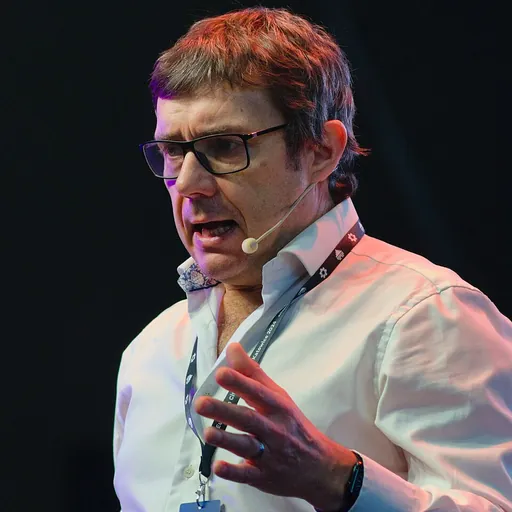
Jeff Forshaw
Professor of Physics at the University of Manchester
About Jeff Forshaw
Born 1968. Jeff Forshaw is a British physicist, writer and university teacher, known for Particle physics, Quantum physics and Theoretical Physics.
Education Forshaw attended Hesketh Fletcher High School and studied A levels at Wigan and Leigh College where he considered his teachers, Jim Breithaupt, Alan Skinner and Jean Wadsworth an important influence on his future career. He went on to study physics at Oriel College, Oxford graduating with a first class Bachelor of Arts degree in physics in 1989, followed by a PhD in Theoretical Physics from the University of Manchester in 1992 for research on the parton content of the photon and photon-induced minijets.
Career and research From 1992 to 1995 he worked as a postdoctoral research scientist at the Rutherford Appleton Laboratory While studying he intended to become a school teacher but began lecturing at university level after his PhD. He began his friendship and eventual collaboration with Brian Cox around 1995 when he was Cox's lecturer in Advanced Quantum Field Theory as they were the same age, despite being student and teacher.
In 2004 he became professor of particle physics at the University of Manchester School of Physics and Astronomy.
In 2008 he added his voice to the Science and Technology Facilities Council (STFC) campaign against spending cuts to UK physics budgets in a letter to the then Secretary of State at the Department for Innovation, Universities and Skills, John Denham, which was signed by around 350 prominent physicists from the UK theoretical particle physics community. The letter pointed out the adverse effects the cuts would have, not only to physics research in the UK, but also in discouraging future students of astronomy, particle physics and science in general. He also encourages people to see the relevance of quantum physics in everyday life and not purely as an academic discipline, using solar panels and lasers as examples of practical everyday applications. and "entertaining and informative." Forshaw often visits schools and colleges to speak in front of young people about aspects of his work and has appeared on children's television in the UK explaining concepts such as the Higgs boson on BBC television programme Newsround for children aged six to twelve. He is an ambassador for educational charity Potential Plus UK which aims to support the emotional and learning needs of gifted and exceptional children. Forshaw also regularly contributes at SciBar events (literally science in a bar) and Café Scientifique events in the UK. He has supervised several PhD students and postdocs.
Publications and media Forshaw writes frequent popular science articles explaining complex concepts in physics for the press and magazine publications. He has written on subjects such as matter and antimatter, the Big Bang, the existence of the Higgs boson, quantum computers, supersymmetry, the Planck satellite, dark matter and the technology of nuclear fusion. He has also co-authored a set of physics talks with educational support materials for TED Studies entitled Physics – The Edge of Knowledge which is designed to be used online by teachers and students. It explores the relationship between the laws of nature and quantum physics from subatomic particles to the wider universe. Other popular science publications include:
QCD and the Pomeron is a text book written with Douglas A. Ross (1997) written for theoretical and experimental particle physicists and those in the field of applied mathematics and investigates the pomeron, an object in high energy particle physics. It was described as the "First book on the physics of the pomeron, fills a gaping hole in the literature." Dynamics and Relativity written with Gavin Smith (2009) is an undergraduate level text book on the physics behind classical mechanics and relativity. Why Does E=mc²? written with Brian Cox (2009) is a popular science book exploring Einstein's Theory of relativity and what it means in relation to topics such as the Big Bang and the Large Hadron Collider. The book received very positive reviews for being easy to read and entertaining, despite dealing with complex physical theories and mathematics, from newspapers such as The Guardian, New York Journal of Books and New Scientist, and was shortlisted for the Royal Society science book prize in 2010. The Quantum Universe written with Brian Cox (2012) is a popular science book that attempts to explain quantum physics. Economist magazine listed it as one of its 'Books of the Year' for 2011. It received favourable reviews from The Guardian and the Economist while The Daily Telegraph described it as enjoyable but "not an easy read," and The Independent found the theoretical sections stodgy. Universal, a guide to the cosmos written with Brian Cox (2016) explores fundamental questions about the universe and the science of astronomy as it attempts to understand it. Universal was also well received, with the New Scientist listing it as one of their Great Christmas books, describing it, "Rarely has a difficult subject been rendered so accessible." The Guardian referred to it as a magnum opus and The Big Issue focussed on the book's encouragement of critical thinking. Universal was featured by Symmetry, the particle physics journal funded by the US Department of Energy and described as a beautiful book which excels on many levels. Forshaw is series editor of the Manchester Physics Series of textbooks aimed at university undergraduates and postgraduates.
Forshaw was science consultant for several BBC Television series and programmes including the following:
The Science of Doctor Who, documentary, 2013 Wonders of Life series, 2012 Wonders of the Universe series, 2010 and 2011 Wonders of the Solar System series, 2009 and 2010 Horizon:- What on Earth is wrong with Gravity? 2009 Horizon – Do You Know What Time It Is? 2008 Naked Science: Time Machine for National Geographic channel, 2008 Equinox: The Big G, 1998
Awards and honours In 1999 Forshaw was awarded the Maxwell Medal and Prize from the Institute of Physics for his outstanding contribution to particle physics. In 2013 Forshaw received the Kelvin Medal from the Institute of Physics for his outstanding contribution to making complex physics accessible and understandable to the public. He was also married to Naomi Baker, an academic at the University of Manchester, with whom he has two daughters.
Don’t just read it —
keep it.
Full-length biographies made to live with: read them, listen on the way to work, watch them tonight.
- E-book
- Audio
- Video
Instant download · yours to keep · every purchase keeps this site free
Important facts
Family & relationships
People in Jeff Forshaw's life
Named in this biography and alive at the same time








Related people
Same field, nearest in time


Contemporaries
People whose lives overlapped Jeff Forshaw's



Frequently asked questions
Who is Jeff Forshaw?
Professor of Physics at the University of Manchester
When was Jeff Forshaw born?
Jeff Forshaw was born on 26 February 1968.
What is Jeff Forshaw's occupation?
Jeff Forshaw is a physicist, writer and university teacher.
What is Jeff Forshaw known for?
Jeff Forshaw is known for Particle physics, Quantum physics and Theoretical Physics.
What nationality is Jeff Forshaw?
Jeff Forshaw is British.
Sources & further reading
Cite this page
APA: Biography.guide. (2026). Jeff Forshaw. https://biography.guide/jeff-forshaw/
MLA: "Jeff Forshaw." Biography.guide, https://biography.guide/jeff-forshaw/.
Chicago: "Jeff Forshaw." Biography.guide. https://biography.guide/jeff-forshaw/.
Data last updated: 2026-09-22 · Spot an error? Report a correction.
Portrait: Wikimedia Commons · author & licence
Page generated 2026-09-27 05:01 UTC