
About Jean V de Parthenay
Lived 1512 – 1566 (aged 53–54). Jean V de Parthenay was a French military leader and diplomat.
Jean V de Parthenay-L'Archevêque, or Larchevêque, Sieur de Soubise ( – 1 September 1566), was a Protestant French nobleman, last lord of Mouchamps, from the Parthenay-l'Archevêque family. His father, Jean IV de Parthenay, died before he was born. His mother was humanist Michelle de Saubonne. He married Antoinette d'Aubeterre, and their daughter and was Catherine de Parthenay, who later married René II, Viscount of Rohan.
During the Italian War of 1551–1559, he served as a fighter and ambassador under Henry II, with whom he had been friends since childhood. He was a close friend of Henry II's wife Catherine de' Medici.
He converted to Calvinism in 1562 after the massacre of Vassy (Wassy). During the French Wars of Religion, he became one of the most ardent supporters of Louis I, Prince of Condé, and the Huguenots. François Viète, who served as his lawyer and secretary from 1564 to 1566, recorded his memoirs.
Jean Clouet, Portrait of Renée de France duchesse de Chartres et de Ferrare (1510-1575), to whom Jean V's mother was a lady-in-waiting, c. 1520, Musée Condé Upon the death of Jean V's father, his mother became a lady-in-waiting to Renée of France. She was a scholar and introduced Clément Marot to the court. Jean V was an enfant d'honneur, a child who played with the then Dauphin Henry II, who was seven years younger than him. Jean V was well educated in humanities and was regarded as a cultured young person of his time. Raised by his mother versed in the classical humanities, frequenting poets from an early age, and nurtured by his sister Anne of Latin or Greek texts, Jean V hardly seems predestined for the military career in which his life was subsequently worn out.
In 1528, Renée of France married Duke Ercole II d'Este and moved to Ferrara, Italy, along with Michelle, Jean V, and two of his sisters. Clément Marot joined them shortly after that. Jean V grew fond of Italy.
According to La Popelinière, Jean V of Parthenay was "a gentleman of fine appearance, endowed with great estates and estates, liberal and honorable in all his actions, grave in speech and manners, affable and gracious nevertheless in conversation, disdainful of his domestic affairs as much as affectionate to the public and especially to the good of the kingdom, diligent and enemy of the birds".
In 1549, his mother died five days after the death of his sister Anne de Parthenay, wife of Antoine de Pons.
Marriage and children Château du Parc-Soubise was rebuilt in 1771 and has burnt down since then. On 9 May 1553, he married Antoinette d'Aubeterre, daughter of François II, Baron d'Aubeterre, and Isabelle de Saint-Seine in Paris.
On 22 March 1554, his wife Antoinette gave birth to their daughter Catherine, who would later become a celebrated woman of letters and action, writer, mathematician, and protector of science. Through her, Jean V de Parthenay is one of the ancestors of the House of Rohan.
Protestant celebrations of Pré-aux-Clercs in Paris began in 1557. Antoine de Navarre and his brother, the Prince of Condé, attended the celebration from 13 to 19 May 1558, which drew many gentlemen to the Reformed faith. This is also the case for Jean V de Parthenay, who converted to the new religion. Antoinette, his wife, preached on his lands. Jean V, however, was hesitant to announce his conversion and waited for some time before making it known. Converting to Protestantism was a dangerous position at the time. It meant leaving a life that had been built upon relationships with priests for confessions and those who offered her spiritual counsel. There was also the risk of persecution.
Peace made, Jean V de Parthenay was acquitted of the Renaudie affair in 1560 and he returned to the good graces of the queen and tried again to bring her back to the cause of the Calvinists. He paid court to her in Lyon during her visit, and stayed with her for a long time. He saw her again in Niort during her trip to Bayonne and accompanied her to La Rochelle.
Jean V was captured in Lille, Flanders, where he remained a prisoner for a year. Not wanting to reveal his real name, he identified himself as 'Ambleville' to the jailers, an assumed name he came up with on the spot. The latter, betting on Charles V, Holy Roman Emperor's respect for the neutrality of Lorraine, declined the offer. From October 1552 to early January 1553, Jean V de Parthenay participated in the Siege of Metz (1552).
War of Parma (1553) On 4 January 1553, Jean V received an order from King Henry II to go to the Duke of Parma and bring him to Fontainebleau.
Around July 1552, Henry II discovered the rapprochement between the Duke of Parma, Ottavio Farnese, and the King of Spain, Philip II. The king, his advisers, and Cardinal Oliviero Carafa decided to act. The Guises had Jean V de Parthenay sent on a mission to Parma with orders to propose an alliance between the Duke and King Henry II that included a marriage between his son Oratio, Duke of Castro and Diane de France, Duchess of Angoulême. He was given letters from Henry II to give to Ercole II d'Este, Duke of Ferrara to rally him and ask him to join the Pope in combating Spanish Inquisitions.
In preparation for the War of Parma, Jean V was appointed lieutenant general for His Majesty and then moved to Siena on 25 November 1554. On 25 February 1555, he moved to Parma at the rate of 500 pounds per month and helped to keep the duke in benevolent neutrality concerning the French, though Farnese ended up getting closer to Philip II of Spain two years later. Around the same time, Jean de Parthenay witnessed the capitulation of Montluc in Siena on 17 April, being unable to help him due to a lack of troops.
In 1555, Jean V joined the assault on Denain with Admiral Gaspard II de Coligny. There, wounded in the head and thrown to the ground, he was almost choked to death by his helm. He nevertheless continued the assault bareheaded until the end of the battle.
He fought in the capture of Calais (3 January 1558) with his friend le maréchal Strozzi. In August 1558, the king granted John V of Parthenay a gratuity of 6,900 pounds as a reward for the wars in Italy and "others". However, because of the boldness of his words and his foresight of military views during councils of war, Jean V made himself an enemy of Gaspard de Saulx, Marshal de Tavannes.
The Renaudie affair (1559–1560)
King Henry II died in 1559 and was succeeded by his son François II, then only 15. Though he was old enough to rule without a regent, he delegated his power to the House of Guise. Jean du Barry, Lord of La Renaudie, a friend of Jean's, then imagined removing the queen-mother and the young king from the influence of the Guise.
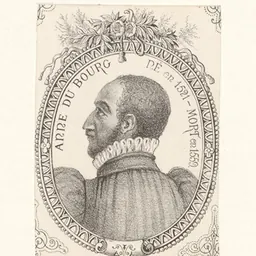
La Renaudie took the lead in the conspiracy, which originated in December 1559, in Geneva, shortly after the execution of Anne du Bourg. Its goal was to impose around the young king a council of regency, where the princes of blood, particularly Condé, would hold the first place. Antoine de Bourbon was opposed to it as well as Calvin; it does not seem that the latter nor Théodore de Bèze were really informed of the real aims of the conspirators. La Renaudie was personally angry with François II and Charles de Guise who had his brother-in-law arrested and executed. He gave himself as accomplices a few friends, Raunay, Baron Charles de Castelnau, François II, Baron d'Aubeterre (Jean V de Parthenay's brother-in-law), Edme de Ferrière-Maligny (brother of Jean II de Ferrières), Captain Mazères, but also the father of Agrippa d'Aubigne. If the Guises resisted, the conspirators promised to massacre them. La Renaudie, who linked up with Soubise at the siege of Metz, confided to him his intention of seizing the king from the month of September 1559, at a time when the conspiracy was far from having taken shape.
A first assembly of conspirators was held in Nantes in February 1560, and their troops, nearly 500 men, split up with the intention of moving towards Blois, Tours, and Orléans. Originally scheduled for 10 March 1560; the operation was postponed until 17 March. However, from 12 February, the Guises, warned by the Parisian lawyer with whom La Renaudie was staying, were made aware of the plot. They decided to take refuge in Amboise. Condé d'Andelot, Coligny, and Odet de Chatillon—taken into confidence by La Renaudie—negotiated an amnesty for Protestants except for the conspirators with Guise.
On 15 March, Jacques de Savoie, Duke of Nemours, seized the castle of Noizay, where some of the conspirators had gathered. Condemned for the crime of lèse-majesté, Castelnau, Mazères, and Raunay died beheaded or hanged at the windows of the castle of Amboise. For the next few days, La Renaudie was nowhere to be found. Jean V, for his part, was retained by the service of the queen mother, who interrogated Jean V and tried to ascertain where his friend was hiding.
Knighted (1561) Workshop of François Clouet , Portrait of Catherine de' Medici (1519-1589), c. 1565, oil on panel, Musée Carnavalet
On 7 December 1561, Jean V was made a Knight of the King's Order at Saint-Germain-en-Laye. Queen Catherine de' Medici wanted to do anything that she could to counterbalance the power of the Guises. The new king, Charles IX, was ten years old when he came to the throne. On 17 January 1562, the Edict of Saint-Germain, also called the Edict of January, gave many assurances to Protestants, but the Parliament of Paris, very Catholic, refused to register this royal act of tolerance.
French Wars of Religion (1562–1598) Jean V became one of the best Protestant captains acting under the orders of Condé at the start of the Wars of Religion.
The Massacre of Wassy (1562)
On 1 March 1562, Francis, Duke of Guise passed through Wassy in Champagne, and sent his armed men to interrupt a Protestant ceremony; 500 Huguenots were forced out of their place of worship. About fifty people were killed, and more than a hundred were wounded.
This massacre, which had nothing fortuitous, went down in history as the massacre of Wassy and set in motion half a century of religious wars, followed by those of Cahors, Carcassonne, Tours, Auxerre, Avignon, and more.
Jean V, citing the sympathies the queen once declared for Calvin, made great efforts to win Catherine de' Medici over to the reform party. He spent hours with her and Chancellor de L'Hospital. The Guises, who sought power, went to Fontainebleau. At their approach, the queen feared for the kingdom. Jean V could not convince her to flee. She begged him to stay and then asked him not to take up arms. It was too late: Jean V revealed to her that he would join forces with those of his friends, to deliver her and to deliver the king from the captivity to which the Lorraine party reduced him.
Catherine de' Medici wrote several times, asking him to return to the city. Jean V replied, "as long as he was governor of Lyon, he would keep it faithfully in the name of the king and queen."
He then faced the Catholic armies of Jacques de Savoie, Duke of Nemours. One of the most courageous leaders of the Protestant party on the eve of Saint Barthélemy, Jean V de Parthenay managed to hold the city until the pacification edict of 19 March 1563. This siege is illustrated two years later by the "speech that occurred in the city of Lion [Lyon] while Monsieur Soubise commanded there," a pleading attributed to François Viète and published (for the first time in the 19th century) by Hector de the Ferriere. Although suspected of sympathy with Soubise, the document revealed how Soubise managed to feed Lyon during his siege and in what resolution he finds himself facing Duke of Nemours. It also allowed Jean V to maintain his freedom of worship. Viète successfully addressed the suspicions against Jean V by providing documents during his administration of the city of Lyon and Viète's summarization of Jean V's behavior the previous year in the form of a memoir.
Last years (1564–1566)
To write his memoirs, an account of his life and the genealogy of the Parthenays were commissioned from François Viète, the great mathematician. After Viète went with him to Lyon to illustrate his defense in 1564, the lawyer was assigned the role of tutor to Soubise's daughter, the learned Catherine de Parthenay.
In October 1565, he saw Catherine de' Medici again in Meaux in April 1566, one last time in Moulins, where he was almost assassinated with all the Huguenot leaders present in this city. Whatever efforts his secretary may have expended to acquit him, Jean V remained one of the culprits of these plots. Bossuet even saw encouragement in the words that Jean V launched to Poltrot du Méré, who had come to confess to him "that he had resolved in his mind to deliver France from so much misery, by killing the Duc de Guisse"; familiar words with him, to which Jean V replied that he did his usual duty; God would know how to provide for it by other means.
He could not find peace and, although he harbored few illusions as to his chances of converting the Queen Mother to the "true religion", his repeated, ongoing efforts caused the party of Lorraine to abandon their last forces fairly quickly.
The judgement of posterity
Upon the death of Jean V, his daughter and heiress Catherine became Dame de Soubise. She first married Charles de Quellenec, Baron du Pont. In her second marriage, the land that she inherited, the land of Soubise, passed to Benjamin, Duke of Soubise, her youngest son with René II, Viscount of Rohan. On his death in 1642, the seigneury of Soubise passed to his niece the Duchess of Rohan, who bequeathed it to her daughter Anne de Rohan-Chabot, wife of his cousin François, Prince of Soubise. The seigneury of Soubise was erected by letters patent (unregistered) of Louis XIV dated March 1667, in the Principality of Soubise in favor of François, Prince of Soubise (1630–1712). The latter's grandson Charles de Rohan-Soubise, Marshal of France protected by the Marquise de Pompadour, left the memory of an incapable favourite, leaving his men to be massacred at the Battle of Rossbach in 1757. A song, "les reproaches de The Tulip to Madame de Pompadour," recounts this episode. Its lyrics have been attributed to Voltaire.
Brantôme and Bossuet were extremely severe against Jean V de Parthenay. For one as for the other, he was the accomplice of the assassin of Francis, Duke of Guise. Jean-Antoine Roucher says of the first,
The second recognizes himself,
Don’t just read it —
keep it.
Full-length biographies made to live with: read them, listen on the way to work, watch them tonight.
- E-book
- Audio
- Video
Instant download · yours to keep · every purchase keeps this site free
Important facts
People in Jean V de Parthenay's life
Named in this biography and alive at the same time




Related people
Same field, nearest in time



Contemporaries
People whose lives overlapped Jean V de Parthenay's


Frequently asked questions
Who was Jean V de Parthenay?
(1512-1566)
When was Jean V de Parthenay born?
Jean V de Parthenay was born in 1512 in Parthenay.
When did Jean V de Parthenay die?
Jean V de Parthenay died on 1 September 1566 in Mouchamps.
What was Jean V de Parthenay's occupation?
Jean V de Parthenay was a military leader and diplomat.
What nationality was Jean V de Parthenay?
Jean V de Parthenay was French.
Sources & further reading
· Wikipedia: Jean V de Parthenay
· DBpedia: Jean V of Parthenay
Cite this page
APA: Biography.guide. (2026). Jean V de Parthenay. https://biography.guide/jean-v-de-parthenay/
MLA: "Jean V de Parthenay." Biography.guide, https://biography.guide/jean-v-de-parthenay/.
Chicago: "Jean V de Parthenay." Biography.guide. https://biography.guide/jean-v-de-parthenay/.
Data last updated: 2026-09-20 · Spot an error? Report a correction.
Page generated 2026-09-27 05:18 UTC