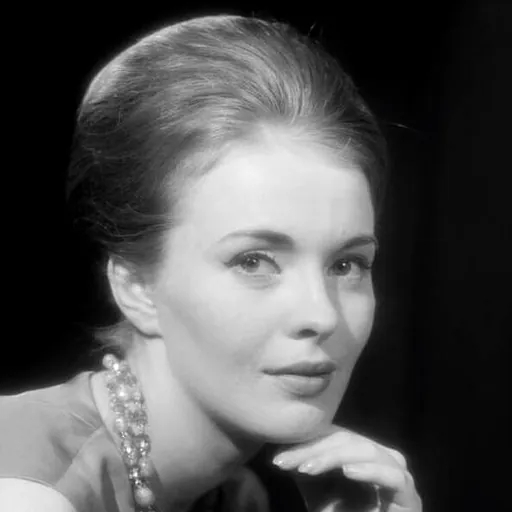
About Jean Seberg
Lived 1938 – 1979 (aged 40). Jean Seberg was an American film actor, film director and actor.
Jean Dorothy Seberg (; ; November 13, 1938 – August 30, 1979) was an American actress. She is considered an icon of the French New Wave as a result of her performance in Jean-Luc Godard's 1960 film Breathless.
Seberg appeared in 34 films in the United States and Europe, including Saint Joan, Bonjour Tristesse, Lilith, The Mouse That Roared, Breathless, Moment to Moment, A Fine Madness, Paint Your Wagon, Airport, Macho Callahan, and Gang War in Naples. Seberg was among the best-known targets of the FBI's COINTELPRO project. Her targeting was in retaliation for her support of the Black Panther Party and was directly ordered by J. Edgar Hoover.
Seberg died at the age of 40 in Paris, and the French police ruled her death a probable suicide. Seberg's second ex-husband, Romain Gary, called a press conference shortly after her body was found, at which he blamed the FBI's campaign against Seberg for her demise. Gary mentioned how the FBI had planted false rumors in the media that Seberg's pregnancy by Carlos Navarra in 1970 was by a Black Panther, and how the trauma had resulted in her losing the baby. Gary stated that Seberg had attempted suicide on numerous anniversaries of the infant's death, August 25. At the time of her death, Seberg was separatedthough not divorcedfrom third husband Dennis Berry.
Early life Seberg was born in Marshalltown, Iowa, the daughter of Dorothy Arline (née Benson), a substitute teacher, and Edward Waldemar Seberg, a pharmacist. Her family was Lutheran and of Swedish, English, and German ancestry. Seberg had a sister, Mary-Ann, and two brothers, Kurt and David, the younger of whom was killed in a car accident at the age of 18 in 1968.
Her paternal grandfather, Edward Carlson, arrived in the U.S. in 1882 and observed, "There are too many Carlsons in the New World." He changed the family surname to Seberg in memory of the water and mountains of Sweden.
In Marshalltown, Seberg babysat Mary Supinger, some eight years her junior, who became the stage and film actress Mary Beth Hurt. After she graduated from Marshalltown High School, Seberg enrolled at the University of Iowa to study dramatic arts but took up filmmaking instead.
Film career Seberg made her film debut in the title role of Joan of Arc in Saint Joan (1957), based on the George Bernard Shaw play, having been chosen from among 18,000 hopefuls by director Otto Preminger in a $150,000 talent search. Her name was entered by a neighbor.
When she was cast on October 21, 1956, Seberg's only acting experience had been a single season of summer stock performances. The film generated a great deal of publicity, but Seberg commented that she was "embarrassed by all the attention." On the failure, she later told the press:I am the greatest example of a very real fact, that all the publicity in the world will not make you a movie star if you are not also an actress.
Preminger promised her a second chance, Seberg renegotiated her contract with Preminger and signed a long-term contract with Columbia Pictures. Preminger had an option to use her on another film, but they never again worked together. Her first Columbia film was the successful comedy The Mouse That Roared (1959), starring Peter Sellers.
Mylène Demongeot recalled in a 2015 filmed interview in Paris: "Otto had high hopes in Jean and Saint Joan 's failure took a toll on him also because there was a 5-films-contract from what I recall. She was extremely sad too about it and when we all arrived on the set of Bonjour Tristesse she carried on her shoulders the weight of guilt, she was scared. And with that type of man, of character [Preminger] she shouldn't have shown fear, that's why I got along with him. I was a supporting role, I didn't have the weight of the expected success of the film on my shoulders. I had no apprehension regarding him. When he screamed, I would turn and tell him [sarcastically] "you know, you shouldn't screech like that, you gonna get yourself a stroke". Such words would defuse him. On the contrary, Jean was scared of him so he would take advantage and eventually became very mean to her."
Breathless and French career During the filming of Bonjour Tristesse, Seberg met François Moreuil, the man who was to become her first husband, and she then based herself in France, finally achieving success as the free-love heroine of French New Wave films. Despite her achievements, Seberg did not identify with her characters or the film plots, saying that she was "making films in France about people [I'm] not really interested in." In New York City, she acted in the comedy A Fine Madness (1966) with Sean Connery and under the direction of Irvin Kershner.
In 1966 and 1967, Seberg played the leading roles in two French films directed by Claude Chabrol and co-starring Maurice Ronet. In February and March 1966, she starred in Line of Demarcation, filmed around Dole, Jura, and in May and June 1967, she played the lead role in the French-Italian Eurospy film The Road to Corinth, shot in Greece.
After making the crime drama Pendulum with George Peppard (1969), Seberg appeared in her only musical film, Paint Your Wagon (also 1969), based on Lerner and Loewe's stage musical and co-starring Lee Marvin and Clint Eastwood. Her singing voice was dubbed by Anita Gordon. Seberg also starred in the ensemble disaster film Airport (1970), which drew mixed reviews but was a huge success at the box office.
Later career
Seberg acted in the western Macho Callahan (1970) and the violent crime drama Kill! Kill! Kill! Kill! (1971), but both films were failures. In 1972, she appeared in Gang War in Naples, which was successful in Europe but not in the United States.
Seberg was François Truffaut's first choice for the central role of Julie in Day for Night (La Nuit américaine, 1973), but after several fruitless attempts to contact her, he gave up and cast British actress Jacqueline Bisset instead.
Seberg's last American film appearance was in the TV movie Mousey (1974). She remained active during the 1970s in European films, appearing in White Horses of Summer (Bianchi cavalli d'Agosto) (1975), The Big Delirium (Le Grand Délire, 1975, with husband Dennis Berry) and Die Wildente (1976, based on Ibsen's The Wild Duck ).
At the time of Seberg's death, she was working on the French film Operation Leopard (La Légion saute sur Kolwezi, 1980), which was based upon the book by Pierre Sergent. She had filmed scenes in French Guiana and returned to Paris for additional work in September. After her death, the scenes were reshot with actress Mimsy Farmer.
FBI COINTELPRO operation FBI inter-office memo: "... cause her embarrassment and cheapen her image" FBI inter-office memo: "Usual precautions to avoid identification of the Bureau" During the late 1960s, Seberg provided financial support to groups supporting civil rights, such as the NAACP as well as Native American school groups such as the Meskwaki Bucks at the Tama County settlement near her hometown of Marshalltown, for whom she purchased $500 worth of basketball uniforms.
As part of its extended campaign to smear and discredit black liberation and anti-war groups, which began in 1968, the FBI became aware of several gifts Seberg had made to the Black Panther Party, totaling an estimated $10,500 in contributions; these were noted among a list of other celebrities in FBI internal documents later declassified and released to the public under FOIA requests. The FBI's strategy and modalities can be found in its interoffice memos.
In 1970, the FBI created a false story from a San Francisco-based informant that the child Seberg was carrying was not fathered by her ex-husband Romain Gary, as initially claimed, but by Raymond Hewitt, a member of the Black Panther Party. The story was reported by gossip columnist Joyce Haber of the Los Angeles Times as a blind item. ("She is beautiful, she is blonde, and she was born in the state of one of the senators Ted Kennedy just proposed for the 1972 Democratic Presidential nomination...) a distinguished diplomat picked her for his wife... her houseguests were often... black nationalists... And now, according to all those really 'in' international sources, topic A is the baby Miss A is expecting, and its father. Papa's said to be a rather prominent Black Panther." Seberg went into premature labor and, on August 23, 1970, gave birth to a baby girl. The child died two days later. Seberg held a funeral in her hometown with an open casket that allowed reporters to see the infant's white skin to disprove the rumors, though she later acknowledged that a Mexican student revolutionary, Carlos Navarra, was the actual father.
Seberg and Gary later sued Newsweek for libel and defamation, asking for $200,000 in damages. She contended that she had become so upset after reading the story that she went into premature labor, which resulted in the death of her daughter. A Paris court ordered Newsweek to pay the couple $10,800 in damages, and it ordered Newsweek to print the judgment in its publication and eight other newspapers.
The Seberg investigation went far beyond the publication of defamatory articles. According to friends interviewed after her death, she experienced years of aggressive in-person surveillance, amounting to constant stalking, as well as burglaries and other means of intimidation. Newspaper reports say Seberg was well aware of the surveillance. FBI files show that she was wiretapped, and in 1980, the Los Angeles Times published logs of her Swiss wiretapped phone calls. FBI records show that Hoover kept President Richard Nixon informed of FBI activities related to the Seberg case through Nixon's domestic affairs chief John Ehrlichman. Attorney General John Mitchell and Deputy Attorney General Richard Kleindienst were also kept informed of FBI activities related to Seberg. Following the FBI's admission, Haber said she could not disclose the source of the information from her column and said, "If I were used by the FBI, I didn't know it. ... I am certainly shocked to learn that the FBI engaged in planting stories with news people."
Possible Hollywood blacklisting At the peak of her career, Seberg suddenly stopped acting in Hollywood films. Reportedly, she was not pleased with the roles that she had been offered, some of which, she claimed, bordered on pornography. She was not offered any great Hollywood roles, regardless of their size.
Family reaction to FBI abuse of Seberg Seberg's father reacted strongly to the story of FBI abuses, stating that "if this is true, why in the dickens didn't they just shoot her, instead of having all this travail that's gone on. I have this flag in the corner, that I used to put out every morning, and I haven't put it out since."
Personal life On September 5, 1958, at the age of 19, Seberg married François Moreuil, a French lawyer (aged 23) in her native Marshalltown, having met him in France 15 months earlier. They divorced in 1960. Moreuil had ambitions to work in film and directed his estranged wife in Love Play. He said that the marriage was "violent" and that Seberg "got married for all the wrong reasons." The child's birth and first year of life were hidden, even from close friends and relatives. Gary's divorce from Blanch took place on September 5, 1962, and he married Seberg secretly on October 6, 1962, in Corsica.
During her marriage to Gary, Seberg lived in Paris, Greece, Southern France and Mallorca. She filed for divorce in September 1968, and the divorce was finalized on July 1, 1970. As of 2009, their son resides in Spain, where he runs a bookstore and oversees his father's literary and real-estate holdings.
Seberg reportedly had affairs with co-stars Warren Beatty (Lilith), Clint Eastwood (Paint Your Wagon) and Fabio Testi (Gang War in Naples), as well as filmmaker Ricardo Franco. Novelist Carlos Fuentes also claimed to have had an affair with her.
While filming Macho Callahan in Durango, Mexico, in the winter of 1969–70, Seberg became romantically involved with a student revolutionary named Carlos Ornelas Navarra. She gave birth to their daughter, Nina Hart Gary, by Caesarean section on August 23, 1970. The baby died two days later on August 25, 1970. Ex-husband Gary assumed responsibility for the pregnancy, but Seberg acknowledged that Navarra was the father. Nina is buried at Riverside Cemetery in Marshalltown.
On March 12, 1972, Seberg married director Dennis Berry. The couple separated in May 1976, but never divorced. Seberg subsequently dated aspiring French filmmaker Jean-Claude Messager, who later spoke to CBS's Mike Wallace for a 1981 profile of the actress. Hasni persuaded her to sell her second apartment on the Rue du Bac, and he kept the proceeds (reportedly 11 million francs in cash), announcing that he would use the money to open a Barcelona restaurant. The couple departed for Spain, but she was soon back in Paris alone, and went into hiding from Hasni, who she claimed had grievously abused her.
Death
On August 30, 1979, Seberg disappeared from her Paris apartment. Hasni told police that the couple had gone to see Womanlight and when he awoke the next morning, Seberg was gone. After Seberg went missing, Hasni told police that he had known that she was suicidal for some time. He claimed that she had attempted suicide in July 1979 by jumping in front of a Paris subway train.
On September 8, nine days after her disappearance, Seberg's decomposing body was found wrapped in a blanket in the back seat of her Renault, parked close to her apartment in the 16th arrondissement. Police found a bottle of barbiturates, an empty mineral water bottle, and a note written in French by Seberg addressed to her son. It read in part, "Forgive me. I can no longer live with my nerves." In 1979, her death was ruled a probable suicide by Paris police,
Romain Gary, Seberg's second husband, called a press conference shortly after her death at which he blamed the FBI's campaign against Seberg for her deteriorating mental health. Gary claimed that Seberg "became psychotic" after the media had reported the false story—planted by the FBI—that she was pregnant with a Black Panther's child in 1970; Seberg had said in an interview that the story was such a shock to her that she went into early labour, leading to the stillbirth of her child. Gary stated that Seberg had repeatedly attempted suicide on the anniversary of the child's death, August 25.
Aftermath According to FBI documents obtained via the Freedom of Information Act, six days after the discovery of Seberg's body, the FBI released documents admitting its defamation of Seberg, while making statements attempting to distance the agency from the practices of the Hoover era. The FBI's campaign against Seberg was further explored by Time magazine in a front-page article titled "The FBI vs. Jean Seberg." Media attention surrounding the FBI's abuse of Seberg led to an examination of the case by the Church Committee of the U.S. Senate, which noted that despite the FBI's claims of reform, "COINTELPRO activities may continue today under the rubric of investigation."
In his autobiography, Los Angeles Times editor Jim Bellows describes events leading up to the Seberg articles, expressing regret that he had not vetted the articles sufficiently. In June 1980, Paris police filed charges against "persons unknown" in connection with Seberg's death. Police stated that Seberg had such a high amount of alcohol in her system at the time of her death that it would have rendered her comatose and unable to enter her car without assistance, and no alcohol was found in the car. Police thought that someone was present at the time of Seberg's death and failed to seek medical care. Foster was set to produce and star in the film, but the project was canceled two years later.
In 1995, Mark Rappaport created a documentary about Seberg, From the Journals of Jean Seberg. Mary Beth Hurt played Seberg in a voiceover. Hurt was born in Marshalltown, Iowa, in 1948, attended the same high school as Seberg, and was babysat by Seberg.
The plot of the 1998 film Black Tears, starring Ariadna Gil, is reportedly inspired by Seberg's reported affair with Ricardo Franco.
The 2000 short film Je t'aime John Wayne is a tribute parody of Breathless, with Seberg played by Camilla Rutherford.
In 2004, French author Alain Absire published Jean S., a fictionalized biography. Seberg's son Alexandre Diego Gary brought a lawsuit, unsuccessfully attempting to stop publication.
Also from 2004, Seberg is recalled in the Divine Comedy song "Absent Friends": "Little Jean Seberg seemed / So full of life / But in those eyes such troubled dreams / Poor little Jean".
Since 2011, Seberg's hometown of Marshalltown, Iowa, has held an annual Jean Seberg International Film Festival.
In 2019, Amazon released an original film based on Seberg's life called Seberg that focuses on her battle against the FBI, with the title role played by Kristen Stewart.
The character of Anny Vikland in William Boyd's 2020 novel Trio strongly resembles Seberg's in details of her life and death.
In 2022, Kacey Rohl portrayed Seberg in White Dog (Chien blanc), a film adaptation by Anaïs Barbeau-Lavalette of Gary's 1970 book.
In 2025, Zoey Deutch portrayed Seberg in Richard Linklater's Nouvelle Vague, a film about the making of Jean-Luc Godard's Breathless told in the style and spirit of that film.
Filmography Year Title Role Language Notes 1957 Saint Joan St. Joan of Arc English 1958 Bonjour Tristesse Cecile English 1959 The Mouse That Roared Helen Kokintz English 1960 Breathless Patricia Franchini FrenchEnglish Let No Man Write My Epitaph Barbara Holloway English 1961 Time Out for Love Ann French Love Play Kate Hoover French Five Day Lover Claire French 1962 Congo vivo Annette Italian 1963 In the French Style Christina James English 1964 The World's Most Beautiful Swindlers Patricia Leacock French (segment "Le Grand Escroq")(scenes deleted) Backfire Olga Celan French Lilith Lilith Arthur English 1965 Diamonds Are Brittle Bettina Ralton French 1966 Moment to Moment Kay Stanton English A Fine Madness Lydia West English Line of Demarcation Mary, comtesse de Damville French 1967 The Looters Colleen O'Hara French Alternate title: Revolt in the Caribbean The Road to Corinth Shanny French Alternate title: Who's Got the Black Box? 1968 Birds in Peru Adriana French The Girls English Documentary 1969 Pendulum Adele Matthews English Paint Your Wagon Elizabeth English 1970 Airport Tanya Livingston English Dead of Summer Joyce Grasse Italian Macho Callahan Alexandra Mountford English 1972 Kill! Kill! Kill! Kill! Emily Hamilton English This Kind of Love Giovanna Italian Gang War in Naples Luisa Italian The Assassination Edith Lemoine French Alternate title: The French Conspiracy 1973 The Corruption of Chris Miller Ruth Miller Spanish 1974 Les hautes solitudes — Silent film without named characters Mousey Laura Anderson / Richardson English Television film Ballad for the Kid (Short film) La star French Director, writer, producer 1975 White Horses of Summer Lea Kingsburg Italian The Big Delirium Emily French 1976 The Wild Duck Gina Ekdal German (Final film role)
Awards and nominations British Academy Film Awards
Golden Globe Awards
Don’t just read it —
keep it.
Full-length biographies made to live with: read them, listen on the way to work, watch them tonight.
- E-book
- Audio
- Video
Instant download · yours to keep · every purchase keeps this site free
Important facts
Family & relationships
People in Jean Seberg's life
Named in this biography and alive at the same time







Related people
Same field, nearest in time




Contemporaries
People whose lives overlapped Jean Seberg's





Frequently asked questions
Who was Jean Seberg?
American actress (1938–1979)
When was Jean Seberg born?
Jean Seberg was born on 13 November 1938 in Marshalltown.
When did Jean Seberg die?
Jean Seberg died on 30 August 1979 in 16th arrondissement of Paris, Paris.
What was Jean Seberg's occupation?
Jean Seberg was a film actor, film director and actor.
What nationality was Jean Seberg?
Jean Seberg was American.
Sources & further reading
Cite this page
APA: Biography.guide. (2026). Jean Seberg. https://biography.guide/jean-seberg/
MLA: "Jean Seberg." Biography.guide, https://biography.guide/jean-seberg/.
Chicago: "Jean Seberg." Biography.guide. https://biography.guide/jean-seberg/.
Data last updated: 2026-09-22 · Spot an error? Report a correction.
Portrait: Wikimedia Commons · author & licence
Page generated 2026-09-27 05:04 UTC