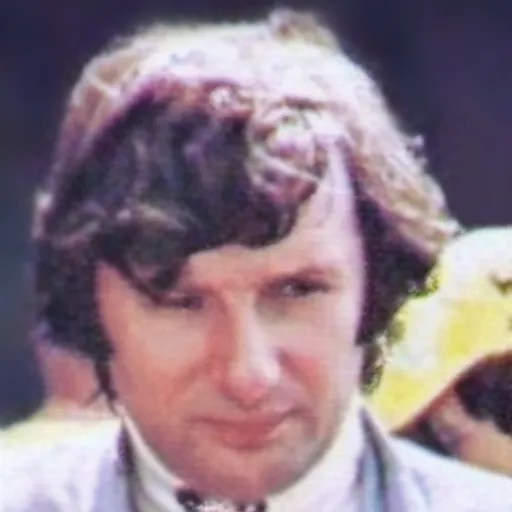
About Jean-Pierre Jarier
Born 1946. Jean-Pierre Jarier is a French racing automobile driver and formula One driver.
Jean-Pierre Jacques Jarier (; born 10 July 1946) is a French former racing driver, who competed in Formula One from to .
Jarier contested 143 Formula One Grands Prix for March, Shadow, ATS, Ligier, Lotus, Tyrrell, and Osella. He achieved three podiums and three pole positions across 12 seasons.
Early career Jean-Pierre Jacques Jarier was born on 10 July 1946 in Charenton-le-Pont, near Paris. After competing in Formula France, he moved up to French Formula Three, finishing 3rd overall in 1970, before moving on to the Shell Arnold European Formula Two team in 1971. He peaked with two 3rd places, and also made his Grand Prix debut at Monza when the team rented a March Engineering 701. However, the team dropped him midway through 1972 for financial reasons. For 1973 he signed to the March Engineering Formula Two team, and was also given a Formula One seat by the outfit. Formula One was difficult in the uncompetitive 721G, but Jarier stormed to the Formula Two title with eight wins.
Formula One Jarier won the 1000 km Nürburgring race in 1974 with Jean-Pierre Beltoise. The pair drove a Matra-Simca 670C.
After his good form in the 1973 F2 European series, Jarier nearly signed for Ferrari, but their established driver Clay Regazzoni insisted on having the young Austrian Niki Lauda as his teammate. In 1974, Jarier drove a full season of Formula One, signing with the Shadow Racing Cars team. He became team leader following the death of Peter Revson, and finished 3rd at the Monaco Grand Prix on his way to 14th overall. As a sports car driver. Jarier led Matra's successful defense of its world sports car title, and proved himself the fastest driver of all on the classic road circuits, being faster than Ickx at Nürburgring and the old Spa road circuit and winning three other rounds on GP circuits at Brands Hatch, Watkins Glen and Paul Ricard.
1975 began Jarier putting his Shadow DN5 on pole position for the Argentine Grand Prix, only for a component to break in the warm-up, preventing Jarier from taking the start. He repeated the feat at the Brazilian Grand Prix, and then dominated the race until a fuel metering unit failed, ending his race. Bad luck and poor reliability would curse his season, though the Shadow team fell from the pace as well. His only points-scoring finish was for fourth place in the shortened Spanish Grand Prix.
Jarier spent 1976 with Shadow Racing Cars, qualifying third in an updated version of the previous year's car, the DN5B and setting fastest lap at the opening Brazilian Grand Prix, before spinning off and crashing on James Hunt's oil whilst running second a few seconds behind Niki Lauda in a Ferrari. Subsequently, the car became uncompetitive, and Jarier failed to score any points.
After this, Jarier's career slowed. He switched to the ATS team in 1977, driving a Penske. He scored a point in his first race for the team, and then had one-off drives for Shadow and Équipe Ligier when the German team elected to miss the final races of the year. He also dabbled in sports cars, winning two races in an Alfa Romeo T33 with Arturo Merzario, and coming second at the Le Mans 24 Hours with Vern Schuppan in a Mirage.
Jarier's second year at ATS in the in-house HS1, was less successful, and he was fired after an argument with team principal Günter Schmid after failing to qualify the car for the Monaco Grand Prix. He was briefly re-hired for the German Grand Prix, only to miss the grid again, and again argued with Schmid, leaving once more. However, at the end of the year he was signed by Team Lotus to take the seat left by Ronnie Peterson's death. He set fastest lap at the United States Grand Prix East at Watkins Glen, running third before he ran out of fuel, and then took pole and dominated at the Canadian Grand Prix at Montreal before an oil leak ended his race.
These showings saw him signed by Tyrrell Racing. He was a regular points-scorer over two seasons with the team, with his best results being two 3rd places, achieved at the 1979 South African Grand Prix and the 1979 British Grand Prix.
Jarier began 1981 with a temporary assignment for Ligier, standing in while Jean-Pierre Jabouille returned to fitness, for two races at Long Beach and Rio de Janeiro. He then drove with Osella beginning midway through the season.
1982 saw a full season with Osella, with Jarier securing the team's best-ever finish with fourth at the San Marino Grand Prix (which was boycotted by the majority of British teams). While the rest of the year would be difficult, Jarier was instrumental in keeping the team's morale up following the death of Riccardo Paletti at the Canadian Grand Prix.
The following year saw a full season with Equipe Ligier, but after a good run at Long Beach ended with a collision with Keke Rosberg, he finished the season without points, and spent most of the season making other drivers angry because of his blocking tactics as a back marker. One example of this was the Austrian Grand Prix that year. On lap 22, Ferrari driver Patrick Tambay, who had led the race from the start, was held up by Jarier for two corners (the Glatsch-kurve and the Bosch-kurve). As he was being held up, Tambay's team-mate René Arnoux was able to pass Tambay on the approach to the Texaco-Schikane by boxing Tambay in behind Jarier. This also allowed Brabham driver Nelson Piquet to come from third to second by nipping past Tambay into the second of the two left-handers, which dropped Tambay to third and denied him the lead he had been preparing to re-take from Arnoux. A furious Tambay waved his fist at Jarier when he finally did pass him.
Later life Following this, Jarier retired from motorsport, but was tempted back to drive in the Porsche Supercup in 1994. This led to several sports car drives, winning the 1998 and 1999 French GT Championships. Jarier contributed major stunt work to the film Ronin, directed by John Frankenheimer, who also directed the 1966 Grand Prix.
Racing record Career summary
Lucky Strike Shadow Racing ‡ Graded drivers not eligible for European Formula Two Championship points.
Complete European Formula Two Championship results (key) (Races in bold indicate pole position; races in italics indicate fastest lap) Year Entrant Chassis Engine 1 2 3 4 5 6 7 8 9 10 11 12 13 14 15 16 17 Pts Shell-Arnold Team March 712M Ford HOC THR NÜR JAR PAL ROU MAN TUL ALB VLL VLL 8th 10 Shell-Arnold Team March 722 Ford MAL THR HOC PAU PAL HOC ROU ÖST IMO MAN PER SAL ALB HOC NC 0 STP March Racing Team March 732 BMW MAL HOC THR NÜR PAU KIN NIV HOC ROU MNZ MAN KAR PER SAL NOR ALB VLL 1st 78 Fred Opert Racing Chevron B35 Hart HOC THR VLL SAL PAU HOC ROU MUG PER EST NOG HOC NC 0 Maublanc Racing Services March 782 BMW THR HOC NÜR PAU MUG VLL ROU DON NOG PER MIS HOC NC 0 Graded drivers not eligible for European Formula Two Championship points
Complete Formula One World Championship results (key) (Races in bold indicate pole position, races in italics indicate fastest lap)
Complete Formula One non-championship results (key) (Races in bold indicate pole position, races in italics indicate fastest lap) Year Entrant Chassis Engine 1 2 3 4 5 6 7 8 1971 Shell-Arnold Team March 701 Ford Cosworth DFV 3.0 V8 ARG ROC QUE SPR INT RIN OUL VIC 1974 UOP Shadow Racing Team Shadow DN3 Ford Cosworth DFV 3.0 V8 PRE ROC INT 1975 UOP Shadow Racing Team Shadow DN5 Ford Cosworth DFV 3.0 V8 ROC INT SUI 1976 Shadow Racing Team Shadow DN5 Ford Cosworth DFV 3.0 V8 ROC INT 1979 Candy Tyrrell Team Tyrrell 009 Ford Cosworth DFV 3.0 V8 ROC GNM DIN 1980 Candy Tyrrell Team Tyrrell 010 Ford Cosworth DFV 3.0 V8 ESP
24 Hours of Le Mans results
Don’t just read it —
keep it.
Full-length biographies made to live with: read them, listen on the way to work, watch them tonight.
- E-book
- Audio
- Video
Instant download · yours to keep · every purchase keeps this site free
Important facts
People in Jean-Pierre Jarier's life
Named in this biography and alive at the same time





Related people
Same field, nearest in time

Contemporaries
People whose lives overlapped Jean-Pierre Jarier's


Frequently asked questions
Who is Jean-Pierre Jarier?
French racing driver
When was Jean-Pierre Jarier born?
Jean-Pierre Jarier was born on 10 July 1946 in Charenton-le-Pont.
What is Jean-Pierre Jarier's occupation?
Jean-Pierre Jarier is a racing automobile driver and formula One driver.
What nationality is Jean-Pierre Jarier?
Jean-Pierre Jarier is French.
Sources & further reading
· Wikipedia: Jean-Pierre Jarier
Cite this page
APA: Biography.guide. (2026). Jean-Pierre Jarier. https://biography.guide/jean-pierre-jarier/
MLA: "Jean-Pierre Jarier." Biography.guide, https://biography.guide/jean-pierre-jarier/.
Chicago: "Jean-Pierre Jarier." Biography.guide. https://biography.guide/jean-pierre-jarier/.
Data last updated: 2026-09-23 · Spot an error? Report a correction.
Portrait: Wikimedia Commons · author & licence
Page generated 2026-09-27 05:08 UTC