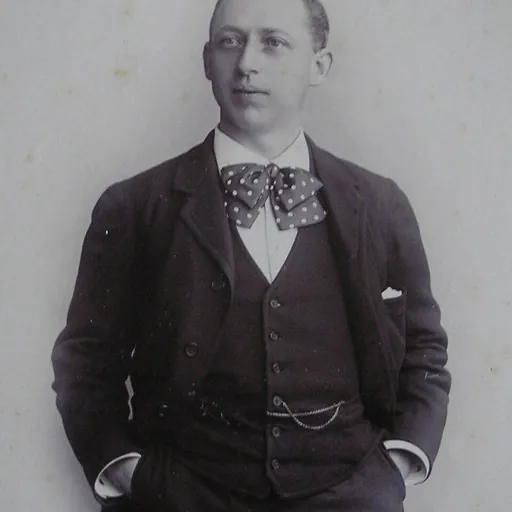
About Jean Delvoye
Lived 1854 – 1938 (aged 83). Jean Delvoye was a Belgian opera singer.
Jean Delvoye (25 November 1854, in Liège – 13 June 1938, in Ougrée) was a Belgian baritone, who, after working in the French provinces, enjoyed a long career in Paris, centred on the Opéra-Comique, and left some recordings representative of his repertoire.
Life and career
Delvoye studied singing at the Conservatoire de Liège under Georges Bonheur, obtaining a 2nd prize after only five months. He also won two first prizes in the "déclamation lyrique" class of baritone Sébastien Carman. He sang in Dunkerque during the 1886-1887 season, before moving on to Angers (1887-1888) then Nantes for two seasons, singing Zurga in Les pêcheurs de perles, and appearing as well in Les dragons de Villars, La Béarnaise, Si j'étais roi and Le Roi d'Ys. He spent 1890 to 1893 in Marseille, where he also took lessons from Ismaël as well as appearing in local premieres of Le Rêve et La Basoche. Later he sang in Nice then in Lyon, where he was praised for his superb method, stunning virtuosity, and his Beckmesser was singled out for praise.
His Paris début was at the Théâtre du Château d'Eau on 27 October 1898 as Ourrias in Mireille. At the Salle Favart, created Céleste (the role of Mazurier), le Chemineau (Thomas), Circé (Politès), La Danseuse de Pompéi (Philippe), La Fille de Tabarin (Frère Eloi), Le Follet (Jeannic), Les Fugitifs (Méraudon), L'Heure Espagnole (Inigo), Télémaque (Ménélas), Mârouf (Vizir), La Marseillaise (Moreau), Myrtil (Probulos), La Petite Maison (Dominique), La Reine Fiammette (Lucagnolo), La Revanche d'Iris (Diogène), Sanga (Gauchut), Le Secret de Maître Cornille (Cornille), Solange (le Maire de Saint-Dié), Titania (Mathieu), Les Visitandines (Frontin), Feminissima (le Précepteur) and sang in major revivals and local premieres of Hansel et Gretel (le Père), Macbeth (le Portier) and Tosca (le Sacristain),
He also appeared in le Barbier de Séville (Figaro, Bartholo), La Basoche (Duc de Longueville), Carmen (Escamillo), Cavalleria rusticana (Alfio), Le Déserteur (Montauciel), Don Juan (Mazetto), Don Pasquale (Malatesta), Les Dragons de Villars (Bellamy), Le Farfadet (Marcelin), L'Irato (Scapin), Falstaff (Ford), Fortunio (Maître André), Le Jongleur de Notre-Dame (Boniface), Lakmé (Frédéric), Louise (Chansonnier), Madame Butterfly (Sharpless), Le Maître de Chapelle (Barnabé), Maître Wolfram (Wolfram), Manon (Brétigny, Lescaut), Les Noces de Jeannette (Jean), L'Ouragan (Gervais), Le Roi d'Ys (Karnac), Sapho (Césaire), La Traviata (d'Orbel), and La Bohème (Marcel). Two of these were reissued on CD as part of the Becko set of historical Belgian singers.
Don’t just read it —
keep it.
Full-length biographies made to live with: read them, listen on the way to work, watch them tonight.
- E-book
- Audio
- Video
Instant download · yours to keep · every purchase keeps this site free
Important facts
Related people
Same field, nearest in time


Contemporaries
People whose lives overlapped Jean Delvoye's




Frequently asked questions
Who was Jean Delvoye?
Belgian singer and opera singer (1854–1938)
When was Jean Delvoye born?
Jean Delvoye was born on 25 November 1854 in Liège.
When did Jean Delvoye die?
Jean Delvoye died on 13 June 1938 in Ougrée.
What was Jean Delvoye's occupation?
Jean Delvoye was an opera singer.
What nationality was Jean Delvoye?
Jean Delvoye was Belgian.
Sources & further reading
Cite this page
APA: Biography.guide. (2026). Jean Delvoye. https://biography.guide/jean-delvoye/
MLA: "Jean Delvoye." Biography.guide, https://biography.guide/jean-delvoye/.
Chicago: "Jean Delvoye." Biography.guide. https://biography.guide/jean-delvoye/.
Data last updated: 2026-09-23 · Spot an error? Report a correction.
Portrait: Wikimedia Commons · author & licence
Page generated 2026-09-27 05:05 UTC