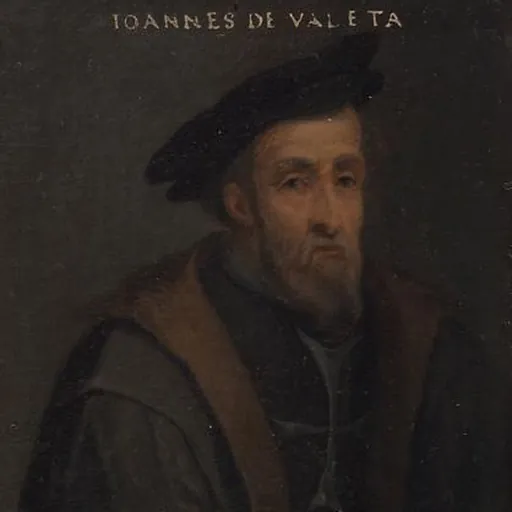
Jean de Valette Parisot
Nobleman from Quercy, having belonged to the order of the Hospitallers of Saint John of Jerusalem of which he was Grand Prior of Saint-Gilles (Langue de Provence) from 1556 to 1557 then Grand Master from 1557 to 1568
About Jean de Valette Parisot
Lived 1494 – 1568 (aged 73–74). Jean de Valette Parisot was a French warrior monk, politician, religious and military personnel.
Fra' Jean "Parisot" de (la) Valette (; – 21 August 1568) was a French nobleman and 49th Grand Master of the Order of Malta, from 21 August 1557 to his death in 1568. As a Knight Hospitaller, joining the order in the , he fought with distinction against the Turks at Rhodes. As Grand Master, Valette became the Order's hero and most illustrious leader, commanding the resistance against the Ottomans at the Great Siege of Malta in 1565, sometimes regarded as one of the greatest sieges of all time.
The foundation stone of Valletta was laid by Grandmaster La Valette in 1566. He did not live to see Valletta completed, as he died in 1568 and was succeeded by Grandmaster Pierre de Monte.
Early life
He was born into the noble La Valette family in Quercy, South-western France, which had been an important family in France for many generations, various members having participated in the Crusades. Jean Parisot's grandfather, Bernard de La Valette, was a Knight and King's Orderly, and his father Guillot was a Chevalier de France. Jean Parisot was a distant cousin (through their mutual ancestor Almaric, Seigneur de Parisot) of Jean Louis de Nogaret de La Valette, first Duke of Épernon.
Although his birth year is usually given as 1494, both chroniclers of the Great Siege of Malta, Francisco Balbi di Correggio and Hipolito Sans, say he was 67 at the time, thereby implying that he was born in 1498. In his history of the Order of St. John, the 18th-century historian Abbe Vertot (whose history is largely based on - but often contradicted - the earlier one of Giacomo Bosio) indicates that La Valette was indeed the same age as both Suleiman I and Kızılahmedli Mustafa Pasha (the commander of the Ottoman land forces), which would mean that he was actually 70 years old at the time of the siege.
Early career and rise within the Order
La Valette joined the Order when he was 20 years old in around 1514, and he never returned to France or his family estates from that day on.
After the loss of Rhodes, the Order was granted the Maltese Islands and Tripoli by Emperor Charles V. In 1538, he was imprisoned in the Gozo prison for four months after attacking a man. In 1541, La Valette was involved in a naval battle against Abd-ur-Rahman Kust Aly, in which he was wounded and his galley, the San Giovanni, was captured. La Valette was taken as a galley slave for a year by Barbary pirates under the command of Turgut Reis but was later freed during an exchange of prisoners. In 1546, La Valette became Governor of Tripoli, where he tried to restore order within the vulnerable city.
In 1554, he was elected Captain General of the Order's galleys.
Grandmastership
In 1557, upon the death of Grand Master Claude de la Sengle, the Knights, mindful of the attack that was sure to come, elected La Valette to be Grand Master. In 1560 he formed an alliance with the Habsburg Empire to reconquer Tripoli, but the expedition resulted in a Christian defeat at the Battle of Djerba. Despite this the Order's galleys were able to rescue several other Christian vessels, and later on in his reign, La Valette greatly strengthened the Order's navy.
Claims have also been put forth that La Valette had at least another child, Isabella Guasconi, after a presumed affair with the wife of a Rhodiot nobleman of Florentine descent. Isabella later married a Florentine gentleman Stefano Buonaccorsi, but he murdered her on 31 July 1568, sometime after their marriage. After the murder, Buonaccorsi escaped the islands with Isabella's wealth and was never heard from again.
Legacy
La Valette is well known for being the Grandmaster who won the Great Siege and founded Valletta. A street in the town of Naxxar as well as the flagship of Virtu Ferries are both named after him. La Valette was also featured on Maltese stamps, coins, banknotes and telecards a number of times.
Jean de Valette Square In 2012, a square was inaugurated in Valletta named Pjazza Jean de La Valette which also features a statue of the Grandmaster. The statue is 2.5m high and was cast in bronze by the local sculptor Joseph Chetcuti. In the statue, La Valette is shown in armour and holding Valletta's plan in one hand and a sword in the other.
For many years, the widely accepted version of the Grandmaster's surname was de La Valette. However, during the unveiling of the statue at Pjazza Jean de Valette in November 2012, judge and historian Giovanni Bonello stated that the Grandmaster always signed his name as de Valette without the La. A week later, Désireé von la Valette Saint Georges, a descendant of the Grandmaster, stated that the family name was de la Valette not de Valette and since then, a dispute has started as to what his name actually was.
Members of the various branches of the Valette family actually used both versions at the time, but the Grandmaster himself never used the La. In fact, all 138 coins and 19 medals minted by the Order during de Valette's reign show the names de Valette, de Valetta or just Valette. Bonello additionally stated that the La possibly originated since the city of Valletta was commonly called La Valletta, so people started including the La and sometimes the double l in the Grandmaster's name.
When de Vallette was around 45 years old and already in Malta, Francis I, seeing the wide linguistic disparity in the use of various Romance and Germanic languages in France, enacted the Ordinance of Villers-Cotterêts which prescribed the use of standard French, mostly as spoken in northern France and in the Paris area where the langues d'oui prevailed.
The name de Valette is now used in Malta, although many still refer to him as de La Valette due to the collective memory. The Order's successor, the Sovereign Military Order of Malta, call the Grandmaster Fra' Jean de La Vallette-Parisot.
In literature Due to his key role in holding Malta during the siege of 1565, de Valette has appeared as a main and supporting character in several works of literature:
Marthese Fenech's Siege of Malta Trilogy includes Eight-Pointed Cross (2011), Falcon's Shadow (2020), and Ash Fall (2022), and all three novels feature Valette. Angels in Iron is a 1997 pseudo-historic novel by Nicholas Prata; de Valette is the main character. Ironfire: An Epic Novel of War and Love is a 2005 adventure novel by David Ball. De Valette is a supporting character. The Religion: A Novel (2007) – by Tim Willocks; de Valette is a supporting character. The Course of Fortune (2015) – by Tony Rothman; de Valette is a supporting character, with the surname "de Valette" and portrayed according to recent historical evidence. The Great Siege is a 1961 historic account of the 1565 siege, as drawn from historic documents. Πανάκεια (2008) / Panacea, a Greek adventure novel by Παναγιώτης Κονιδάρης. De Valette is a supporting character.
Don’t just read it —
keep it.
Full-length biographies made to live with: read them, listen on the way to work, watch them tonight.
- E-book
- Audio
- Video
Instant download · yours to keep · every purchase keeps this site free
Important facts
People in Jean de Valette Parisot's life
Named in this biography and alive at the same time



Related people
Same field, nearest in time
Contemporaries
People whose lives overlapped Jean de Valette Parisot's






Frequently asked questions
Who was Jean de Valette Parisot?
nobleman from Quercy, having belonged to the order of the Hospitallers of Saint John of Jerusalem of which he was Grand Prior of Saint-Gilles (Langue de Provence) from 1556 to 1557 then Grand Master from 1557 to 1568
When was Jean de Valette Parisot born?
Jean de Valette Parisot was born in 1494 in Parisot.
When did Jean de Valette Parisot die?
Jean de Valette Parisot died on 21 August 1568 in Malta.
What was Jean de Valette Parisot's occupation?
Jean de Valette Parisot was a warrior monk, politician, religious and military personnel.
What nationality was Jean de Valette Parisot?
Jean de Valette Parisot was French.
Sources & further reading
· Wikipedia: Jean de Valette Parisot
· DBpedia: Jean Parisot de Valette
Cite this page
APA: Biography.guide. (2026). Jean de Valette Parisot. https://biography.guide/jean-de-valette-parisot/
MLA: "Jean de Valette Parisot." Biography.guide, https://biography.guide/jean-de-valette-parisot/.
Chicago: "Jean de Valette Parisot." Biography.guide. https://biography.guide/jean-de-valette-parisot/.
Data last updated: 2026-09-23 · Spot an error? Report a correction.
Portrait: Wikimedia Commons · author & licence
Page generated 2026-09-27 05:07 UTC