
About Jean de Dinteville
Lived 1504 – 1557 (aged 52–53). Jean de Dinteville was a French diplomat.
Jean de Dinteville (21 September 1504 – 1555) was a French courtier, administrator and diplomat who served Francis I and members of the French royal family. As seigneur of Polisy and bailli of Troyes, he undertook five diplomatic missions to the court of Henry VIII of England between 1531 and 1537, a period encompassing Henry's marriage to Anne Boleyn and the developing English break with Rome. He later played an active part in the restoration to royal favour of the Dinteville family after a political crisis in the late 1530s.
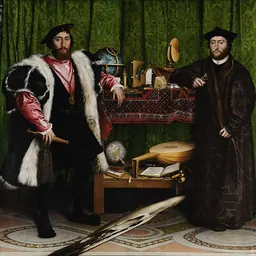
Dinteville is best known as the figure on the left in Hans Holbein the Younger's 1533 double portrait Jean de Dinteville and Georges de Selve, commonly known as The Ambassadors. The painting, which Dinteville commissioned during his principal English embassy, was subsequently displayed at his family's château at Polisy.
Jean's paternal grandfather, Claude de Dinteville, served Charles the Bold, Duke of Burgundy, as surintendant des finances and was killed alongside him at the Battle of Nancy in 1477. Jean's father, Gaucher de Dinteville (1459–1531), served Louis XII and Francis I, acted as Francis I's lieutenant in Italy and was awarded the Order of Saint Michael. More recent scholarship has suggested that the unidentified artist was probably Netherlandish and may have been Bartholomeus Pons, although that attribution remains uncertain.
The work bears repeated references to the year 1537, and the Metropolitan Museum dates it accordingly. Brown has argued, however, that it may instead have been commissioned around 1539, after François, Guillaume and Gaucher had gone into Italian exile. On this interpretation, the references to 1537 recall the last period before the family's fall from royal favour rather than necessarily recording the date of the painting's execution.
Brown has interpreted the biblical imagery as an allegory of the family's political circumstances. The exiled Dintevilles are associated with the captive Israelites awaiting deliverance, whereas Jean, who remained in France, appears as Moses. In Brown's interpretation, the painting functioned not only as a family portrait but as an allegorical statement about persecution, exile and hoped-for restoration.
Return to royal service and Polisy
Following the family's reconciliation with the crown, Dinteville resumed royal service. He returned to the household of Charles, Duke of Orléans, in 1542 and in 1549 was appointed gentilhomme ordinaire of the chamber of Henri II, an office in the king's household.
During these years, Polisy became an increasingly important focus of Dinteville's activity. He undertook substantial rebuilding of the family's older residence, with construction under way by the mid-1540s.
Francesco Primaticcio, who worked at Fontainebleau and maintained connections with the Dinteville family, was at Polisy in December 1544. Domenico del Barbiere was also associated with the documentary record of that visit. Although both artists have subsequently been connected with the renovation of the château, their involvement in the building work remains uncertain.
Decorative work commissioned for Polisy included an elaborate tiled pavement dating from the 1540s. The château also became the setting for major works associated with the family, including The Ambassadors and Moses and Aaron before Pharaoh. The 1589 inventory records both paintings at Polisy.
Dinteville and his brothers were also associated with broader artistic patronage. An elaborately illuminated manuscript now in the Bibliothèque nationale de France, Latin 1429, was originally produced for a member of the Dinteville family after its return to royal favour in 1542 and was later altered for presentation to Henri II. The identity of the original Dinteville commissioner is uncertain, and the manuscript cannot securely be attributed to Jean personally.
Illness and final years
Dinteville's health deteriorated during the later years of his life. Documents mention illness as early as 1542, while later family evidence associates the onset of his severe paralysing condition with about 1546.
The surviving sources describe the effects of the illness but do not identify its medical cause. A younger relative, Jean de Mergey, later remembered Dinteville as paralytique et impotent de tous ses membres—paralysed and deprived of the use of his limbs. Royal documents similarly refer to his weakness, debility and inability to attend court.
Nevertheless, his illness did not immediately end his royal standing. Despite his increasing disability, Dinteville was appointed to Henri II's chamber in 1549.
Jean de Mergey, a younger relative who spent time at Polisy, later described Dinteville as occupying himself with the construction of the château after illness prevented his continued attendance at court. Dinteville's building and artistic activities at Polisy therefore continued during at least part of his physical decline.
His connections with court artists also persisted. At some point in 1551 or 1552, Primaticcio wrote to François II de Dinteville that he intended to make another likeness of Jean for the Duke of Guise, showing that portraits of Dinteville were still being requested during his final years.
By 1552 Dinteville was reported to be unable to leave his home. He died unmarried in 1555. A seventeenth-century family account records that he was buried in the church at Polisy.
Portraits and legacy
Dinteville's modern reputation rests principally on Holbein's The Ambassadors, now in the National Gallery in London, which has become one of the best-known portraits of the Northern Renaissance and has generated extensive scholarship concerning its political, religious and scientific imagery.
The few other surviving or documented likenesses provide a broader visual record of Dinteville. A chalk portrait by Jean Clouet is preserved at the Musée Condé at Chantilly. Dinteville also appears as Moses in Moses and Aaron before Pharaoh. At least one further portrait or drawing was planned by Primaticcio late in Dinteville's life, although the identification of some paintings traditionally claimed to represent him remains disputed.
Although remembered chiefly as the principal sitter in Holbein's painting, surviving diplomatic correspondence and modern scholarship document a substantially wider career. Dinteville served successive members of the French royal family, administered royal authority in Champagne and undertook repeated missions to Henry VIII's court during a decisive period of the English Reformation. He remained in France during his brothers' exile, played an active part in the family's return to royal favour, and continued his architectural and artistic activities at Polisy despite severe illness in his later years.
Don’t just read it —
keep it.
Full-length biographies made to live with: read them, listen on the way to work, watch them tonight.
- E-book
- Audio
- Video
Instant download · yours to keep · every purchase keeps this site free
Important facts
People in Jean de Dinteville's life
Named in this biography and alive at the same time




Related people
Same field, nearest in time


Contemporaries
People whose lives overlapped Jean de Dinteville's
Frequently asked questions
Who was Jean de Dinteville?
French diplomat
When was Jean de Dinteville born?
Jean de Dinteville was born on 21 September 1504 in Troyes.
When did Jean de Dinteville die?
Jean de Dinteville died in 1557 in Polisy.
What was Jean de Dinteville's occupation?
Jean de Dinteville was a diplomat.
What nationality was Jean de Dinteville?
Jean de Dinteville was French.
Sources & further reading
· Wikipedia: Jean de Dinteville
Cite this page
APA: Biography.guide. (2026). Jean de Dinteville. https://biography.guide/jean-de-dinteville/
MLA: "Jean de Dinteville." Biography.guide, https://biography.guide/jean-de-dinteville/.
Chicago: "Jean de Dinteville." Biography.guide. https://biography.guide/jean-de-dinteville/.
Data last updated: 2026-09-20 · Spot an error? Report a correction.
Page generated 2026-09-27 05:19 UTC