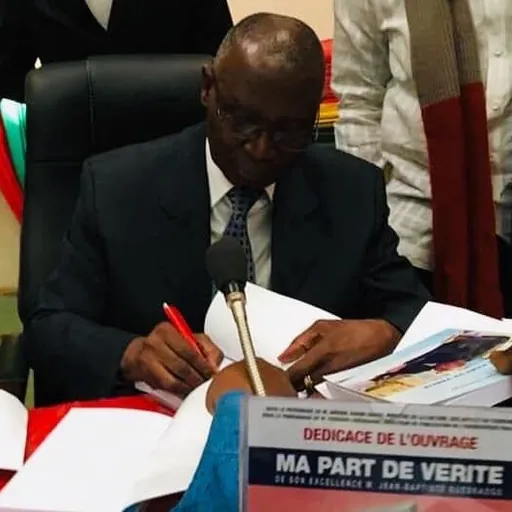
About Jean-Baptiste Ouédraogo
Born 1942. Jean-Baptiste Ouédraogo is a Burkinabé and French politician and president.
Jean-Baptiste Philippe Ouédraogo (; born 30 June 1942), also referred to by his initials JBO,
Ouédraogo became the first head of the paediatrics department at the Centre hospitalier universitaire Yalgado-Ouédraogo in Ouagadougou, serving there from 1976 until 1977.
Military career and presidency Early military career
Ouédraogo was commissioned as a second lieutenant and medic into the Upper Voltan Army in October 1972. In October 1979 he was promoted to médicin-commandant (equivalent to major). Three years later he was appointed chief medical officer of the new Ouagadougou military base, Camp Militaire de Gounghin.
On 21 November Ouédraogo declared that the CSP would restore a constitutional, civilian regime in two years time. Five days later the CSP installed a formal government. Ouédraogo was the only soldier in the cabinet and, in addition to his role as President, was made Minister of National Defence and Veterans Affairs. On the whole the CSP exercised true control of the government while Ouédraogo served as little more than a figurehead. The freedoms of labour unions and the press, having been restricted under Zerbo's reign, were restored by the new administration. Ouédraogo attended Mogho Naba Kougri's funeral in December and placed a wreath at the Mossi leader's coffin. The CSP elected Sankara as Prime Minister in January 1983, That day the CSP organised a large rally in the city where a moderate speech by Ouédraogo was much less enthusiastically received than Sankara's radical remarks. From 20 to 26 April Ouédraogo and several of his ministers visited Lomé, Togo; Accra, Ghana; and Niamey, Niger. President Félix Houphouët-Boigny refused to meet him in the Ivory Coast, advising that he should focus on stemming Libyan influence within his own country.
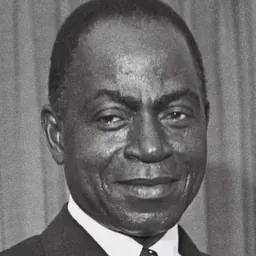
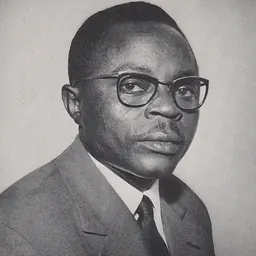
Dispute with Sankara and overthrow Ouédraogo's rehabilitation of former Upper Voltan President Maurice Yaméogo (pictured) generated backlash from some politicians. As his tenure progressed, Ouédraogo found himself unable to reconcile the conservative and radical factions of the CSP, whose disagreements were leading to a political stalemate. On 14 May 1983 the CSP convened in the town of Bobo-Dioulasso. A crowd gathered to hear a message from the council. Sankara spoke until dusk, and the crowd mostly dispersed, its members eager to break their Ramadan fasts. Ouédraogo was in turn left without an audience for his speech, as Sankara seemingly intended in an effort to humiliate him. The following day he met with Guy Penne, a top African affairs adviser of President of France François Mitterrand. On 16 May he purged his government of pro-Libyan and anti-French elements, disbanded the CSP, and had Sankara and several other important officials arrested. Explaining the reasons for the radicals' removal, he said, "It is a problem of ideology...We were following step by step the program of the Ligue patriotique pour le développement , and that program was to lead us to a communist society." He met again with Penne, who promised his government significant financial aid from France. One officer, Blaise Compaoré, evaded capture and escaped to Sankara's former garrison at Pô where he began to organise resistance. In the following days large demonstrations occurred in Ouagadougou in support of Sankara. Ouédraogo's political position was weak; his left-wing opponents were well organised while he did not have reliable connections with the conservative factions he supposedly represented and could only really count on the support of a handful of his former classmates from the Pabré minor seminary. Realising that the use of force was of little recourse, he sought to resolve the situation by appeasing his adversaries.
On 27 May Ouédraogo delivered a speech, promising a quick return to civilian rule and the liberation of political prisoners. He also announced the drafting of a new constitution within six months, to be followed by an election in which he would not participate. Sankara became the new President of Upper Volta. Ouédraogo was officially removed from his post as Minister of National Defence on 23 August and succeeded by Jean-Baptiste Boukary Lingani. He was discharged from the army two days later. Sankara changed the name of Upper Volta to Burkina Faso in 1984, and three years later he was killed in a coup and replaced by Compaoré.
Later life Ouédraogo was granted clemency on 4 August 1985 and returned to medical work, taking a job at the Hôpital Yalgado-Ouédraogo. That December a street in the Nongr-Massom district of Ouagadougou was named after him. In 2016 he was the president of the Fédération des Associations Professionnelles de la Santé Privée. As of 2021 Ouédraogo still worked at his medical clinic.
Involvement in politics "I have been mediator a few times. And every time I have been, I have always felt it was a duty and a moral obligation not to shun a patriotic call...Whenever my contribution can help to solve a problem, I am happy to do so." source= Ouédraogo's thoughts on serving as a political mediator (translated from French) In 1999 he was made a member of the Conseil du Sages, though by 2014 he had left the consultative body. In November 2012 he delivered a speech on behalf of himself and Saye Zerbo, expressing concern about how corrupt Burkina Faso's administration had become over the preceding years and accusing the country's leaders of inaction on the matter.
In early 2014 Ouédraogo acted as a mediator between President Compaoré and opposition groups as tensions between the two dramatically rose. However, the arbitration failed in April, and Compaoré later resigned and fled the country. In September 2015 members of the military launched a coup. Ouédraogo was asked to mediate, and he attempted to delay the putschists and secure the release of hostages. As the army turned against the coup he made multiple appeals to the plot's leader, Gilbert Diendéré, to surrender. After seeking refuge in the Vatican embassy, Diendéré was handed over to Burkinabé transitional government authorities and Ouédraogo escorted him into custody at the gendarmerie base in the capital. In April 2017 Ouédraogo and several other national figures met with leaders of the Coalition for Democracy and National Reconciliation, an opposition coalition formed out of Compaoré's supporters, to discuss political reconciliation. In 2020 he released a memoir titled Ma part de vérité.
Don’t just read it —
keep it.
Full-length biographies made to live with: read them, listen on the way to work, watch them tonight.
- E-book
- Audio
- Video
Instant download · yours to keep · every purchase keeps this site free
Important facts
People in Jean-Baptiste Ouédraogo's life
Named in this biography and alive at the same time


Related people
Same field, nearest in time



Contemporaries
People whose lives overlapped Jean-Baptiste Ouédraogo's


Frequently asked questions
Who is Jean-Baptiste Ouédraogo?
Burkinabé politician
When was Jean-Baptiste Ouédraogo born?
Jean-Baptiste Ouédraogo was born on 30 June 1942 in Kaya.
What is Jean-Baptiste Ouédraogo's occupation?
Jean-Baptiste Ouédraogo is a politician and president.
What nationality is Jean-Baptiste Ouédraogo?
Jean-Baptiste Ouédraogo is Burkinabé and French.
Sources & further reading
· Wikipedia: Jean-Baptiste Ouédraogo
· DBpedia: Jean-Baptiste Ouédraogo
Cite this page
APA: Biography.guide. (2026). Jean-Baptiste Ouédraogo. https://biography.guide/jean-baptiste-ouedraogo/
MLA: "Jean-Baptiste Ouédraogo." Biography.guide, https://biography.guide/jean-baptiste-ouedraogo/.
Chicago: "Jean-Baptiste Ouédraogo." Biography.guide. https://biography.guide/jean-baptiste-ouedraogo/.
Data last updated: 2026-09-22 · Spot an error? Report a correction.
Portrait: Wikimedia Commons · author & licence
Page generated 2026-09-27 05:02 UTC