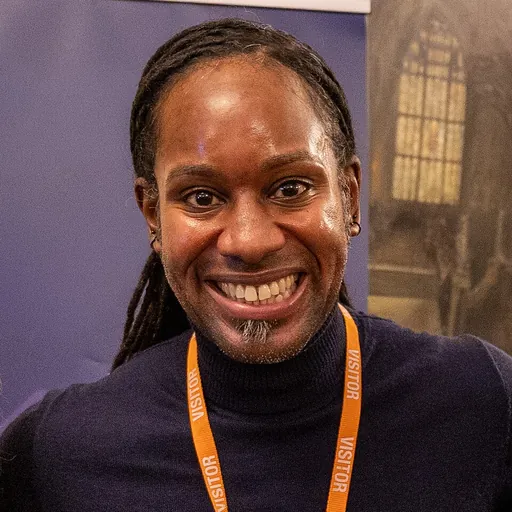
About Jason Arday
Lived 1985 – 2026 (aged 41). Jason Arday was a British sociologist, university teacher, pedagogue and sports pedagogue.
Jason Atta Kwei Arday (9 May 1985 – 14 August 2026) was a British academic and a professor of sociology of education. He joined the faculty of the University of Cambridge in 2023, becoming the youngest black professor in the university's history. In August 2026, he resigned following accusations of academic misconduct and biographical inaccuracies. Arday was found dead at his London home nine days later.
Born in London to Ghanaian parents, Arday said he was diagnosed with autism, was mute until 11, and could not read or write until adulthood. After receiving a PhD from Liverpool John Moores University in 2015, Arday taught physical education at Leeds Beckett and Roehampton, education studies at Warwick, and sociology at Durham and Glasgow, where he became a professor in 2022. From 2018, he produced academic publications, some focusing on race and racism in the British education sector, and others offering autoethnographic reflections about his life as a neurodivergent black academic. After joining Cambridge in 2023, Arday attracted media attention and made television appearances over the following years. He was given several honorary degrees, and was appointed to trustee and advisory roles in civil society. His memoir, Great and Unfortunate Things, was published in 2026.
In 2026, media reported allegations that Arday had engaged in plagiarism, falsified research, and made false claims regarding his academic and personal history. Although acknowledging mistakes in his work, Arday maintained he was not a liar, noted that an institutional panel had cleared his PhD thesis of deliberate plagiarism, and argued that there was a racially motivated campaign against him. Shortly after Cambridge announced an investigation into his appointment, Arday resigned. Some media commentators and academics accused Cambridge's employment process of failing to uphold academic standards, argued that the controversy emboldened critics of equality, diversity, and inclusion (EDI) initiatives, and stated that the case increased challenges for black scholars.
Prime Minister Andy Burnham and other political figures expressed condolences upon Arday's death. Various politicians and other public figures said that Arday had been subjected to a racist public shaming by sections of the media, with some calling for a public inquiry into this and greater press regulation. Some media sources defended their obligation to report allegations of academic misconduct and The Guardian noted that journalists investigating the claims were facing abuse.
Early life and education Jason Atta Kwei Arday was born in Clapham, South London, on 9 May 1985 to Ghanaian parents. He was the third of four brothers and also grew up in Clapham. His mother was a mental health nurse and his father a chef. According to his memoir, Arday spent many afternoons missing secondary school and playing snooker, regularly winning money in tournaments across London. He wrote that, as a student, he made money by entering pro–am nine-ball pool tournaments and frequently reaching the latter stages, winning prize money.
Arday said that at the age of three, he received diagnoses of autism, global developmental delay, deafness, and dyscalculia, and was non-verbal until the age of 11. The claim of being non-verbal was later contested in the media. The statement that he was illiterate until 18 also came under media scrutiny. In 2012, Arday was a bearer of the Olympic Torch. That year, he met the tennis player Andy Murray on the television show Surprise Surprise.
Higher education Arday studied for his BA and MA degrees at St Mary's University, Twickenham, which later awarded him an honorary doctorate.
In 2005, Arday began undergraduate study in education studies with physical education at St Mary's University, Twickenham, graduating with a Bachelor of Arts (BA) degree, validated by the University of Surrey, in 2008. He remained to complete a Master of Arts (MA) degree in education and pedagogy.
Arday then attended Liverpool John Moores University, where he gained a Doctor of Philosophy (PhD) degree in education. and to have relearnt the content of his dissertation weeks before defending it due to memory loss following the removal of a brain tumour and suffering a transient ischemic attack, or mini-stroke. Arday's thesis, An Exploration of Peer-Mentoring among Student Teachers sic to Inform Reflective Practice within the Context of Action Research, was completed in 2015 under the supervision of Phil Vickerman, who hired Arday as a lecturer at LJMU. According to Arday's memoir, one examiner remarked about his thesis, "I am struggling to see that there is any original contribution here".
Arday gained an academic post at Leeds Beckett University. According to his memoir, he joined this university as a physical education specialist in 2014, while he was still working on his PhD.
Arday claimed he began a job in 2017 as head of the sports department at "a university in London" before his position was cut for financial reasons on his second day. Arday said he then secured a teaching position at "one of the UK's most prestigious universities", but soon resigned as he was given additional unwanted responsibility for recruiting black students. He subsequently became an associate professor of sociology at Durham University. At Durham, Arday conceived and developed Pro:NE, a project to run events, training and workshops to encourage people of colour to enter academia across North East England. Operating in collaboration with five other universities in the region, it secured £2.5 million of funding. In 2020, he was interviewed for a BBC News article discussing the proportional under-representation of black, Asian and ethnic minority PhD candidates. That year, he wrote a report for The Black Curriculum, which stated that the UK school curriculum "systematically omits the contribution of black British history in favour of a dominant white, Eurocentric curriculum".
Between 2022 and 2023, Arday taught the sociology of education at the University of Glasgow (pictured).
In 2020, Routledge published Arday's monograph, Cool Britannia and Multi-Ethnic Britain: Uncorking the Champagne Supernova, referencing the "Cool Britannia" pop culture phenemonon of the 1990s. The book examines that decade in Britain and its music through Arday's own autoethnographical lens, with a particular focus on racial issues such as the murder of Stephen Lawrence and the resulting Macpherson Inquiry. He said that he had interviewed just over 80 people as part of his research for the monograph. In 2026, the musicologist Ian Pace reviewed the monograph in The Critic, calling it "intellectually threadbare, methodologically indefensible and textually compromised", arguing that it failed in its aim of providing a sociological analysis of 1990s British culture. In a 2023 interview with The Guardian, Arday said that he had "barely slept" for the previous 15 years due to his precarious employment. The hiring process was informed by the university's equality and inclusion working group. Arday became a Fellow of Jesus College.
On his appointment, Hilary Cremin, head of the Faculty of Education, described Arday as "the best in the world in terms of the research that you do." Bhaskar Vira, the university's pro-vice-chancellor for education, similarly called him "an exceptional scholar of race, inequality and education. He will contribute significantly to Cambridge's research in this area". In January 2024 Arday was appointed to ITV's cultural advisory council. In February 2024, he was a guest on the BBC TV current affairs panel programme Question Time,
Arday was appointed a Fellow of Jesus College, Cambridge (entrance pictured). In the two years after receiving his Cambridge position, Arday was awarded honorary doctorates from Anglia Ruskin University, Southampton Solent University, the University of Westminster, South Bank Colleges, and St Mary's University, Twickenham. In 2023, he received the "Most Inspirational Person of the Year Award" at the MBCC (Multicultural Business and Community Champion) Awards, was placed fourth in the Shaw Trust's list of the 100 most influential disabled people in the UK, and was awarded an honorary fellowship by the British Science Association.
In 2025, he became patron of Get Further, a charity promoting English and mathematics education. He served on the Royal Society's Diversity and Inclusion Committee between 2023 and 2026 and as a member of its Rosalind Franklin Award committee from 2024 to 2025. By 2026, he was listed as a trustee of the Adult Literacy Trust, Autism Action, and the British Sociological Association. Arday also signed up to speakers' bureau x and addressed conventions of a range of associations, including at gatherings of the Association of British Insurers and the U.S. National Association of Funeral Directors. Similarly, in the Sociological Review Foundation, Alexa MacDermot wrote that "Lewis and Arday's call to action is a visceral demand for change, particularly in education, that we can all implement in our daily lives". Siobhan O'Neill, writing in Ethnic and Racial Studies, called it "an original and valuable contribution for those theorising and working toward social and racial justice", arguing that a "real strength" of the work was its "approach to intersectionality".
Later evaluations of Arday's appointment Following the allegations around Arday's work in 2026, many commentators questioned his Cambridge appointment. The Guardian noted that such a senior appointment was unusual for someone as young as 37, particularly given Arday's "slim track record of research and publications compared with those appointed to similar chairs at Cambridge".
Roger Mosey, a former Master of Selwyn College, Cambridge, said that Arday was a "compelling candidate" for the role because of his claims to have autism and to have been unable to read until he was 18.
Some media alleged that Cambridge appointed Arday to the position because he was black. The Times of India later noted that Arday "was presented as an inspiring figure and a symbol of progress in an institution that has faced criticism over the historical under-representation of Black academics". The BBC reported that, as of 2025, Cambridge's black academics numbered 75 out of 6,180, and that the university had "spent the last decade working to redress the perception that the institution is a bastion of affluent white privilege".
Allegations of misconduct and fabrication
Initial concerns In May 2023, David Harris, an emeritus professor at Plymouth Marjon University, emailed Arday to enquire about similarities between sentences in Arday's 2018 Social Sciences article and an earlier BMJ Open article by Anjum Memon. Arday responded: "Instead of spending your time trying to dismantle racism and ableism, you have spent what I assume is hours combing through my work looking for mistakes [...] Anything further from you will be considered bullying and harassment." a legal firm specialising in libel, after which the Times Higher Education chose not to publish the story. Grove said that the story could have tied the publication up in months of expensive litigation. Mark Rowley, Commissioner of the Metropolitan Police, later said that the complaint about Grove should not have been taken forward.
Having been alerted in 2025 to allegations of plagiarism in Arday's PhD thesis, Liverpool John Moores University—which had awarded him his PhD—established a misconduct panel. Arday did not dispute the allegations of plagiarism, but said he had not received adequate supervision given his autism and learning disabilities, and described the allegations against him as being part of an "insidious and relentless" strategy to undermine black academics. Accepting that there were problems with Arday's supervision, the panel concluded that the similarities between Arday's thesis and an earlier PhD thesis by another academic were the result of "honest and reasonable error", not deliberate plagiarism, and were "well within the accepted range of compliance with the academic standards of the time". Cofnas said he had run Arday's PhD thesis through plagiarism detection software and discovered that "many passages are lifted with minimal editing, sometimes retaining copy-editing mistakes from the original source".
On 24 July, an article by Gordon Rayner in The Daily Telegraph alleged that Arday's published works, including his PhD thesis, contained similar or identical passages to other academic works. On 1 August, The Guardian published its own investigation by Lanre Bakare, highlighting wider discrepancies in claims Arday had made about his life. and featured heavily across social media.
When Bakare challenged Arday over accusations of plagiarism, Arday said "there have been multiple thorough investigations across several institutions as a result of the allegations, and immense scrutiny, including with an academic misconduct panel who concluded that there was no plagiarism or academic misconduct."
The Times further alleged a falsified statement about funding; a 2021 article by Arday reported that the research was financed by the charity Mind, which the organisation denied. and a speech professional who worked with Arday when he was young said his claims were false. A parent of a childhood friend said he had "severe learning difficulties" as a child and that she did not witness him speaking until he was 14–15.
In 2022, Arday said he was involved in a programme called Seven Up as a child, "when they follow you over the duration of your life.. at [ages] 7, 14, 21. I was pulled out of the project when I was 14." Gareth Corfield of The Daily Telegraph stated that it was impossible for Arday to have appeared in the televised documentary programme Seven Up!, as it first aired two decades before Arday's birth. Celia Walden said that a BBC spokesperson also denied that Arday was in the spin-off Up New Generation, which followed people who were aged seven in 2000. Some of Arday's supporters stated that he was referring to a community project of the same name, not a television show.
Arday's charitable work was also questioned. For example, he said he worked on projects abroad for the charity WaterAid. The charity told The Daily Telegraph that it did not send volunteers abroad. David Sanders, associate professor at Purdue University, who writes on scientific misconduct for Times Higher Education, reviewed the 63 page dossier of text comparisons prepared by Times Higher Education and stated: "There is no question that there is extensive plagiarism."
Cambridge University initially defended Arday, stating that he was "the victim of a vile campaign to undermine his credibility" and that his PhD thesis had been cleared of deliberate plagiarism by the Liverpool John Moores University misconduct panel. Several signatories subsequently had their names removed or distanced themselves from the letter as more allegations came to light, including Uchegbu, Alleyne, and Kebede.
Academic investigation and resignation On 5 August, following publication of The Guardian article, Cambridge University announced it had begun an investigation into Arday's qualifications and appointments. Four days later, he also resigned as a publication director and trustee of the British Sociological Association. The letter expressed concern that the affair would discourage black academics from taking future jobs at Cambridge and had "the potential to set back the modest progress Cambridge has made in addressing historical underrepresentation". Among the almost 100 signatories were the physicist Suchitra Sebastian, sociologist Mónica Figueroa, literature scholar Clair Wills, logician Anuj Dawar and historian Nicholas Guyatt. Gopal said that "American-style affirmative action … simply doesn’t exist" at Cambridge. while Queen's University Belfast began investigating a 2021 article that Arday had co-written with several of its employees.
Possible implications for academia The Guardian reported interviewing academics who believed that "fallout from the row could [...] set the study of race in Britain back 20 years". Paul Gilroy, a sociologist at University College London, stated his concern that the controversy would overshadow cuts being made to humanities programmes, and that "the unthinking culture warriors who have supported [Arday] unconditionally share responsibility with his racist critics for making life harder for Black academics and dragging UK higher education deeper into the mire".
The New Statesman commented that Arday was an example of a perceived decline in academic standards, and that the scandal gave ammunition to those who regard the sociology of education and related fields as "low-value pseudo-science". In The Guardian, Okundaye commented that the affair played into issues of Britain's culture wars, in particular the view held by some that academic standards have been lowered due to "woke" beliefs and EDI policies. Various right-wing figures suggested that Arday's appointment was the result of EDI policies. Former Conservative politician Jacob Rees-Mogg stated that the incident revealed how Cambridge had "drunk the D.E.I. Kool-Aid".
The journalist and author Nesrine Malik told The Guardian that it was hard "not to feel this is about all of us" black people, resulting in feeling that black people were likely to be seen as exaggerating their credentials, or that black people had been given preferential treatment and used by liberal institutions to seem more diverse.
Memoir
Arday's memoir, Great and Unfortunate Things, co-written with Eve Claxton, was released in the US on 11 August and the UK on 27 August 2026. Arday said he had been paid an advance of "1.4 million" for the book, although he did not specify the currency. Prior to Arday's resignation, the publishers confirmed that they had not changed their plans to launch the book, although three promotional appearances by Arday were cancelled. The Washington Free Beacon said there were similarities between the memoir's contents and films and television shows that Arday had publicly admired.
US print sales for its first five days were 433.
Personal life Arday married Debbie McKenzie, a teacher, in 2014. In his memoir, he said that it was McKenzie, at the time his girlfriend, who helped him read and write. They separated in 2019. An inquest into Arday's death opened on 26 August 2026 at London Inner South Coroner's Court. The senior coroner, Julian Morris, said that the London Ambulance Service and Metropolitan Police had attended the address after Arday was found unresponsive, that he had been pronounced dead at the scene despite attempts at resuscitation, and that the police had said the scene was not suspicious. Morris said that initial investigations had given him "reason to suspect that Professor Arday died an unnatural death", and that an investigation was therefore being opened.
Reactions
Arday's family stated that "Jason was subjected to a campaign of sustained abuse for the more than three years since he accepted the role of professor at Cambridge University by those who would leave no stone unturned in their quest to undermine him" and that it had become too much for him to bear. Political activist Patrick Vernon established a fundraiser for Arday's family, raising over £200,000. Arday's postdoctoral students organised a vigil in Cambridge attended by over 200 people, while another, organised by Stand Up to Racism in central London, attracted several thousand.
Describing Arday's death as "a tragedy on so many levels", Prime Minister Andy Burnham called for a "moment of reflection" and encouraged people not to rush to judgement. The universities of Cambridge and Glasgow expressed deep sadness and offered their condolences to Arday's family. Cambridge defended their handling of the situation, stating that they had provided Arday with "extensive mental health support and security measures" following his resignation. Media debates regarding Arday's statements continued following his death. The suspension was partially lifted nine days later.
Media criticism Some academics, journalists, and activists criticised the extent of media scrutiny of Arday, arguing that while there were legitimate questions about his career, coverage was disproportionate to that such academic investigations normally receive, possibly due to his race, and possibly contributing to his death. Trade union leader Daniel Kebede criticised what he called a "public and brutal takedown" that unleashed a "tirade of racism". The Mayor of London, Sadiq Khan, said that Arday had been the victim of an "unacceptable public hounding" and a "pernicious public shaming". The National Union of Journalists stated that, although there were "legitimate concerns over aspects" of the Arday coverage, it condemned "attacks against individual journalists – including Black journalists – who have been targeted with threats, harassment or racial slurs following Arday's death." Several commentators likened Arday's treatment to lynching, including in The Emancipator, Socialist Worker, Inside Higher Ed, and The Irish News.
Simon Woolley, Principal of Homerton College, Cambridge and Arday's former mentor, called for an investigation into the media's handling of the accusations. By 18 August, 188,000 complaints had been sent to the UK's media regulator, the Independent Press Standards Organisation (IPSO), via the one click mechanism of Newscord; IPSO noted that it would only accept those which could be verified as having been sent by humans. A cross-party group of 53 MPs and peers, organized by Labour MP Afzal Khan, wrote to IPSO requesting an inquiry into the media scrutiny surrounding Arday prior to his death. The signatories argued that the coverage exceeded legitimate public-interest reporting and that Arday's race was a key factor in the volume and hostile tone of the press attention.
The number of articles by the British media on Arday has been tallied by independent organisations for various periods. An NLA ClipShare search by The Observer found 210 articles published by seven major British newspapers over the last year. An analysis of the coverage published in The Conversation using LexisNexis data showed 242 substantive print articles about Arday from 25 July to 20 August, with The Times leading, with 53 articles.
Tyler Austin Harper, writing in The Atlantic, argued that competing accounts of Arday's career contained elements of truth: that race had played a role in the enthusiasm surrounding his appointment, but also in the intense scrutiny surrounding the allegations against him. The New York Times stated that the press scrutiny was "as much about Cambridge" as it was about Arday himself. Although agreeing that Arday faced racism, an editorial in The Guardian defended its reporting: "It was right for the Guardian to publish its investigation, and it is wrong that the journalists who did their job responsibly are now being subjected to an onslaught of abuse." Graeme Wood in The Atlantic argued that "The press's obsession was in proportion with the outlandishness of the lies told by Arday and on his behalf, and with public interest in the failures they revealed."
In The Telegraph, Charles Moore wrote that responsibility for Arday's death lay with Cambridge for initially dismissing allegations rather than investigating them in a timely manner, while Sarah Ditum of The Times said that Arday was a legitimate subject because of his previously relatively high media profile and the consequences for others of his academic misconduct. She acknowledged that focus on the story may have been intensified by its occurring in summer's silly season when Parliament is in recess and there are fewer newsworthy events. Helen Lewis in The Atlantic noted the impact on the volume of coverage of competition between media outlets and the large number of claims being scrutinised and challenged, particularly when they were denied or amended. Conservative party leader Kemi Badenoch said "I don't think that Jason Arday's death should be used as a way to bring about a muzzling of the press."
Don’t just read it —
keep it.
Full-length biographies made to live with: read them, listen on the way to work, watch them tonight.
- E-book
- Audio
- Video
Instant download · yours to keep · every purchase keeps this site free
Important facts
People in Jason Arday's life
Named in this biography and alive at the same time





Related people
Same field, nearest in time



Contemporaries
People whose lives overlapped Jason Arday's

Frequently asked questions
Who was Jason Arday?
British academic (1985–2026)
When was Jason Arday born?
Jason Arday was born on 9 May 1985 in Clapham, London.
When did Jason Arday die?
Jason Arday died on 14 August 2026 in Battersea, London.
What was Jason Arday's occupation?
Jason Arday was a sociologist, university teacher, pedagogue and sports pedagogue.
What nationality was Jason Arday?
Jason Arday was British.
Sources & further reading
Cite this page
APA: Biography.guide. (2026). Jason Arday. https://biography.guide/jason-arday/
MLA: "Jason Arday." Biography.guide, https://biography.guide/jason-arday/.
Chicago: "Jason Arday." Biography.guide. https://biography.guide/jason-arday/.
Data last updated: 2026-09-23 · Spot an error? Report a correction.
Portrait: Wikimedia Commons · author & licence
Page generated 2026-09-27 05:06 UTC