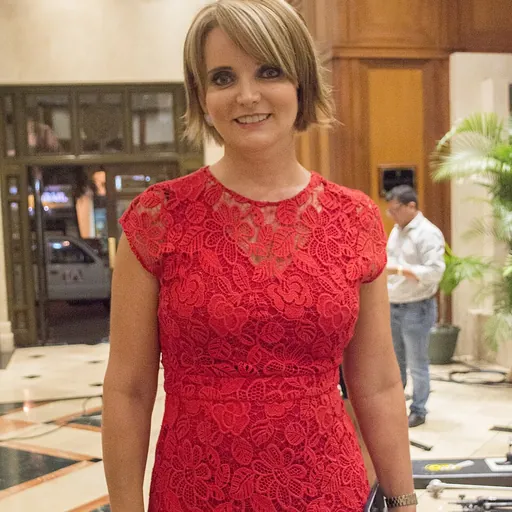
About Janet Hinostroza
Born 1971. Janet Hinostroza is an Ecuadorian journalist.
Janet Hinostroza, third from the left, meeting with US State Department officials. Janet Hinostroza is a television journalist from Ecuador. Her work focuses on the exposure of government corruption. She is the anchor on a morning news program, La Mañana de 24 Horas, and was the creator and anchor of the long-running investigative news program 30 Plus, which aired on Teleamazonas for more than a decade, investigating such subjects as human trafficking, arms trafficking, government and police corruption, and extrajudicial killings.
Hinostroza has been a major target and opponent of the Ecuadorian government, and has also been a recurring topic of President Rafael Correa's weekly TV and radio talks, which usually last several hours. Correa has referred to her dismissively as "blondie." In 2012, after Hinostroza reported on a suspicious loan by the state bank Cofiec to a businessman allegedly associated with a cousin of Correa, she received death threats and took a leave of absence for safety reasons. Due to this she was offered security surveillance by the Minister of the Interior José Serrano to which Hinostroza gratefully did not accept.
In 2013, she was awarded the International Press Freedom Award of the New York–based Committee to Protect Journalists.
Early life and education Hinostroza is from Quito, the next to youngest of seven children of Quiteño and Ibarreña Hinostroza. "I always wanted to be a journalist since I can remember," she has said. "I was always a very shy girl, so when I announced my desire to be a journalist, my family, and especially my father, were very surprised." She studied at the International University of Ecuador while working as a reporter and presenter for Teleamazonas.
Career After her graduation, Hinostroza found work as a national news reporter on TC TV, a cable TV channel in Ecuador.
Hinostroza is also the longtime host of the morning news program “La Mañana de 24 Horas,” which is broadcast daily on Teleamazonas.
In addition, shea radio program on 98.1 FM Mundo, is the local correspondent for the international TV network Univision,
Bank scandal and leave of absence After presenting a report on an apparent case of government corruption on La Mañana de 24 Horas in 2012, Hinostroza received a number of anonymous, threatening phone calls. After receiving a call from an unidentified stranger who detailed her young son's daily movements and threatened to kidnap him, She explained that she had spent years enduring insults, but that her family should not have to endure them. The threat to her son, she stated, was “the drop that spilled the cup” (i.e., the straw that broke the camel's back).
The case in question involved a loan by the state-owned Cofiec Bank, then headed by Pedro Delgado Campaña, an Argentinian second cousin of Correa, to a businessman, Gastón Duzac, who later defaulted on the loan. Hinostroza's reporting uncovered irregularities in the loan and linked Delgado to Duzac.
Hinostroza has said that Ecuador's then interior minister, José Serrano, after hearing about the threats that forced her off the air, immediately offered her protection, but she turned down the offer because "I do not think that an honest journalist should have to do his or her job with bodyguards." Correa himself maintained that the government was "seriously investigating" the threats against Hinostroza and "expressed solidarity" with her, but he added that he still considered her "a politician disguised as a journalist."
During Hinostroza's absence from La Mañana de 24 Horas, she continued to appear on 30 Plus and on special news reports.
State Department briefing In November 2013, the U.S. State Department hosted Hinostroza, who briefed officials on "press freedom challenges." The officials "expressed concerns about the plight of journalists worldwide and reaffirmed the United States' commitment to freedom of expression." Acting Assistant Secretary of State Uzra Zeya praised Hinostroza and other awardees for their "courage" and "commitment to speaking truth to power."
End of 30 Plus run 30 Plus ended its nearly 11-year run on January 11, 2014. Hinostroza explained that investigative journalism "has never been profitable" and that in recent years, the budget of 30 Plus had fallen every year, eventually making it impossible to continue production. Another factor was that "now the doors of public institutions are hundred percent closed" to Teleamazonas, a situation she characterized as "outrageous, unacceptable, and unbelievable" in a country claiming to be a democracy with "full freedom of expression."
"not interested in having a free press" and "has made confrontation of the press a state policy." It has, according to her, "employed different tactics to silence the press, including regulations and legislation. …. It's a government that wants to do many good things for people but is violating the law. So that's why they need a silent press."
Hinostroza has complained about the Ecuadorian government's introduction of the legal concept of "media lynching," meaning "a concerted effort of media and journalists to damage the reputation of a public institution or an individual." She has explained this concept as follows: "if I break some story about corruption of a public official or a public entity, and that investigation is followed" by reports on the same matter by another news outlet, Ecuadorian law considers this "a concerted effort to disseminate information that damages the reputation of an individual or entity" and, thus, a punishable offense.
Honors and awards She has received 3 international awards and 11 national awards for her journalism.
Upon accepting the CPJ award, Hinostroza described 30 Plus as "the only investigative show currently on the air in Ecuador," adding that "I cannot air very controversial issues as I did in the past," partly because “the government has banned officials from talking to the press, and it's not allowing access to information."
In a video made in connection with the CPJ award, Hinostroza noted that there were no longer any investigative units in any Ecuadorian media companies, owing largely to government pressure. Healy said she had "attracted the wrath of the Ecuadorian authorities" and cited this as an "example of a steady deterioration of democratic principles in Ecuador.
Don’t just read it —
keep it.
Full-length biographies made to live with: read them, listen on the way to work, watch them tonight.
- E-book
- Audio
- Video
Instant download · yours to keep · every purchase keeps this site free
Important facts
People in Janet Hinostroza's life
Named in this biography and alive at the same time


Related people
Same field, nearest in time




Contemporaries
People whose lives overlapped Janet Hinostroza's




Frequently asked questions
Who is Janet Hinostroza?
Ecuadorian journalist
When was Janet Hinostroza born?
Janet Hinostroza was born in 1971 in Latacunga.
What is Janet Hinostroza's occupation?
Janet Hinostroza is a journalist.
What nationality is Janet Hinostroza?
Janet Hinostroza is Ecuadorian.
Sources & further reading
Cite this page
APA: Biography.guide. (2026). Janet Hinostroza. https://biography.guide/janet-hinostroza/
MLA: "Janet Hinostroza." Biography.guide, https://biography.guide/janet-hinostroza/.
Chicago: "Janet Hinostroza." Biography.guide. https://biography.guide/janet-hinostroza/.
Data last updated: 2026-09-22 · Spot an error? Report a correction.
Portrait: Wikimedia Commons · author & licence
Page generated 2026-09-27 05:04 UTC