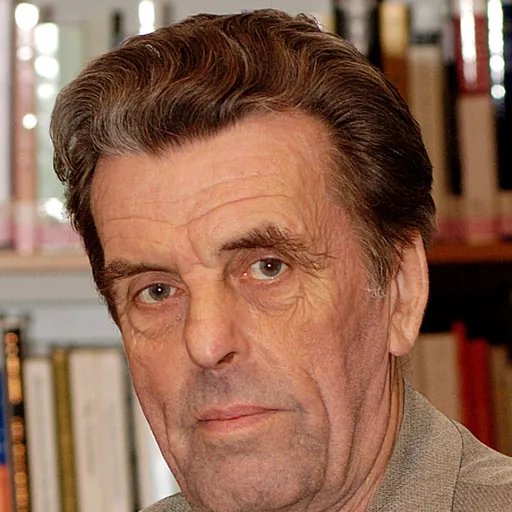
About Jan Sokol
Lived 1936 – 2021 (aged 84). Jan Sokol was a Czech politician, philosopher, pedagogue, translator, university teacher and journalist.
Jan Sokol (18 April 1936 – 16 February 2021) was a Czech philosopher, dissident, politician and translator. He briefly served as Minister of Education, Youth and Sports in 1998 under Prime Minister Josef Tošovský. From 1990 to 1992, he was Member of Parliament for Prague. From 2000 to 2007, he served as the first dean of the Faculty of Humanities at Charles University in Prague. Sokol ran for President of the Czech Republic in the 2003 election but lost to Václav Klaus.
Life and work He was born in Prague in a Catholic family, his father Jan was an architect, his grandfather František Nušl was an astronomer and mathematician. His younger brother Václav is a graphic artist.
During the Communist era, he was not allowed to study and, therefore, worked as a goldsmith, precision mechanic and software developer. participated on the Czech Ecumenical Bible translation (1963–1979), In 1998 he was Minister of Education, Youth and Sports in caretaker Josef Tošovský's Cabinet. His works mainly dealt with Philosophical Anthropology, Phenomenology, Anthropology of Religion and of Law and in the theory of Human Rights. He has published several books, articles in Czech and in other languages and has delivered many guest lectures in various European countries and in the US, mostly on philosophy, religion, ethics and on European questions.
In a 2020 interview, Sokol stated that he frequently edited Wikipedia in order to reach young people. He was prolific contributor to Wikipedia and honorary member of Wikimedia Czech Republic.
Some publications
Books In Czech: Cílek – Sokol – Sůvová, Evropa – náš domov (Europe – Our Home). Albatros, Praha 2018, 132 p. Sokol, J., Naděje na neděli (Hope for Sunday). Praha 2017. 280 p. Sokol, J., Dluh života. Články – eseje – glosy (The Debt of Life). FHS UK, Praha 2016. 668 p. Sokol, J., Člověk jako osoba (Man as a Person). Vyšehrad, Praha 2016. 3rd. ed. 280 p. Sokol, J.: Moc, peníze a právo (Power, Money and Law). Vyšehrad, Praha 2015. 2nd. ed. 304 p. Sokol, J.: Etika, život, instituce (Ethics, Life and Institutions). Vyšehrad, Praha 2014, 264 p. Sokol, J.: Malá filosofie člověka (A Small Philosophy of Man). Vysehrad, Prague 2010, 6th. ed. Sokol, J.: Čas a rytmus (Time and Rhythm). Oikumene, Prague 2004, 2nd. ed. Sokol, J.: Člověk a náboženství (Man and Religion). Portal, Prague 2004. Sokol, J. – Z. Pinc: Antropologie a etika (Anthropology and Ethics). Triton, Prague 2003. Sokol, J.: Filosofická antropologie (Philosophic Anthropology – Man as a Person). Portal, Prague 2002. Sokol, J.: Mistr Eckhart a středověká mystika (Master Eckhart and the Medieval Mysticism). Vysehrad, Prague 2008, 3rd. ed. .
In English:: Sokol, J.: Ethics, life and institutions. English by N. Cairns and M. Pauzerová. Praha: Karolinum 2016. 258 p. Sokol, J.: Thinking about ordinary things. English by M. Pauzerova. Praha: Karolinum 2013. 236 p.
In German:: Sokol, J.: Mensch und Religion : Ursprünge – Wege – Orientierungen. Übers. J. Ostmeyer. Freiburg im Breisgau: Alber Verlag, 2007. 320 S. . Sokol, J.: Philosophie als Verpflichtung. Manutius Heidelberg 2014, 208 S.
In Chinese: Sokol, J.: Xiao zhexue: ruhe sikao putong de shiwu. (A small philosophy). Peking University Press 2018, 249 p.
Others In English: Europe speaks. Linguistic Diversity and Politics. In: Angelaki: Journal of Theoretical Humanities. Vol. 15/3, 2010, p. 185–193. (electronic) 0969-725X (paper) Language and experience. In: Dynamic structure. Language as an open system. Prague : Litteraria pragensia, 2007. p. 27–35. . What does freedom look like? In: Int. J. Prenatal and perinatal psychology and medicine, Stockholm. Vol. 17, 1/2 (2005), p. 181–187. The market as a place of rules. In: M. T. Vogt (hsg.), Kulturen in Begegnung. Wroclaw – Görlitz 2004. . p. 239–243. The Two Faces of Time. In: European Review, Vol. 9, No. 1, p. 11–18 (2001). . An Address from Elsewhere (The Message of Lévinas). In: Philosophy Today, Chicago, 43/2 (1999), p. 143–150.
In German: Nachbarschaft – Nähe und Abgrenzung aus anthropologischer Sicht. In: Theologie der Gegenwart, Erfurt, Vol. 50 (2007)/3, S. 162–171. Die dreifache Verantwortung der Universität. In R. Gepp et al. (Hsg.), Bildung zwischen Luxus und Notwendigkeit. Wien : LIT-Verlag Wien, 2006. P. 21–27. Schriftenreihe der WA. Bd. 1. . Eine Ethik für alle Menschen? In: Schmidinger – Hoff (hsg.), Ethik im Brennpunkt. Tyrolia, Innsbruck 2005, S. 181–200. . Was ist Geld? In: Zeitschrift für Wirtschafts- und Unternehmensethik 5/2 (2004), S. 176–185. Europa spricht. Sprachenvielfalt und Politik. In: Osteuropa 5-6/2004, Berlin, S. 276–283. . Was ist Geld? In: Zeitschrift für Wirtschafts- und Unternehmensethik 5/2 (2004), S. 176–185. Was ist Geld? In: M. T. Vogt (hsg.), Kulturen in Begegnung. Wroclaw – Görlitz 2004. . S. 189–198. Der zweifache Schöpfungsbericht als hermeneutischer Schlüssel. In: Pokorný, P. (ed.): Philosophical Hermeneutics and Biblical Exegesis. Tübingen 2002., S. 238–244. Leben als Bewegung. Jan Patočka und die Philosophie der Erziehung. In: Jahrbuch fuer Bildungs- und Erziehungsphilosophie, 3 (2000), S. 223–229. Schneider Hohengehren.
In French: Jan Patocka et la Charte 77. La nouvelle alternative, Paris, 22, 1, p. 29–34, 5 s. . 2008. Les regles: conditions de la liberté concrete. In: Philosophie de l'action. Cluj 2005, , p. 173–181. Novotný, K. – Sokol, J.: Jan Patočka, penseur d'une dissidence philosophique et politique. In: Delsol – Maslowski – Nowicki (eds.): Dissidences. PUF Paris 2005. . p. 15–34. L'obligation et la vie. In: Pouvoir et vie. Actes UEE de Nice. Cluj : Idea Design & Print, Editura, 2004. p. 117–125. . D'ou vient l'idée de l'obligation morale? In: Quelle conception de l'homme aujourd'hui? Zuerich 2003. . p. 119–130. La pensée européenne de Jan Patočka. In: Delsol – Maslowski (ed.): Histoire des idées politiques de l'Europe centrale, p. 496–510. PUF Paris 1998.
In other languages: Zijn mensenrechten natuurlijk? Filosofie ond Praktijk, Budel (NL) : Damon, 28/2007, 4, p. 43–53. 2007.
Don’t just read it —
keep it.
Full-length biographies made to live with: read them, listen on the way to work, watch them tonight.
- E-book
- Audio
- Video
Instant download · yours to keep · every purchase keeps this site free
Important facts
People in Jan Sokol's life
Named in this biography and alive at the same time

Related people
Same field, nearest in time





Contemporaries
People whose lives overlapped Jan Sokol's





Frequently asked questions
Who was Jan Sokol?
Czech philosopher (1936–2021)
When was Jan Sokol born?
Jan Sokol was born on 18 April 1936 in Prague.
When did Jan Sokol die?
Jan Sokol died on 16 February 2021 in Prague.
What was Jan Sokol's occupation?
Jan Sokol was a politician, philosopher, pedagogue, translator, university teacher and journalist.
What nationality was Jan Sokol?
Jan Sokol was Czech.
Sources & further reading
· DBpedia: Jan Sokol (philosopher)
Cite this page
APA: Biography.guide. (2026). Jan Sokol. https://biography.guide/jan-sokol/
MLA: "Jan Sokol." Biography.guide, https://biography.guide/jan-sokol/.
Chicago: "Jan Sokol." Biography.guide. https://biography.guide/jan-sokol/.
Data last updated: 2026-09-20 · Spot an error? Report a correction.
Portrait: Wikimedia Commons · author & licence
Page generated 2026-09-27 04:58 UTC