
About Jan Ingenhoven
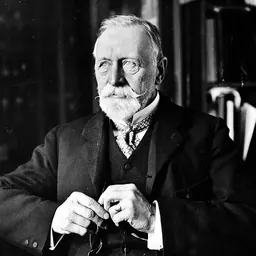
Lived 1876 – 1951 (aged 75). Jan Ingenhoven was a Dutch conductor, composer, pianist, clarinetist and singer.
Johannes Theodorus (Jan) Ingenhoven (Breda, 19 May 1876 – Hoenderloo, 20 May 1951), was a Dutch composer and conductor. He was one of the first to introduce new influences shaping twentieth century European music into the Netherlands before World War 1, and also took contemporary Dutch music into Germany.
Career Jan Ingenhoven was born into a family of gifted amateur musicians: his father (a baker) played oboe and violin and an uncle played the saxophone. He learned the clarinet at an early age, sang in a choir and was soon conducting local choirs in Breda and Dordrecht. From 1902 he studied harmony and composition with Ludwig Felix Brandts Buys (1847–1917). After his marriage to Johanna Hermine Frantzmann in 1905 he settled in Munich and continued his studies with the Austrian conductor Felix Mottl.
Ingenhoven promoted Dutch music abroad, organizing a Dutch Music Festival in Munich in 1906 that included his own music and pieces by his contemporaries Alphons Diepenbrock, Johan Wagenaar and Carl Smulders (1863–1934). The following year he put on a similar festival in Berlin, introducing music by Anna Cramer, Kor Kuiler (1877–1951) and Cornélie van Oosterzee. The vocal quartet ‘Nous n’irons plus au bois’ (1909) from the 4 quatuors à voix mixtes, was claimed by Ingenhoven to be the first atonal vocal work by a Dutch composer. The choral settings put an emphasis on intricate polyphony, derived both from Renaissance music and his contemporary Max Reger. In particular, the later chamber works combine his interest in polyphony with a more homophonic approach, harmonically ambiguous with long melismatic melodies of little thematic function. but after his German period Ingenhoven himself did little to promote his compositions. Violin Sonata No. 1 (1919-20) Violin Sonata No. 2 (1921) Cello Sonata No. 2, Quasi una fantasia (1922) Four pieces for flute, oboe, clarinet, bassoon, 2 horns, timpani and strings (1924) Three movements for three clarinets, three oboes and piano (1924-25) The wild wind (words Guido Gezelle), for a capella male voices (1926) String Trio (Präludium - Intermezzo - Finale) (published 1928) What a silence, for a capella male voices
Don’t just read it —
keep it.
Full-length biographies made to live with: read them, listen on the way to work, watch them tonight.
- E-book
- Audio
- Video
Instant download · yours to keep · every purchase keeps this site free
Important facts
People in Jan Ingenhoven's life
Named in this biography and alive at the same time





Related people
Same field, nearest in time


Contemporaries
People whose lives overlapped Jan Ingenhoven's
Frequently asked questions
Who was Jan Ingenhoven?
Dutch conductor and composer (1876-1951)
When was Jan Ingenhoven born?
Jan Ingenhoven was born on 19 May 1876 in Breda.
When did Jan Ingenhoven die?
Jan Ingenhoven died on 20 May 1951 in Hoenderloo.
What was Jan Ingenhoven's occupation?
Jan Ingenhoven was a conductor, composer, pianist, clarinetist and singer.
What nationality was Jan Ingenhoven?
Jan Ingenhoven was Dutch.
Sources & further reading
Cite this page
APA: Biography.guide. (2026). Jan Ingenhoven. https://biography.guide/jan-ingenhoven/
MLA: "Jan Ingenhoven." Biography.guide, https://biography.guide/jan-ingenhoven/.
Chicago: "Jan Ingenhoven." Biography.guide. https://biography.guide/jan-ingenhoven/.
Data last updated: 2026-09-20 · Spot an error? Report a correction.
Page generated 2026-09-27 05:25 UTC