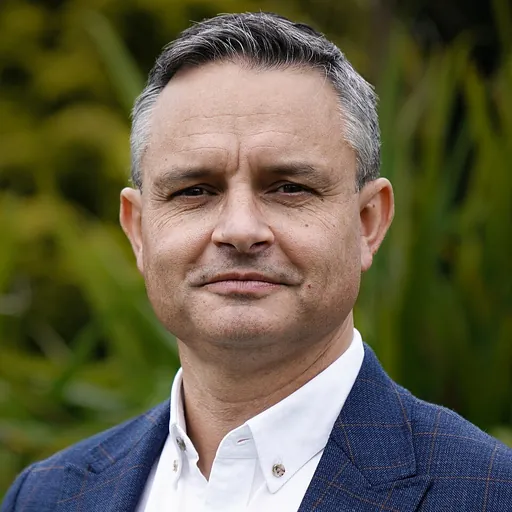
About James Shaw
Born 1973. James Shaw is a New Zealand politician and political candidate.
James Peter Edward Shaw (born 6 May 1973) is a New Zealand climate activist, businessman, and former politician. He was a Member of Parliament from 2014 to 2024, and a co-leader of the Green Party of Aotearoa New Zealand from 2015 to 2024.
Voters elected Shaw to the New Zealand parliament at the 2014 general election as a list representative of the Green Party. The party selected Shaw as its male co-leader in May 2015. Following Metiria Turei's resignation in August 2017, Shaw became the party's sole leader for the duration of the 2017 general election. From 2018 until his retirement he served alongside Marama Davidson.
In October 2017, the Green Party agreed to support a Labour-led government. Shaw became the Minister of Statistics, Minister for Climate Change, and Associate Minister of Finance (outside Cabinet). Following the 2020 general election, the Greens agreed to cooperate with the Labour majority government, and Shaw was re-appointed as the Minister for Climate Change.
Shaw retired from politics in May 2024. He is currently an operating partner at infrastructure management firm Morrison & Co, a strategic adviser to Sunshine Hydro, a director at Greenbridge Capital Management, a member of the Air New Zealand sustainability advisory panel, and a World Wide Fund for Nature New Zealand board member.
Early life Shaw was born in Wellington, and was primarily raised by his single mother Cynthia Shaw. When he was twelve years old his mother entered into a relationship with fellow teacher Susanne Jungersen. Shaw credits his two mothers for instilling him with his passion for politics and social justice. He attended Wellington High School (1985–1990) and Victoria University of Wellington. He later moved to London, living there for 12 years, before returning to New Zealand in 2010. Shaw completed an MSc in sustainability and business leadership at the University of Bath School of Management in 2005.
Career before politics Before returning to Wellington in 2010, Shaw worked in the consulting division at PricewaterhouseCoopers. Between 2011 and 2014, Shaw worked as both a consultant for HSBC bank on "environmental awareness programmes for future leaders" and also at Wellington social enterprise the Akina Foundation.
Early political career As a teenager Shaw attended a candidates debate in during the . He found himself agreeing with the Green Party candidate Stephen Rainbow and decided to volunteer for Rainbow's campaign. At age 19, Shaw stood in the 1992 local elections in the Western ward for the Wellington City Council. Three candidates were elected, with Shaw coming seventh of ten candidates.
In the , Shaw stood in the electorate, succeeding Sue Kedgley as the Green Party candidate in this seat. He came third in the candidate vote after Labour and National, but second in the party vote, beating Labour into third place.
Shaw has said that in the 2011 Greens selection process, party members "didn't have a lot of time to get to know me" and disregarded him as "an ex-PWC management consultant in a suit". He says he has proved his worth to the party subsequently and was rewarded with a higher list ranking in both the draft and final party lists for the 2014 election.
First term in Parliament and ascension to leadership
Shaw was elected to Parliament for the first time as a Green Party list MP in the 2014 general election. He also unsuccessfully contested the Wellington Central, coming third place to Labour's Grant Robertson and National's Paul Foster-Bell with 5,077 votes. His first term in Parliament was the final term of the John Key and Bill English-led National Government. The Green Party, led by Russel Norman and Metiria Turei, was not part of the Government. Shaw was initially appointed as Green Party spokesperson for a selection of justice and business-related portfolios and made a member of the Justice and Electoral Committee.
Norman announced his retirement from the co-leadership position in January 2015, triggering a leadership contest. Despite having only been an MP for seven months, Shaw successfully contested the election against longer-serving MPs Kevin Hague and Gareth Hughes and extra-parliamentary candidate Vernon Tava. During the campaign, Shaw said that as co-leader he would try and connect with "the 28 per cent of voters that considered voting Green last year and didn't and remove all of the barriers that are currently stopping them voting Green". At the election held at the Green Party AGM on 30 May 2015, Shaw won 54 per cent of the delegates' first preference votes, compared to Hague who won 44 per cent (the other two candidates both won 1 per cent). He also said in his first major speech that he wanted the Green Party to be "more like modern New Zealand", and expand its membership both in terms of numbers and to include a more diverse group of people. A Vanity Fair-style photoshoot presented the co-leaders alongside four new candidates on the cover of North & South magazine in May 2017. Despite this, the party launched "radical" policy reform to the New Zealand welfare system and tax system. In the policy announcement on 16 July, Turei admitted committing benefit fraud in the 1990s and later admitted to electoral fraud in the same period. Under pressure, she eventually resigned on 9 August, leaving Shaw as the Green Party's sole leader for the duration of the 2017 general election campaign.
As sole leader, Shaw relaunched the party's campaign in Auckland and a new slogan ("Love New Zealand") on 13 August. In September, Shaw launched the party's climate policy: a Zero Carbon Act with the goal of net zero carbon emissions by 2050, the establishment of an independent Climate Change Commission, and the replacement of the current New Zealand Emissions Trading Scheme with a Kiwi Climate Fund that pays an annual dividend of $250 to each New Zealander and is generated by taxing farmers for pollution.
The Green Party's share of the party vote dropped to 6.3%, resulting in eight MPs being elected. Shaw was re-elected on the party list. He also contested Wellington Central, coming third place to Labour's Grant Roberston and National's Nicola Willis.
Possible government arrangements after the election included a National/Green government, a Labour/Green/New Zealand First government and a National/New Zealand First government. Shaw ruled out cooperating with the National Party. New Zealand First also negotiated with National but decided to form a coalition government with the Labour Party, with confidence and supply from the Green Party.
Minister in the Sixth Labour Government
Coalition Government, 2017–2020
Shaw was appointed Minister of Statistics, Minister for Climate Change and Associate Minister of Finance (outside Cabinet) in the coalition government.
As Minister for Statistics, Shaw received criticism from National MP Nick Smith for the low response rate during the 2018 New Zealand census. Shaw attributed the lower response to a lack of Internet access particularly among the older generation.
In April 2018, Shaw as Minister for Climate Change expressed support for the Government's decision to end future gas and oil exploration, hailing it as the "nuclear-free moment of our generation." He also reiterated the Green Party's support for ending deep-sea oil and gas exploration, stating that "fossil fuels are not our future."
According to figures released by the Department of Internal Affairs, Shaw was the government minister to spend the most on air travel fares in late 2018. Shaw spent NZ$77,771 on international air travel fares during the period between October and December 2018 while Prime Minister Jacinda Ardern spent NZ$54,487 during that same period. Shaw clarified that these air travel fares had been spent on attending multiple international climate change conferences.
On 14 March 2019, Shaw was assaulted while walking to Parliament, sustaining a black eye and lacerations to his face. The attack was condemned by politicians from all sides of the political spectrum. Police confirmed that a 47-year-old man was arrested and charged with injuring with intent to injure in relation to the incident. During a press conference held the following day, Shaw expressed support for climate change school strikes held across the country calling for governments worldwide to take action on climate change. Shaw declined to give details about the assault, stating it was under police investigation.
On 8 May 2019, Shaw introduced the Climate Change Response (Zero Carbon) Amendment Bill into the New Zealand Parliament. The Bill subsequently passed its first reading on 22 May 2019.
James Shaw at the School Strike for Climate Change, Wellington 2019In late August 2020, Shaw attracted criticism from the opposition National Party, school principals, teachers unions' and members of his own Green Party after he approved the allocation of NZ$11.7 million from the Government's $3 billion COVID-19 "shovel-ready" recovery fund to the private "Green School New Zealand" in Taranaki. This funding boost violated the Green Party's own policy of opposing state funding being allocated to private schools. Shaw had defended the decision, claiming it would have created 200 jobs and boosted the local economy. Former Green MPs Catherine Delahunty, Mojo Mathers and Sue Bradford criticised Shaw's decision as a betrayal of the Green Party's policies and principles.
According to Newshub, Shaw refused to sign the Government's NZ$3 billion "shovel-ready" infrastructure fund until the Green School in Taranaki was approved. On 1 September, Shaw apologised for approving the funding of the Green School, describing it as "an error of judgment." Shaw has also apologised to Green Party members in a Zoom call. Representatives of the school have reportedly approached the Crown to convert part or all of the Government's grant into a loan. On 3 September, the Education Minister Chris Hipkins disputed Shaw's claim that he had given verbal approval to the allocation of NZ$11.7 million to the private Green School in Taranaki. On 2 November, it was reported that the owners of the Green School had reached a settlement for the Government's NZ$11.7 million grant to be converted into a loan; a development that was welcomed by local principals.
Cooperation agreement, 2020–2023 During the 2020 New Zealand general election, Shaw was re-elected on the Green Party list. He also contested the Wellington Central electorate, coming third place to Labour's Grant Robertson and National's Nicola Willis.
Labour won an outright majority in the 2020 general election. Despite this, Labour and the Green Party agreed a "cooperation agreement" on 31 October 2020 that resulted in Shaw retaining the Climate Change portfolio and become Associate Minister for the Environment (Biodiversity).
At the 2021 party annual general meeting Shaw was challenged for the co-leadership by Dunedin climate activist and software developer, James Cockle. Cockle stated his unhappiness with the progress the Greens were making during the Parliamentary term and wanted the Greens to become a "major party" and cease being seen as "Labour's little helper" as was the case under the current leadership. Shaw responded, stating he was "quietly confident" he would be re-elected by party members. Shaw was overwhelmingly re-elected, winning 116 delegate votes with just four to Cockle.
In mid September 2021, Shaw attracted media attention after Prime Minister Ardern granted him and a team of nine diplomats spaces in the managed isolation and quarantine system to attend the upcoming 2021 United Nations Climate Change Conference summit in Glasgow. Shaw's planned trip to the Climate Change conference was criticised by National Party leader Judith Collins and ACT Party leader David Seymour for denying places to homeward bound New Zealanders seeking places in managed isolation.
Shaw was not reconfirmed by Green Party delegates in the annual party co-leadership confirmation in July 2022, triggering a leadership election. Shaw stated Ardern had confirmed that he would retain his position as Climate Change Minister regardless of any potential change to his leadership. Two days after the confirmation vote, Shaw announced that he would put himself forward to continue in the leadership role. On 10 September, Shaw was re-elected as Green Party co-leader by 142 (97%) of the 145 eligible delegates at the party's annual general meeting.
Retirement from politics During the 2023 New Zealand general election, Shaw was re-elected to Parliament on the party list. The Greens won a total of 15 seats.
In late November 2023, Shaw assumed the Green Party's climate change, finance, public services and regulation spokesperson portfolios.
On 5 December 2023, Shaw was granted retention of the title The Honourable, in recognition of his term as a member of the Executive Council.
In January 2024 Shaw announced that he would be resigning the co-leadership role, effective March 2024, triggering the 2024 Green Party of Aotearoa New Zealand co-leadership election. He remained a member of parliament in the short term to see some remaining legislation, a member's bill to amend the New Zealand Bill of Rights to include the "right to sustainable environment", through its first reading. The bill was defeated at its first reading on 10 April 2024. The following day, Shaw announced that he would retire from Parliament in early May 2024. He gave his valedictory statement on 1 May and his resignation took effect at 11:59 pm on 5 May 2024.
In 2024, Shaw joined infrastructure management firm Morrison & Co and investment management firm Greenbridge Capital Management. He became a member of the Air New Zealand Sustainability Advisory Panel and the New Zealand board of World Wide Fund for Nature. In 2025, he moved to Morrison's Singapore office.
Political views Shaw believes that the market can be reformed to incorporate sustainability within its normal operations. In an interview with the Aro Valley Valley Voice he put forward his views:
Electorate (as at 26 November 2011): 48,316
2014 election
2017 election
2020 election
Local elections 1992 Wellington local elections Election box begin | title=Western Ward !!Percentage
2021 leadership election
Don’t just read it —
keep it.
Full-length biographies made to live with: read them, listen on the way to work, watch them tonight.
- E-book
- Audio
- Video
Instant download · yours to keep · every purchase keeps this site free
Important facts
People in James Shaw's life
Named in this biography and alive at the same time



Related people
Same field, nearest in time



Contemporaries
People whose lives overlapped James Shaw's

Frequently asked questions
Who is James Shaw?
New Zealand politician, born 1973
When was James Shaw born?
James Shaw was born on 6 May 1973 in Wellington.
What is James Shaw's occupation?
James Shaw is a politician and political candidate.
What nationality is James Shaw?
James Shaw is New Zealand.
Sources & further reading
· DBpedia: James Shaw (New Zealand politician)
Cite this page
APA: Biography.guide. (2026). James Shaw. https://biography.guide/james-shaw-politician/
MLA: "James Shaw." Biography.guide, https://biography.guide/james-shaw-politician/.
Chicago: "James Shaw." Biography.guide. https://biography.guide/james-shaw-politician/.
Data last updated: 2026-09-21 · Spot an error? Report a correction.
Portrait: Wikimedia Commons · author & licence
Page generated 2026-09-27 04:59 UTC