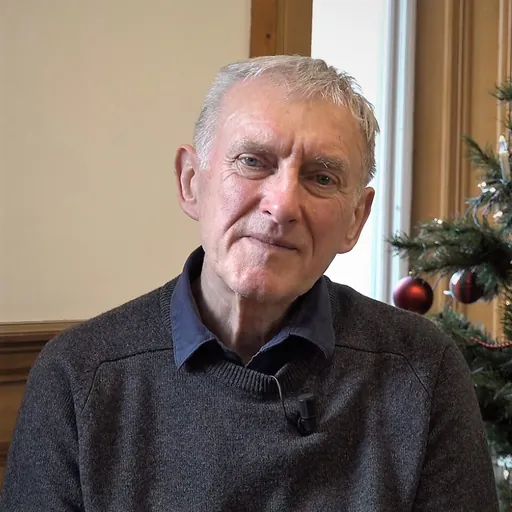
About James Kelman
Born 1946. James Kelman is a British writer, novelist, political activist and screenwriter.
James Kelman (born 9 June 1946) is a Scottish novelist, short story writer, playwright and essayist. His fiction and short stories feature accounts of internal mental processes of usually, but not exclusively, working-class narrators and their labyrinthine struggles with authority or social interactions, mostly set in his home city of Glasgow. Frequently employing stream of consciousness experimentation, Kelman's stories typically feature "an atmosphere of gnarling paranoia, imprisoned minimalism, the boredom of survival."
His novel A Disaffection was shortlisted for the Booker Prize and won the James Tait Black Memorial Prize for Fiction in 1989. Kelman won the 1994 Booker Prize with How Late It Was, How Late. In 1998, Kelman was awarded the Glenfiddich Spirit of Scotland Award. His 2008 novel Kieron Smith, Boy won both of Scotland's principal literary awards: the Saltire Society's Book of the Year and the Scottish Arts Council Book of the Year.
In 2024, Kelman was honoured by the Saltire Society with a Lifetime Achievement Award for his contribution to Scottish literature. His literary archive is held at the National Library of Scotland.
Life and work Born in Glasgow, Scotland, Kelman says:
Kelman himself stated his key influences came from "two literary traditions, the European Existential and the American Realist", although his style was also influenced by the modernist movement. These stories introduced a distinctive style, expressing first-person internal monologues in a pared-down prose using Glaswegian speech patterns, though avoiding for the most part the quasi-phonetic rendition of Tom Leonard. Kelman's developing style has been influential on the succeeding generation of Scottish novelists, including Irvine Welsh, Alan Warner and Janice Galloway.
In 1998, Kelman received the Stakis Prize for "Scottish Writer of the Year" for his collection of short stories The Good Times, one of several books of his stories that have been published. In 2012, a film was made based on the short story "Greyhound For Breakfast".
Novels Kelman's first published novel was The Busconductor Hines (1984), although it was written after A Chancer, which was published in 1985. His 1989 novel A Disaffection was shortlisted for the Booker Prize and won the James Tait Black Memorial Prize for Fiction, and he won the 1994 Booker Prize for How Late It Was, How Late. His 2008 novel Kieron Smith, Boy won the Saltire Society's Book of the Year and the Scottish Arts Council Book of the Year.
Kelman's most recent novel, God's Teeth and Other Phenomena (2022), was described in a review by Gerry Hassan as a "tour de force [that] works as both a roman a clef, a writing primer and a guide to the world of literature and publishing. ... an astonishing book that confirms James Kelman's right to be seen as a global literary figure beyond any doubt."
Drama Kelman's play Hardie and Baird: The Last Days, about the Radical Rising of 1820, was produced at the Traverse Theatre, Edinburgh, under the direction of Ian Brown, between 30 June and 22 July 1990.
Critical reception Kelman's 1994 Booker Prize win was, at the time, controversial due to what some saw as the book's casual use of strong language: one of the judges, Rabbi Julia Neuberger, denounced the awarding of the prize to Kelman's book as "a disgrace". Another judge, critic James Wood, recalls that "Kelman turned up at the foolishly formal, black-tie award dinner in a regular business suit and an open-necked shirt, the rebellious semiotics of which were quickly understood, and spoke about how the writer must stand up to oppression: 'My culture and my language have the right to exist, and no one has the authority to dismiss that. . . . A fine line can exist between élitism and racism. On matters concerning language and culture, the distance can sometimes cease to exist altogether.
In 2020, Douglas Stuart on becoming the second Scottish writer to be awarded the Booker Prize, for his novel Shuggie Bain, said that his life was changed by Kelman's win with How Late It Was, How Late: "It is such a bold book, the prose and stream of consciousness is really inventive. But it is also one of the first times I saw my people, my dialect, on the page." As Stuart noted: "When James won in the mid-90s, Scottish voices were seen as disruptive and outside the norm."
Political views and activism Kelman's work has been described as flowing "not only from being an engaged writer, but a cultural and political activist". At the time of Glasgow's Year as City of Culture, Kelman was prominent in the Workers' City group, critical of the celebrations. The name was chosen as to draw attention to the renaming of part of the city centre as the Merchant City, which they described as promoting the "fallacy that Glasgow somehow exists because of (...) 18th century entrepreneurs and far-sighted politicians. (The merchants) were men who trafficked in degradation, causing untold misery, death and starvation to thousands" The Workers' City group campaigned against what was seen as the victimisation of People's Palace curator Elspeth King and a Council attempt to sell off one third of Glasgow Green. Their activities drew the ire of Labour Party councillors and commentators, with Kelman and his colleagues Hugh Savage and Farquhar McLay being described as "an 'embarrassment' to the city's 'cultural workforce. and he has expressed support for the Autonomous Centre of Edinburgh (ACE), its successor organisation.
Kelman has been a prominent campaigner, notably in issues of social justice and traditional left-wing causes, although he is resolutely not a party man, and remains at his heart a libertarian socialist anarchist, saying "the parliamentary opposition parties are essential to the political apparatus of this country which is designed to arrest justice".
In his introduction to Born up a Close: Memoirs of a Brigton Boy (2006), an edition of Glaswegian political campaigner Hugh Savage's writings, Kelman sums up his understanding of the history of national and class conflict as follows:
Despite reservations about nationalism, Kelman has voiced his support for Scottish independence, stating: "Any form of nationalism is dangerous, and should be treated with caution. I cannot accept nationalism and I am not a Scottish Nationalist. But once that is said, I favour a Yes or No decision on independence and I shall vote Yes to independence." He has voiced criticism of Scottish arts funding council Creative Scotland.
Personal life
In 1969, Kelman married Marie Connors from South Wales. He lives in Glasgow with his wife and their children, and has also lived in London, Manchester, the Channel Islands, Australia and America.
Don’t just read it —
keep it.
Full-length biographies made to live with: read them, listen on the way to work, watch them tonight.
- E-book
- Audio
- Video
Instant download · yours to keep · every purchase keeps this site free
Important facts
People in James Kelman's life
Named in this biography and alive at the same time





Related people
Same field, nearest in time

Contemporaries
People whose lives overlapped James Kelman's

Frequently asked questions
Who is James Kelman?
Scottish writer
When was James Kelman born?
James Kelman was born on 9 June 1946 in Glasgow.
What is James Kelman's occupation?
James Kelman is a writer, novelist, political activist and screenwriter.
What nationality is James Kelman?
James Kelman is British.
Sources & further reading
Cite this page
APA: Biography.guide. (2026). James Kelman. https://biography.guide/james-kelman/
MLA: "James Kelman." Biography.guide, https://biography.guide/james-kelman/.
Chicago: "James Kelman." Biography.guide. https://biography.guide/james-kelman/.
Data last updated: 2026-09-20 · Spot an error? Report a correction.
Page generated 2026-09-27 05:10 UTC