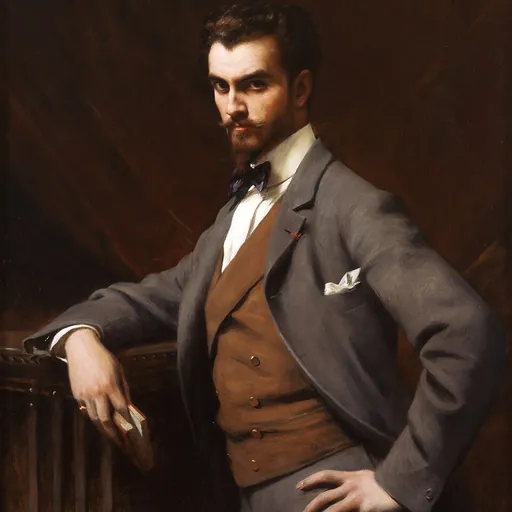
About James Hazen Hyde
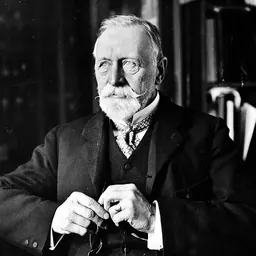
Lived 1876 – 1959 (aged 83). James Hazen Hyde was an American entrepreneur, photographer and art collector.
James Hazen Hyde (June 6, 1876 — July 26, 1959) was the son of Henry Baldwin Hyde, the founder of The Equitable Life Assurance Society of the United States. James Hazen Hyde was twenty-three in 1899 when he inherited the majority shares in the billion-dollar Equitable Life Assurance Society. Five years later, at the pinnacle of social and financial success, efforts to remove him from The Equitable set in motion the first great Wall Street scandal of the 20th century, which resulted in his resignation from The Equitable and relocation to France.
Early life James Hazen Hyde was born in New York City on June 6, 1876. He was the only surviving son of Henry Baldwin Hyde and Annie (née Fitch) Hyde. His older sister was Mary who was married to Sidney Dillon Ripley in 1886. After Ripley's death in 1905, she married banker Charles R. Scott in 1912.
He graduated from the Cutler School, and received his degree from Harvard University in 1898. Hyde studied French history, language and literature, and was involved in efforts to establish an exchange program that enabled French authors and educators to lecture at universities in the United States, with American professors reciprocating at universities in France. Hyde's efforts included the endowment of a fund to defray professor's expenses, and he received the Legion of Honor (Chevalier) from the government of France. By the terms of his father's will, he was scheduled to assume the presidency of the company in 1906. Members of the board of directors, including E. H. Harriman, Henry Clay Frick, J.P. Morgan, and company President James Waddell Alexander attempted to wrest control from Hyde through a variety of means, including an unsuccessful attempt to have him appointed as Ambassador to France.
On the last night of January 1905, Hyde hosted a highly publicized Versailles-themed costume ball. Falsely accused through a coordinated smear campaign initiated by his opponents at The Equitable of charging the $200,000 party ($ today) to the company, Hyde soon found himself drawn into a maelstrom of allegations of his corporate malfeasance. The allegations almost caused a Wall Street panic, and eventually led to a state investigation of New York's entire insurance industry, which resulted in laws to regulate activities between insurance companies, banks and other corporations.
Hyde's personal net worth in 1905 was about $20 million ($ today). After the negative press generated by the efforts to remove him from The Equitable, Hyde resigned from the company later that same year, gave up most of his other business activities, and moved to France. There were published rumors that he would marry French actress Yvonne Garrick in 1906.
World War I At the start of World War I, Hyde converted his home and a Paris rental property into French Red Cross hospitals, and he volunteered his services as an organizer and driver with the American Field Ambulance Service. When the United States entered the war Hyde was commissioned as a Captain and assigned as an aide to Grayson Murphy, the High Commissioner of the American Red Cross in France.
Later life Set of German-made porcelains, c. 1775, donated by Hyde to the Cooper Hewitt, Smithsonian Design Museum; figures represent (from left) Asia, Europe, Africa, and America. In 1941 Hyde returned from France as the result of Nazi Germany's occupation of France during World War II. In retirement he resided at the Savoy-Plaza Hotel in New York City and hotels in Saratoga Springs, New York.
Henry Baldwin Hyde II (1915–1997), who married Marie de La Grange, a daughter of Baron Amaury De La Grange and Emily Eleanor, Baroness De La Grange (daughter of Henry T. Sloane), in 1941. Marie's brother was musicologist Henry-Louis de La Grange, known for his biography of Gustav Mahler.
His ex-wife died in 1944. Hyde died in Saratoga Springs on July 26, 1959. He was buried at Woodlawn Cemetery in The Bronx.
Legacy and honors Hyde was a collector of books and documents relating to Franco-American relations beginning in 1776. He was a member of the Académie des Sciences Morales et Politiques, the American Antiquarian Society, and the New-York Historical Society. He formed a collection of allegorical prints illustrating the Four Continents that are now at the New-York Historical Society; Hyde's drawings and a supporting collection of sets of porcelain figures and other decorative arts illustrating the Four Continents were shared by various New York City museums.
For his efforts during the war, Hyde received the Grand-Croix de la Legion d'honneur. He was granted an honorary degree by the University of Rennes in 1920.
Don’t just read it —
keep it.
Full-length biographies made to live with: read them, listen on the way to work, watch them tonight.
- E-book
- Audio
- Video
Instant download · yours to keep · every purchase keeps this site free
Important facts
Family & relationships
People in James Hazen Hyde's life
Named in this biography and alive at the same time



Related people
Same field, nearest in time



Contemporaries
People whose lives overlapped James Hazen Hyde's
Frequently asked questions
Who was James Hazen Hyde?
American businessman (1876-1959)
When was James Hazen Hyde born?
James Hazen Hyde was born on 6 June 1876 in New York City.
When did James Hazen Hyde die?
James Hazen Hyde died on 26 July 1959 in New York City.
What was James Hazen Hyde's occupation?
James Hazen Hyde was an entrepreneur, photographer and art collector.
What nationality was James Hazen Hyde?
James Hazen Hyde was American.
Sources & further reading
Cite this page
APA: Biography.guide. (2026). James Hazen Hyde. https://biography.guide/james-hazen-hyde/
MLA: "James Hazen Hyde." Biography.guide, https://biography.guide/james-hazen-hyde/.
Chicago: "James Hazen Hyde." Biography.guide. https://biography.guide/james-hazen-hyde/.
Data last updated: 2026-09-23 · Spot an error? Report a correction.
Portrait: Wikimedia Commons · author & licence
Page generated 2026-09-27 05:06 UTC