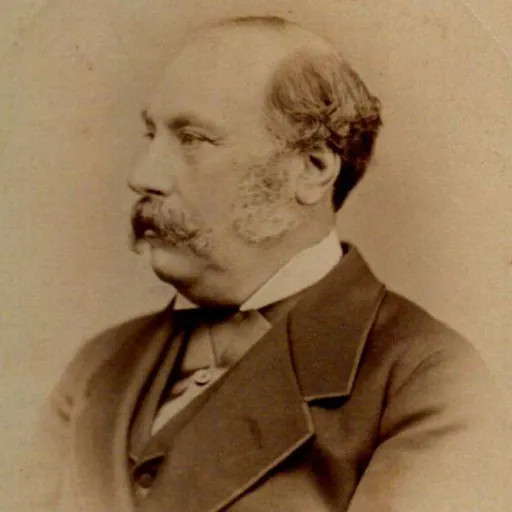
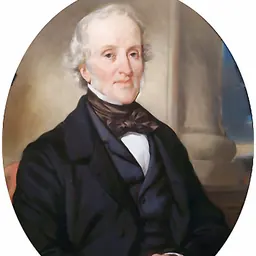
James Harvey Insole
South Wales coal owner and shipper
About James Harvey Insole
Lived 1821 – 1901 (aged 79). James Harvey Insole was a businessperson, diplomat, benefactor and colliery, known for Cardiff, Insole Court and South Wales.
James Harvey Insole JP (30 April 1821 – 20 January 1901) was an English businessman who consolidated and developed the extensive South Wales coal mining and shipping business begun by his father George Insole.
Insole became a partner in his father's business in 1842. They leased and revived the Cymmer (lower Rhondda Valley) bituminous coal pits in 1844 and developed their coastal and international markets together. When his father died in 1851, Insole took sole control of the company. Disaster struck in 1856 when an underground explosion of gas at the Cymmer mine resulted in a "sacrifice of human life to an extent unparalleled in the history of coal mining of this country". In 1862 Insole purchased the Abergorki mine in the upper Rhondda Valley. His company continued to develop the rich steam coal seams of the Rhondda and by the end of that century was one of the main exporters of South Wales steam coal. The company operated until 1940.
Insole also played a significant role in the development of Cardiff, Wales, as a coal shipping port, especially in connection with improving the means of loading coal ships and the construction of the new dock at Penarth which opened in 1865.
Among other civic roles, as a justice of the peace Insole served as magistrate for both Cardiff and Glamorgan. He was also the inaugural president of the Cardiff Chamber of Commerce and he and his company made significant contributions to public causes including education and health.
Insole's modern legacy survives in his Victorian mansion Ely Court in Llandaff, Wales, now a community resource known as Insole Court which is used for a wide range of activities and events.
Early life James Harvey Insole was born on 30 April 1821 in Worcester, Worcestershire, and was baptised at St Helen's Church, Worcester, on 2 May 1821. He was the second child and eldest son of the six children of George Insole and Mary Insole (née Finch). During Insole's early childhood his father was a carpenter in Worcester and the family was associated with the Angel Street Independent (Congregational) Meeting House. In 1828 the family moved to Cardiff where Insole's father began building his South Wales coal mining and shipping business. Insole attended schools in Cardiff and Melksham, Wiltshire.
When Insole came of age in 1842 he received a bequest from his father's uncle, a wealthy saddler's ironmonger in Birmingham. In 1843 Insole married Mary Ann Jones in Edgbaston. She was the daughter of his father's uncle's business partner. They had three children, two sons and a daughter. The family lived in Crockherbtown, Cardiff, next door to Insole's parents, until 1852.
Insole had also suggested that the Taff Vale Railway Company negotiate with Lord Bute to erect coal staiths on the Cardiff Bute Dock (West). In 1848, when the first coal tip was ready, the Insoles became the first to load a ship at Cardiff by "mechanical appliances".
Up to 1847 the Insoles mainly supplied the coastal markets of the Bristol Channel (Bristol, Gloucester), the Cornish ports (St. Ives, Penzance, Fowey), and the Irish markets (Limerick, Dublin, Youghal, Waterford, Cork) with steam coal. Subsequently, they supplied the French markets, first Brest and Nantes, then Calais, Marseilles, and Corsica. In 1849 they sent coal shipments to the Mediterranean, the Near East (Alexandria, Constantinople, Beirut, Smyrna), to South America (Montevideo, Rio Grande, Rio de Janeiro), and as far as Chile and Singapore. The local communities were also devastated by the disaster as almost all the working-age men and boys perished and thirty-five widows and ninety-two children, as well as other dependent relatives, were suddenly left without any immediate means of support.
The ensuing coroner's inquest determined the cause of the deaths to have been "the post-explosion effects of afterdamp or methane poisoning". The evidence indicated that the explosion was due to defective mine ventilation and the use of naked flames underground, despite warnings from HM Inspector of Mines, Herbert Francis Mackworth, who stated that "the explosion arose from the persons in charge of the pit neglecting the commonest precautions for the safety of the men and the safe working of the colliery".
Insole stated that he took "no part in the management", knew nothing of the duties of firemen or the problems of ventilation, did not refuse expenditure for safety, and could not recall having been sent any official documentation on mine safety. Insole was dismissed from the enquiry and, after further legal proceedings, he and his mine officials were exonerated from all blame.
Welsh historian E. D. Lewis' analysis of the disaster concludes:
It was the success of [the Cymmer Old Pit mine] when developed with such inordinate speed and recklessness by ... James Harvey Insole that led directly to the terrible mining disaster of 1856.
Post 1856 The Cymmer Old Pit continued in operation until 1939. The Cymmer mine was deepened in 1875–1877 to reach four rich seams of steam coal. By the end of the century Insole's company was again one of the chief exporters of South Wales steam coal. The company remained in business until 1940. In the 1870s the house was extended and embellished in the neo-Gothic style that had been employed by William Burges to transform Cardiff Castle for Lord Bute.
Ely Court, Llandaff, 1900 (north front). Insole built the original twin-gabled villa in 1855 and 1856, extensively renovated and enlarged it in the 1870s, and added a further extension (left of picture) in 1898 and 1899.
Insole already owned several estates in Glamorganshire as well as land in Cardiff when he set out to build a land-owning dynasty. In 1872, then semi-retired, he acquired armorial bearings from the College of Heralds. Three years later, he purchased the 7,291 acre Luxborough estate in Somerset, including the "picturesque and commodious shooting box", Insole was then able to style himself as "Lord of the Manors of Luxborough and Withiel Florey". In 1878 he was listed in Kelly's Handbook to the Upper Ten Thousand.
Insole regularly entered plants he and his gardeners had cultivated in horticultural shows, competing successfully against other local gentlemen and their gardeners. He devoted over forty years to:
In 1882 Ely Court was described as "the leading residence in the locality".
Insole also collected paintings and objets d'art. In 1881 several of his bronzes, silver items and paintings were exhibited at the Cardiff Fine Art and Industrial Exhibition.
Philanthropy Insole and his company's names were to be found in published lists of subscribers to good causes. In 1882 he announced a subscription of £1,000 for the proposed University College of South Wales and Monmouthshire in Cardiff and provided a £25 per annum scholarship for a Cardiff student to pursue further studies. In 1883 a ward at the Cardiff Royal Infirmary was renamed the Insole Ward in recognition of his donation of £1,000. In 1890 Insole's company announced a £250 contribution over five years towards the funding and maintenance of the new University College engineering department and from 1892 the J. H. Insole scholarship provided £25 per annum for three years to support a University College student of mining.
Although he was associated with the Congregational Church as a boy and in later life financed Nonconformist building projects, as an adult Insole was a noted churchman and his tenants knew him as a generous patron of the parish church at Withiel Florey, of which he held the advowson. justice of the peace and magistrate for Cardiff (1856); land tax commissioner for Glamorgan (1856/1857); vice consul to Spain at Cardiff (1858); inaugural president of the Cardiff Chamber of Commerce (1866); magistrate for Glamorgan (1867); member of the Pall Mall Club. Cardiff Hotel Company; Cardiff Baths Company.
Remarriage, death, and legacy
A Pioneer of Cardiff's Trade – Mr Insole was one of the pioneers in the development of Cardiff as a port for the shipment of coal. — Evening Express, 21 January 1901
Insole died on 20 January 1901, aged 79, at his residence Ely Court, Llandaff, and was buried at the Llandaff Cathedral burial grounds on 24 January 1901. His estate was valued at £245,388 (approximately ).
Insole's death was overshadowed by the death of Queen Victoria two days later, but his numerous obituaries praised his contributions to the South Wales coal industry and the development of Cardiff as a shipping port (the loss to the horticultural world also being noted). and his funeral was attended by many Cardiff dignitaries and businessmen.
Insole's dynastic land-owning vision came to nought when the Luxborough estate was sold in 1920. The Insole coal company closed in 1940 amidst the general decline of the South Wales coal industry.
Selected histories The following accounts include Insole's role in the development of the South Wales coal industry, although each is unreliable in various details, especially regarding his father's origins and early years as a merchant in Cardiff.
Don’t just read it —
keep it.
Full-length biographies made to live with: read them, listen on the way to work, watch them tonight.
- E-book
- Audio
- Video
Instant download · yours to keep · every purchase keeps this site free
Important facts
Family & relationships
People in James Harvey Insole's life
Named in this biography and alive at the same time


Related people
Same field, nearest in time


Contemporaries
People whose lives overlapped James Harvey Insole's




Frequently asked questions
Who was James Harvey Insole?
South Wales coal owner and shipper
When was James Harvey Insole born?
James Harvey Insole was born on 30 April 1821 in Worcester.
When did James Harvey Insole die?
James Harvey Insole died on 20 January 1901 in Insole Court.
What was James Harvey Insole's occupation?
James Harvey Insole was a businessperson, diplomat, benefactor and colliery.
What was James Harvey Insole known for?
James Harvey Insole was known for Cardiff, Insole Court and South Wales.
Sources & further reading
· Wikipedia: James Harvey Insole
· DBpedia: James Harvey Insole
Cite this page
APA: Biography.guide. (2026). James Harvey Insole. https://biography.guide/james-harvey-insole/
MLA: "James Harvey Insole." Biography.guide, https://biography.guide/james-harvey-insole/.
Chicago: "James Harvey Insole." Biography.guide. https://biography.guide/james-harvey-insole/.
Data last updated: 2026-09-24 · Spot an error? Report a correction.
Portrait: Wikimedia Commons · author & licence
Page generated 2026-09-27 05:08 UTC