
About James Gordon
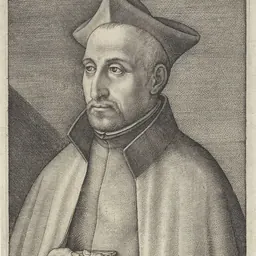
Lived 1541 – 1620 (aged 78–79). James Gordon was a catholic priest, university teacher, hebraist, monk and catholic theologian.
James Gordon (1541 – 16 April 1620) was a Scottish Jesuit. He is sometimes known as James Gordon Huntly, to distinguish him from James Gordon (1553–1641), another Jesuit.
Life He was the fifth son of George Gordon, 4th Earl of Huntly, by Elizabeth Keith, Countess of Huntly, eldest daughter of Robert, Lord Keith, and sister of William Keith, 4th Earl Marischal. He was persuaded to join the Jesuit mission by the papal emissary Nicolas de Gouda. He entered the Society of Jesus at Rome on 20 September 1563, and taught philosophy, theology, sacred scripture, and Hebrew in the colleges of the order at Pont-à-Mousson, Paris, and Bordeaux.
In 1584 William Crichton and Gordon were sent on a mission to Scotland. Their vessel was seized on the high seas by the Dutch. The ship was released; but the merchant who had hired her for the voyage, having discovered that his two passengers were priests, accused them as enemies, and the Dutch detained them. The merchant was concerned about the attitude of the Earl of Huntly, Gordon's nephew, and Gordon was set free after the substitution of a secular priest in his place.
As the popular agitation increased, James changed his mind and resolved that laws against Catholics should be enforced. Gordon was sent into exile in 1595; but he subsequently paid two visits to Scotland in June 1597 and December 1598, still with the object of bringing about the conversion of the king.
Gordon died at the Jesuit college in Paris on 16 April 1620.
Works Gordon's works are:
Controversiarum Epitomes, in qua de quæstionibus theologicis hac nostra ætate controversis, breviter disputatur: idque ex sacris præsertim literis, Poitiers, 1612. The second volume, In quo de augustissimo Eucharistiæ Sacramento contra Calvinianos breviter disputatur, appeared at Paris, 1618. They were reprinted by John Kinchius, with a third part, at Cologne, 1620, under the title of Controversiarum Christianæ Fidei adversus hujus temporis Hæreticos Epitome. This work led to the publication by Solomon Glassius of Dicta Jehovæ, Genesis cap. 3, v. 15 (semen tuum, &c.), a J. Gordoni Huntlæi Jesuitæ Scoti φλυαρίαις et interpretamentis vindicata, Jena, 1625. Treatise of the Unwritten Word of God, commonly called Traditions, 1614. Summary of the Controversies, wherein are briefly treated the cheefe Questions of Divinity, now a Dayes in Dispute betweene Catholikes and Protestants, 1618. Tractatus de Censuris et Irregularitatibus, manuscript, once in the library of the Jesuits at Mantua. Explanation of the Decree of Gratian, manuscript.
Don’t just read it —
keep it.
Full-length biographies made to live with: read them, listen on the way to work, watch them tonight.
- E-book
- Audio
- Video
Instant download · yours to keep · every purchase keeps this site free
Important facts
People in James Gordon's life
Named in this biography and alive at the same time

Related people
Same field, nearest in time



Contemporaries
People whose lives overlapped James Gordon's





Frequently asked questions
Who was James Gordon?
Scottish Jesuit, died 1620
When was James Gordon born?
James Gordon was born in 1541.
When did James Gordon die?
James Gordon died in 1620 in Paris.
What was James Gordon's occupation?
James Gordon was a catholic priest, university teacher, hebraist, monk and catholic theologian.
Sources & further reading
· DBpedia: James Gordon (Jesuit)
Cite this page
APA: Biography.guide. (2026). James Gordon. https://biography.guide/james-gordon/
MLA: "James Gordon." Biography.guide, https://biography.guide/james-gordon/.
Chicago: "James Gordon." Biography.guide. https://biography.guide/james-gordon/.
Data last updated: 2026-09-20 · Spot an error? Report a correction.
Page generated 2026-09-27 05:02 UTC